The Magazine of The Sierra Club
This Private Company Wants to Extract Water From the Driest Desert in the US
Critics say it will deplete a basin and put California's iconic Mojave landscape at risk
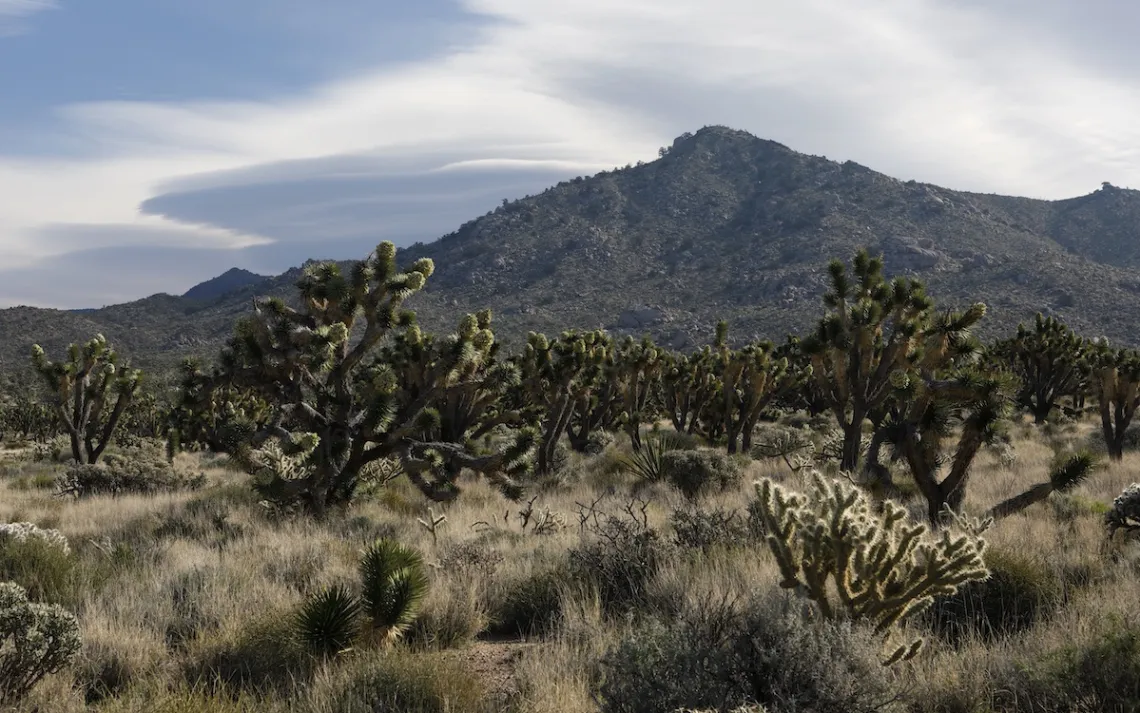
Mojave National Preserve, California. | Photo by Francois Gohier/VWPics via AP Images
Deep in the heart of the Mojave Desert lies Bonanza Spring, a half-mile green oasis in the middle of one of the driest landscapes in the country. Fed by the Fenner Basin aquifer, the spring is lined with moisture-loving plants and trees like cottonwoods, mesquite, Gooddings willow trees, and arrowweed. It’s a vital life source for bighorn sheep, desert tortoises, and migratory birds. But a water-extraction project recently green-lit by the Trump administration could be detrimental to the spring’s survival, critics say.
In July, the Bureau of Land Management approved a permit for Los Angeles–based private water company Cadiz to convert a 220-mile gas pipeline that runs across the Mojave Desert into a water pipeline. Officially named the Mojave Groundwater Bank, the project plans to pump extracted water from the Fenner Valley Aquifer System in California’s eastern Mojave Desert, to “underserved” communities in the Southwest.
Cadiz claims that the pipeline—which runs through Mojave National Preserve and Mojave Trails National Monument—will provide “clean, reliable, and affordable” water to more than 40,000 people on the front lines of climate change.
Environmental organizations and tribal groups, however, have long warned that letting a private company extract water from the driest desert in the United States will deplete the Fenner Basin and put the iconic landscape of the Mojave Desert at risk.
“This is a really historic area that people have been traveling through from time immemorial,” said Lisa Belenky, senior counsel at the Center for Biological Diversity. “It is a desert in the sense of its amount of annual rainfall, but it also has a very rich history and a lot of really important and unique plant communities, as well as these broad vistas of desert landscapes.”
The company plans to extract 16.3 billion gallons per year from the Fenner Basin—about 25 times more than the aquifer can replenish, according to surveys from the National Park Service and US Geological Survey. As temperatures rise due to climate change, recharge rates are expected to decline even further. Groundwater extraction could be detrimental to desert springs that rely on aquifers, particularly when the extraction rate exceeds the aquifer’s ability to replenish itself.
"That means no one is getting water, not just humans. Our four-legged, two-legged friends, our birds. No one will be getting water because there will not be surface water at Bonanza Springs.”
A peer-reviewed study published in the Journal of Environmental Forensics found that Cadiz’s plans to tap the Fenner Basin pose a serious threat to Bonanza Spring (the only wetland of its kind within 1,000 square miles), as it relies primarily on groundwater, not precipitation.
Desert springs support 22 percent of the total vascular plant diversity in the California desert, despite making up just 0.000005 percent of the total land area, according to a 2023 study. Plants are especially important in desert environments; they help cool temperatures and reduce direct evaporation, as well as provide essential food and habitat for wildlife. In other words, wildlife need plants, plants need springs, and springs need a healthy aquifer.
“You start pumping water out of your groundwater and you’re depleting water from the surface. Because there is not enough groundwater now to supply surface water,” said Charming Evelyn, the chair of the water committee at Sierra Club’s Angeles Chapter. “That means no one is getting water, not just humans. Our four-legged, two-legged friends, our birds. No one will be getting water because there will not be surface water at Bonanza Springs.”
Shortly after the BLM’s approval, several environmental and tribal groups including the Sierra Club, the Center for Biological Diversity, and Earthjustice, challenged the permit and filed a lawsuit against the BLM.
The agency concluded that Cadiz’s repurposing of the pipeline “will not significantly affect” the environment, but the aforementioned environmental groups argue that this fails to consider the broader environmental impacts of draining the Fenner Basin and how that would impact the surrounding landscape over time.
“They're focusing solely on this pipeline when the whole purpose of the project is to drain this water basin,” Belenky said.
The application was filed by Fenner Gap Mutual Water Company, a nonprofit corporation formed by Cadiz in 2010. In its authorization, the BLM said the impacts of groundwater extraction associated with the project are “outside the scope of analysis.”
“The BLM is responsible for preserving the land not only along the pipeline, but throughout the California desert that is under its management. To take such a narrow view is really undermining these other resources, and it also just fails in their duty to these other lands,” Belenky said.
“There's a lot of things that people are just starting to really understand about this ecosystem. It's not barren. It's very much alive."
During the first Trump administration, the BLM granted Cadiz a similar permit, which was later discarded after a federal court ruled that the Trump administration did not thoroughly review the project’s groundwater impacts. According to a recent report by Public Citizen, Cadiz has spent at least $330,000 between 2025 and 2026 lobbying the Trump administration through Fenner Gap Mutual Water Company.
Cadiz has been trying to extract groundwater from the Mojave since the 1980s, when it bought a parcel of land and its associated water rights in what is now known as Mojave Trails National Monument. Over time, the company amassed additional properties and now owns about 34,000 acres of land in the Mojave, making it the largest private landowner in the region.
When Kim Stringfellow first heard about the project in 2018, she knew it would be disastrous for a place she loves so deeply, and one she believes is misunderstood.
“There's a lot of things that people are just starting to really understand about this ecosystem. It's not barren. It's very much alive,” she said.
A documentarian based in Joshua Tree, Stringfellow has been capturing the Mojave Desert for over 10 years, with a particular focus on the relationship between humans, water, and landscape. “Water is the only way that life, in this type of very extreme environment, can exist,” Stringfellow said.
Cadiz’s plan to sell the aquifer’s water to municipal districts has taken a number of iterations over the years, but it has always faced harsh opposition from environmental groups, various government agencies, and politicians due to the possible environmental risks.
In 2020, Cadiz bought the 220-mile pipeline from El Paso Natural Gas. Two years later, the company rebranded the pipeline as an environmental-justice project that would benefit communities of color in California. It even used environmental-justice icon Dolores Huerta as a poster child for the project without her permission—a move she later denounced.
“[Cadiz] is aiming to use communities of color as pawns in its program to secure permits for pumping out an aquifer in the Mojave Desert that brings life to natural springs, tribal communities, and wildlife but which, sadly, signifies just dollar signs for them,” Huerta wrote in a column in 2024. She also sent a letter to California lawmakers warning them of Cadiz’s deceptive tactics.
In July, an Arizona water agency signed a memorandum of understanding to buy up to 10,000 acre-feet of water per year from Cadiz’s Mojave Groundwater Bank—an indication that the company wants to expand partnerships across state lines amid the ongoing Colorado River crisis.
“The MOU represents the first agreement for water supply from the Mojave Groundwater Bank with an Arizona water district and provides access to a new source of water supply for Arizona at a time when prolonged drought and shortages are expected to reduce deliveries of Colorado River water to farms, communities, businesses, and tribes throughout the Lower Basin,” Cadiz said in a statement.
To John Monsen, the water committee chair for Save Our Springs, every iteration of the Mojave Groundwater Project is merely an attempt to stay afloat financially. Cadiz is a publicly traded company, and stock has been down since 2019.
“Cadiz and deception just go hand in hand,” he said. Monsen has been working alongside Evelyn and their colleague Joan Taylor at the Angeles Sierra Club for years to protect the Fenner Basin.
Though the project has the green light from the Trump administration, it’s still without state approval, Monsen pointed out. Section 1815 of the California water code prevents water from being taken from desert aquifers unless its proven that the extraction will not harm natural resources.
Both Monsen and Evelyn recognized the need for sustainable, innovative water solutions in California as climate change worsens. A groundwater-extraction project that will deplete an aquifer essential to desert springs, plants, and wildlife is not that, Monsen said.
“We support all sorts of alternative sources of water. There are water districts that are working on cleaning up their own basins, agencies are working to clean up water, so there's a lot of things going on that will actually increase supply, which we advocate for,” he said. “Cadiz just happens to be [doing] something that's egregiously environmentally damaging.”