 The Magazine of The Sierra Club
Rae Wynn-Grant Is Breaking the Mold
The first Black woman to lead a major wildlife TV program is showing millions that anyone can be a wildlife champion
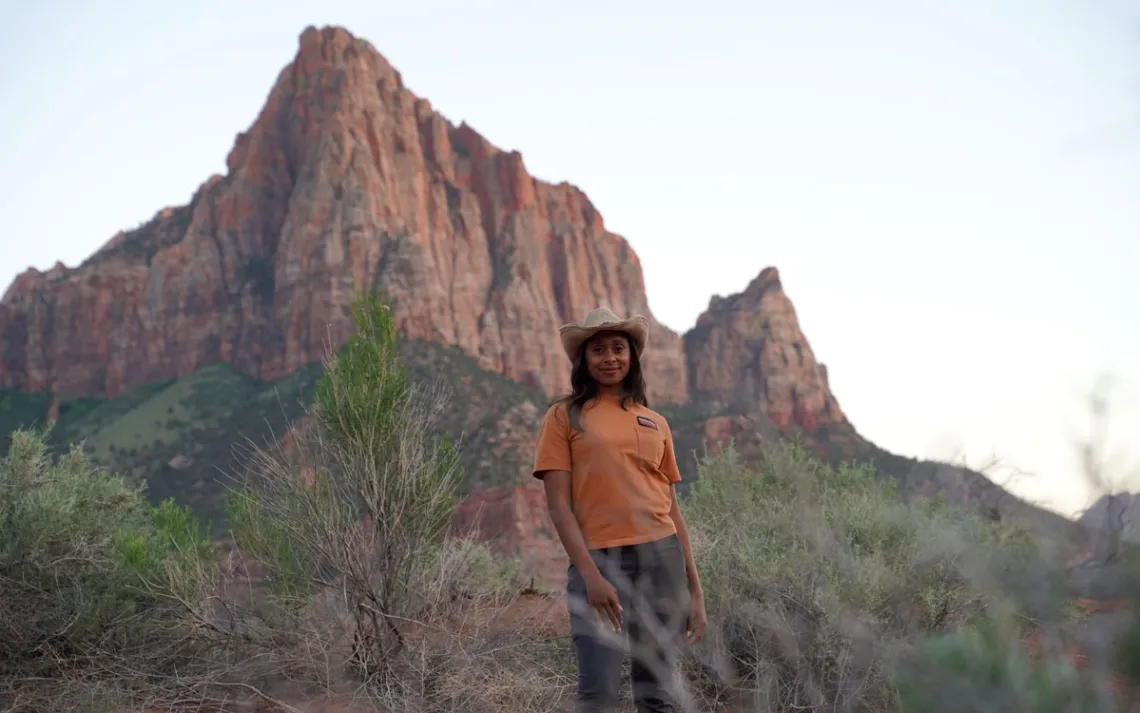
Photo courtesy of Mutual of Omaha’s Wild Kingdom Protecting the Wild
For most of her two-decade career, Rae Wynn-Grant has studied big, charismatic carnivores. She’s tracked bears through North American forests and researched lions in East Africa. Now, she hosts Mutual of Omaha's Wild Kingdom Protecting the Wild, becoming the first Black woman to host a major wildlife television series.
On a recent taping of the series, I joined Wynn-Grant and the production team as they followed Utah’s Zion National Park biologists conducting mountain lion research. The day began at an abandoned kill site. The smell reached through the trees long before the carcass was in sight: the unmistakable scent of rotting flesh. Beneath a circle of piñon pines, a mule deer lay scattered across the desert floor, little more than fur, ribs, and a skull.
Tracking data from three collared lions had led the film crew to what appeared to be a fresh kill, and the biologists pieced together the story. The carcass had clearly been dragged. The ribs were clipped cleanly in half by powerful jaws. The skull had been cracked open to reach the brain. And faint cat tracks pressed into the sand completed the picture.
Wynn-Grant walked straight into the middle of the scene. Flies circled her as she crouched beside the remains, unfazed by the smell, the insects, or the bloodstained ground beneath her boots. Then she pivoted toward a television camera and turned the deadly drama into an accessible lesson.
“Often, the scientists working on lions are trying to put puzzle pieces together from the past to construct an idea of what's going on, what the mountain lions need, and what's getting in the way,” she said. “That takes serious expertise, and sometimes it looks like spending an hour with a dead deer to figure out what's going on.”
Wynn-Grant's goal was to help the viewers understand the circle of life, and how delicate wildlife communities are. “Every species is dependent on other species, and even small changes can make cascading effects,” she said. “Predator life is hard!”
But decades before she stood over a mountain lion kill site explaining predator ecology to millions of viewers, Wynn-Grant was watching someone else do it from her living room. As a child, she was transported from the bustling San Francisco Bay Area to places filled with lions, elephants, and grizzly bears through nature documentaries. She knew from a young age that when she grew up, she wanted to be a nature show host.
There was just one problem: She had never seen people who looked like her represented as being stewards of the environment. The idea that a Black girl from Los Angeles could become a wildlife biologist, much less the face of a series tied to one of television's longest-running conservation programs, simply wasn't a story she had been shown. So, she wrote herself into it.
At 20, Wynn-Grant traveled to Kenya on a study-abroad program, where she pitched her first tent, went on her first hike and worked alongside wildlife researchers. "I was doing something that I had never known anyone like me to do," she said. "None of my friends and family had done it."
Graduate study at Yale University and Columbia University followed, along with years spent studying some of the world's largest carnivores. Her research took her across East Africa tracking lions, into North American forests to study black bears, and eventually to mountain lion country across the American West. Each project deepened her understanding of predators and the complicated relationship they share with people.
With each new project, Wynn-Grant would send friends and family letters explaining the conservation work she was doing. These updates became emails. Emails became newsletters and social media posts. Eventually, she expanded into books, public speaking, podcasts, and television.
Wild Kingdom producers initially invited her to appear as a guest scientist on a bear episode. After filming alongside longtime host Peter Gros, they asked her to return as his co-host for the series, now in Season 3 on NBC.
In a second scene for the mountain lion episode, Wynn-Grant and the researchers carried a steel mountain lion trap up another Zion Canyon, across a shallow stream and through thick brush until they reached a narrow game trail. Then, she tucked her hair behind her ears, grabbed the severed front leg of a road-killed mule deer that had been transported to the site as bait and crawled into the back of the cage. Fully in the mountain lion trap, she wedged the quarter against the wire.
"We're not just introducing viewers to a really cool wild animal," Wynn-Grant explained later. "We're also showing them the people who work to protect them and what that looks like."
That means showing the parts most wildlife documentaries leave on the cutting-room floor. "We try not to cherry-pick what we show," she said, explaining that she is proud that Wild Kingdom is able to show the full nature of this work.
Gros, who has co-hosted the series alongside Wynn-Grant since her first season in 2023, said that her authenticity was obvious from the beginning. The first episode that they co-hosted dropped her into a 98-degree California desert surrounded by dust, cacti, and endangered desert tortoises. "She just popped right in as if we'd been doing shows for years together," he said.
Just as important, he said, is the way she connects with the people behind the research. Whether interviewing veteran biologists or local conservationists, "she puts people at ease," he said, allowing their expertise to come through naturally.
By late afternoon, the trap was set, baited, and properly concealed. Above it hung a predator call box, broadcasting the cries of a distressed fawn into the canyon. The researchers hoped to collect information needed to understand how many lions use the Greater Zion Ecosystem, where they move, and how it overlaps with visitation.
"It was a super cool situation where we were able to take roadkill that would have otherwise rotted on the side of the road and actually use it [to bait the trap]," Wynn-Grant said. "At this point, I have worked with carnivores for my entire career. I am totally used to the circle of life in that way."
The researchers packed up their gear and headed back toward the park, their phones nearby in case a trap transmitter signaled that a lion had arrived. The television crew did the same, but the call never came.
No mountain lion wandered into the trap that night, so no dramatic collaring sequence made it into the episode. Rather than viewing that as a failure, Wynn-Grant said it reflected the reality of fieldwork. "We're really just tracking that animal," she said. "Walking in the steps of that animal to better understand what it's doing." In the field, captures are never guaranteed.
For Wynn-Grant, if the next generation of wildlife biologists looks different than the last, or if a child watching Wild Kingdom begins asking questions about predators instead of fearing them, then she will have done exactly what she set out to do: help more people see themselves, and the natural world, a little differently.
“My hope is that kids watching Wild Kingdom today grow up with the belief that they belong in environmental leadership,” said Wynn-Grant. "I'd love to leave a legacy of spearheading science and science-based solutions to global challenges by inspiring lots of people to become scientists themselves.”