Researchers Race to Understand These Understudied Organisms
Momentum is building to recognize and protect the world’s fungi
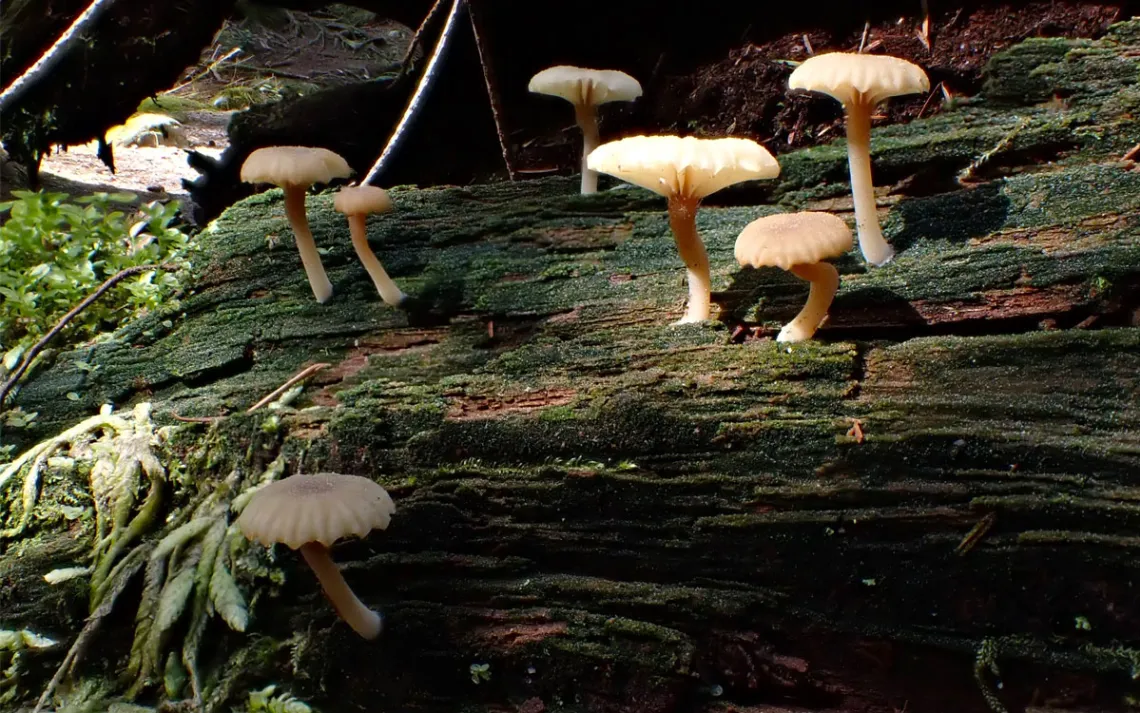
Mushrooms are temporary structures for fungi, akin to the apples growing from a tree. Most of the time, this species, Lichenomphalia ericetorum, exists as a dark-green lichen that’s easy to miss. | Photo by Jessica Allen
Last spring, Jessi Allen and Nora Dunkirk scrambled down a steep slope in the pouring rain. Despite the cold and mud, the duo was just where they wanted to be—a remote forest in southern Oregon. Old-growth trees that had never been logged towered all around them. “You feel like you’ve gone back in time,” said Allen. Then the two women spotted what they’d gone there hoping to find—a rare agarikon mushroom, growing on the side of a fallen tree. It had likely been growing there for more than a decade.
Allen, a lichenologist at the Santa Barbara Botanic Garden in California, and Dunkirk, a mycologist at Oregon State University in Portland, got to work, measuring, photographing, and collecting tissue samples. This species, whose scientific name is Fomitopsis officinalis, is listed as endangered under the International Union for Conservation of Nature’s Red List. Historically, people have used it to treat tuberculosis and a range of other diseases. But it is extinct or declining in many parts of Europe, Asia, and the United States, mainly due to logging, which destroys its habitat.
One of its last remaining strongholds, said Allen, is the old-growth forests of the Pacific Northwest. It’s why Allen and Dunkirk were in the forest. They were on a weeklong mission to find and document the species in hopes of preventing its complete disappearance. “It's so gratifying to finally find [agarikon] and see it up close,” Allen said.
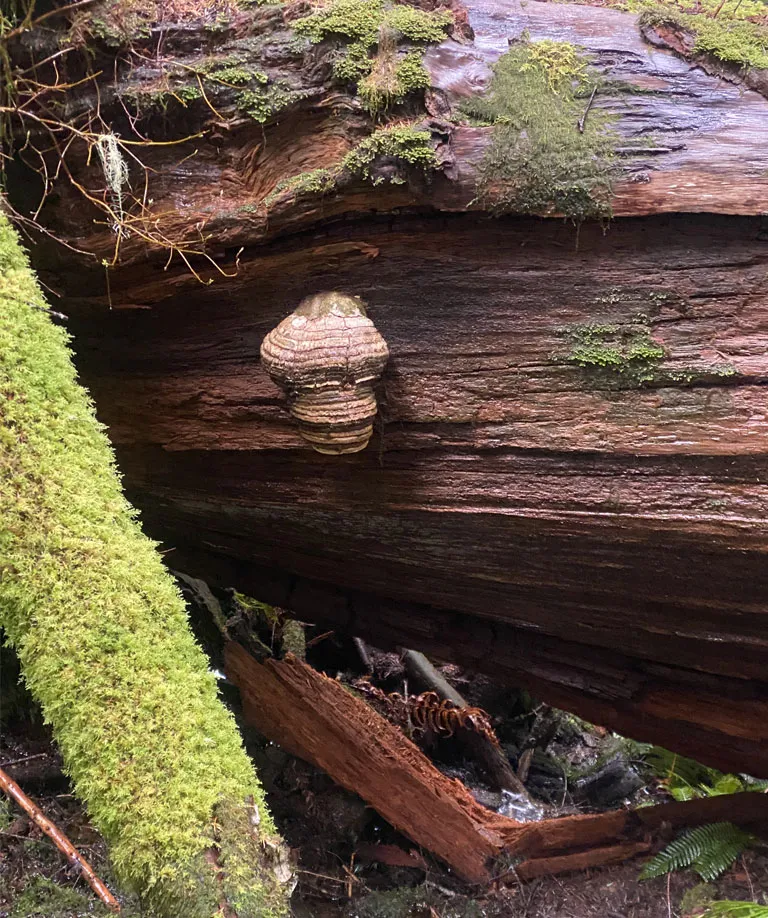
Agarikon (Fomitopsis officinalis) is a rare shelf fungus that has medicinal properties. It forms only on very large, old-growth trees and can continue to grow larger for decades. In the Pacific Northwest, some tribal groups have traditionally carved the fungus and used it in burial rites. | Photo by Nora Dunkirk
During Allen’s career in fungi conservation, she said, the attitude from outsiders has long been, “Why are you doing this? Fungi are fine.” Cuddly pandas, towering redwoods, colorful coral reefs, and other charismatic animals and plants have gotten all the conservation attention and funding. Meanwhile, most fungi lurk in the soil, out of sight, out of mind. Of course, animals and plants deserve protection, Allen said, but fungi are not fine. Just like the rest of the world's biodiversity, fungi face threats from habitat loss, climate change, and pollution.
Scientists warn that protecting this kingdom of organisms is often essential to keeping an ecosystem going strong. Mushrooms are temporary structures that only some types of fungi produce. Other types of fungi exist only as networks of microscopic underground threads called mycorrhizae. Vast networks of these threads help distribute nutrients throughout forests and grasslands, so they are essential to plants’ survival. Meanwhile, other fungi form lichens, which are special structures akin to coral reefs. In a lichen, fungi build a scaffold that houses algae and bacteria that help create the right conditions for numerous other tiny living things, including worms and tardigrades.
Thanks mainly to the persistence of a growing community of determined mycologists and supportive citizen scientists, the call to save the world’s fungi has grown from a whisper to a shout. Last year, researchers added 482 newly assessed fungal species to the IUCN Red List. But even after these additions, less than 1 percent of the 169,420 species on the list are fungi.
The main reason so few are listed as endangered is that researchers don’t know enough about them yet. Only 155,000 fungal species have been described out of an estimated total of over 2.2 million. And it takes further research and monitoring, like what Allen and Dunkirk are doing for agarikon, to assess whether a species needs conservation.
“We’ve been taking [fungi] for granted for so long,” says Toby Kiers, who leads the Society for the Protection of Underground Networks (SPUN) in the Netherlands. “They’ve just been quietly regulating the environment without much fuss.”
In the US, some of the fungi conservation work is starting at the grassroots level. The Fungal Diversity Survey, launched in 2017, was the first nonprofit in North America devoted to fungi conservation. The group’s Rare Fungi Challenge encourages mushroom enthusiasts to seek out and document rare specimens so that scientists will have a better understanding of where conservation efforts are most needed.
Gabriela D’Elia, who serves on the board of the organization, said that scientists need all the help they can get to build better knowledge of the world’s fungi. “Every person who just goes out into the woods can find a new species of mushroom,” D’Elia said. “It’s not difficult to do.”
Since returning from their rainy adventure, Allen and Dunkirk have been working on a conservation action plan for agarikon. This will involve finding and monitoring new locations where the fungus lives, educating people about its plight, and seeking legal protections. Eventually, they hope to try reestablishing the species in places where it has disappeared.
In the US and around the world, other scientists and activists have fought for protections for fungi and won. In 2012, Chile became the first country to include fungi in its environmental laws. This means that new development projects must consider the needs of protected fungi alongside animals and plants.
Daniela Torres, program lead at the Fungi Foundation in Chile, helped create a sustainable harvesting manual for several native, edible mushrooms. One of those, the loyo, can grow as large as a basketball. It’s important to Indigenous and local people who enjoy eating it. And it’s also very important to forests because its underground threads connect with the roots of native trees, said Torres. “Loyo can't survive without the forest,” she said. “And the forest can't survive without loyo.”
She noted that even though scientists have long overlooked fungi, this hasn’t been the case among Indigenous people. While working on the manual, she learned several key practices for sustainable loyo harvesting from tribal communities. For example, they carry harvested loyo in a woven basket, rather than in a plastic container. This is important, Torres cautioned, because spores fall through the openings in the basket to the forest floor, helping to spread the fungus.
She’s now developing a conservation plan for the loyo. And she’s starting by running workshops and interviewing people in rural and Indigenous communities near where loyo grows. She said that all people “think differently,” so it’s important to learn what individuals want and need from a plan to protect loyo.
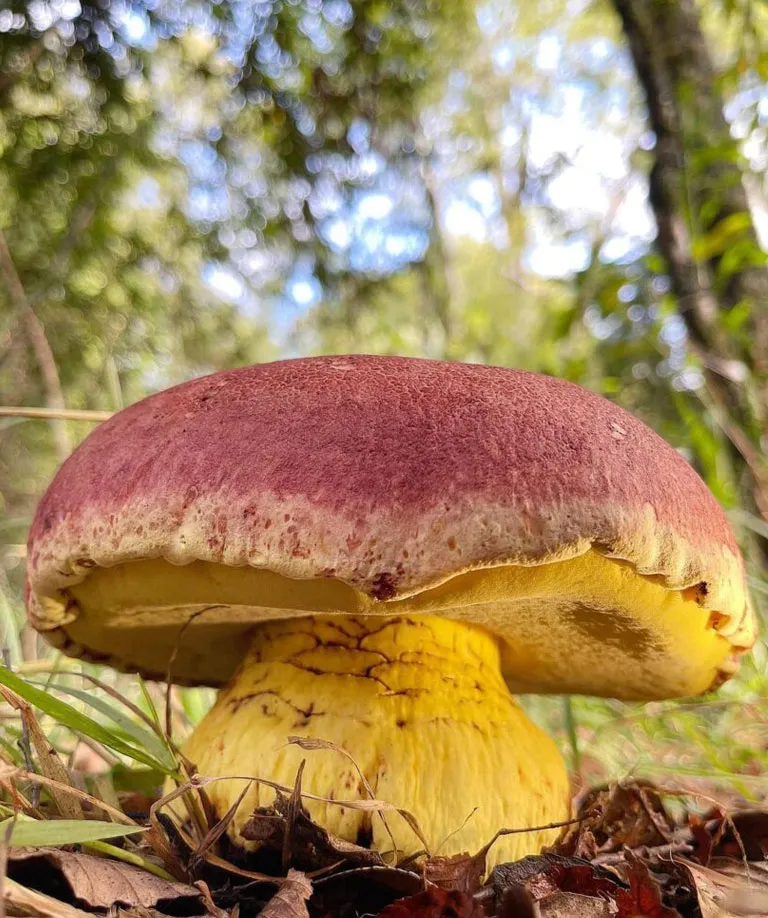
Deforestation, forest fires, and overharvesting threaten Butyriboletus loyo, a fungus native to Chile. It forms colorful mushrooms that can grow as large as a basketball. | Photo courtesy of Guiliana Furci, Fungi Foundation
Agarikon and loyo are both large mushroom-forming species that people like to use. So it makes sense that these would be among the first fungi to attract conservation attention. But most of the fungi on Earth are underground, invisible, and not directly useful to people. Yet all fungi are fascinating organisms and could offer solutions to some of our most pressing problems, including disease, climate change, and pollution, as Merlin Sheldrake detailed in his 2020 best-selling book, Entangled Life: How Fungi Make Our Worlds.
To help catalog what needs to be conserved, researchers with SPUN have analyzed data from 25,000 soil samples to create a global map of the biodiversity of mycorrhizal fungi—the ones that form underground threads. In a 2025 paper in Nature, Kiers’s team found that less than 10 percent of biodiversity hotspots are in protected areas. And this October, they’ll speak at the United Nations Convention on Biological Diversity about including these hotspots in conservation planning.
Paying attention to fungi can also help bolster conservation efforts for other species. For example, staff at Joshua Tree National Park have been planting baby Joshua trees for years, but most of them do not survive to adulthood. “There's a pretty strong hypothesis that fungal communities can help,” said Kiers. Her group is working with the park to study whether adding certain kinds of fungi to seedlings’ soil could help the trees survive to adulthood. And in the Pacific Northwest, one effort to protect the northern spotted owl looked for specific fungi and lichens to help identify habitats where the bird could thrive. That’s because these fungal species are “excellent indicators of old-growth forest,” said Allen.
One big thing anyone can do to help with conservation efforts, said Torres, is to include fungi in conversations about conservation. “When you mention flora and fauna, also mention funga,” she said. “Don’t forget them.”