Rewilding a Massachusetts Golf Course Back to Wetlands
The first project of its kind in the state is part of an effort to improve climate resilience

How can a community best make use of the land once dedicated to an active golf course? When that course is ready for retirement, the opportunity to rewild it can be tantalizing. In Massachusetts, a first-of-its-kind project is underway to do just that.
In Northampton, city officials, in partnership with the Massachusetts Division of Ecological Restoration (Mass DER) and Mass Audubon, are rehabilitating the 105-acre retired Pine Grove Golf Course into a permanent conservation area that incorporates the Nashawannuck Stream and wildlife corridors. Phase one of the project wrapped up in mid-July. All heavy equipment has been removed from the site and access is now open to the public, with open walking trails for the community.
The Nashawannuck Brook Restoration is one of the other restoration efforts being planned across the state.
“The industry is going through a bit of transition with some owners retiring from the business, and in some places, interest in golf, in particular, golf courses, may be declining,” said Beth Lambert, director of Mass DER. “It’s potentially an enormous opportunity to combine land protection with restoration and rewilding in a way that provides new open space for residents, as well as habitat for fish and wildlife.” Lambert hopes the project inspires other golf courses considering restoration to take the same approach.
When looking at potential restoration projects, Mass DER looks for sites with significant ecological benefits as well as larger benefits for surrounding communities, such as climate adaptation, recreation, and education opportunities. With the Nashawannuck site specifically, officials evaluated stressors on the ecology, specifically the aquatic ecology, and how undoing those stressors could restore self-sustaining wetlands and rivers.
Typically, a golf course’s objective is to keep water out, but in this case, contractors are bringing the water back in. They removed a failed culvert and transformed it into a pedestrian-and-bicycle-access bridge, removed a dam to restore the stream channel, and installed vernal pools. These changes will help enhance the conservation area’s climate resiliency to extreme weather events such as flooding and erosion while contributing to carbon sequestration.
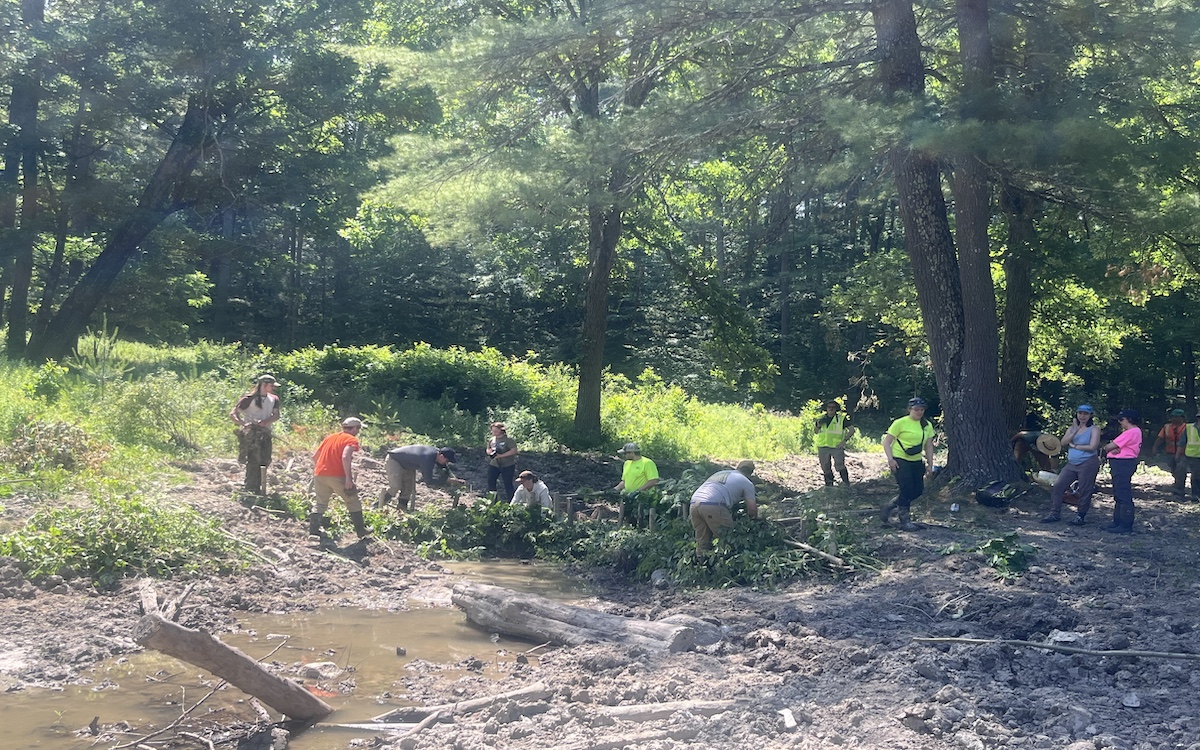
Volunteers work to build a beaver dam analog.
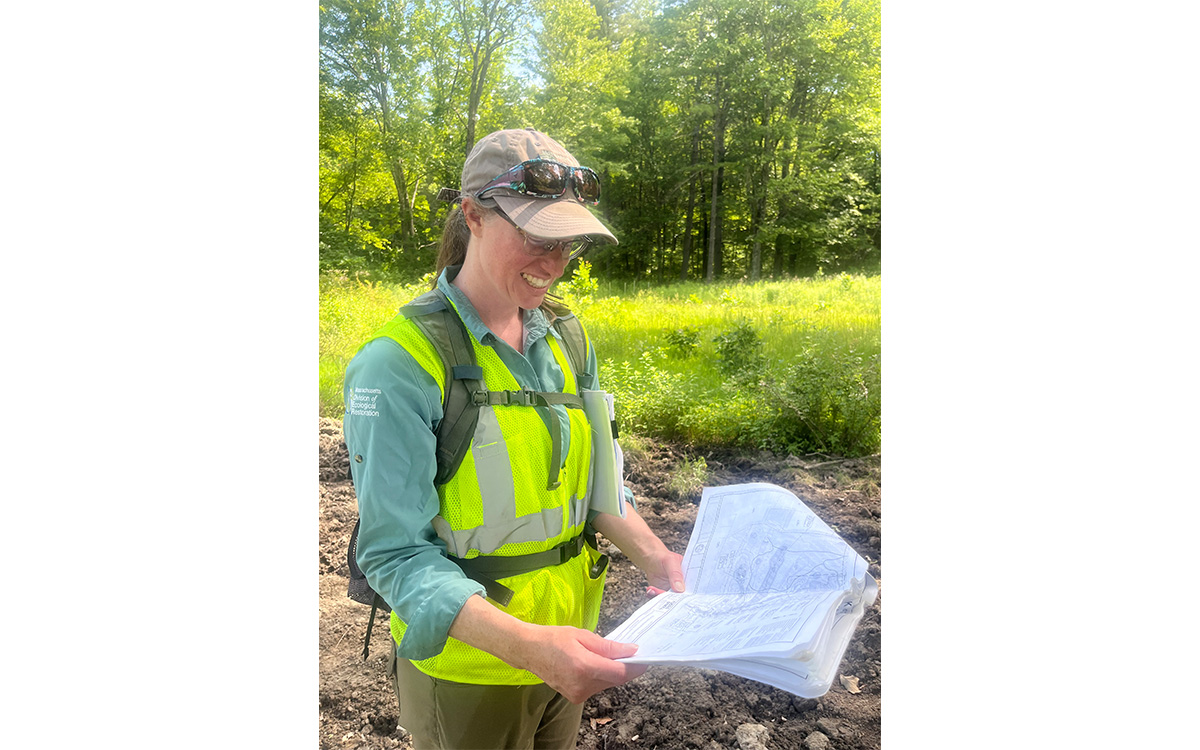
Kate Bentsen, restoration ecologist at Mass DER, looks at site plans.
According to Sarah LaValley, assistant director for Northampton’s Office of Planning and Sustainability, the city bought the Pine Grove Golf Course property in 2020. Planning began immediately. While the City of Northampton Conservation Commission owns the property, Mass Audubon holds a conservation restriction. The initial phase of construction began with deconstructing the golf course and removing and reusing the 400 yards of riprap, large stones throughout the golf course, to armor the stream bed.
In the design report from the civil engineering firm Fuss & O'Neill, the senior restoration ecologist on the project, Julianne Busa—now the owner of the ecological restoration design firm Truly Ecological—requests that beavers be an “active partner in restoration” on the Nashawannuck site. Groups of volunteers have begun the construction of six beaver dam analogs (BDAs) to mimic traditional beaver dams and reduce downstream flooding. The hope is that beavers will come and finish the dams themselves. According to Mass DER restoration ecologist Kate Bentsen, this has already been working.
“We were hoping to encourage beavers to return to the area to assist us with reconnecting the stream with its flood plain that had been separated from it so long by human activities,” said Bentsen. “They got the invitation even sooner than we expected and returned to the site soon after.”
Tom Lautzenheiser, a senior conservation ecologist for Mass Audubon, said that speckled alders, a natural wetland shrub and a favorite food source of beavers, began growing once the land’s vegetation took its own course. Bentsen pointed out that beaver dams allow water to be released slowly during periods of drought, as it is pushed into the banks, but the dams are also permeable, allowing some water to always flow through.
Ecologists also hope that the two vernal pools built on former fairways will expand the area’s existing turtle habitat and help spotted salamander and wood frog populations cross over to the Nashawannuck site.
So far, Lautzenheiser said he has seen a variety of teals, mallards, and other ducks, along with swallows flying overhead in search of insects. The poster bird for the project, he said, is the American woodcock, which has benefited from the expansion of wetlands and softer soils. Lautzenheiser expects the vernal pools to attract spring peepers, gray treefrogs, and red spotted eastern newts.
One of the initial concerns addressed by the project was the need to stabilize the Nashawannuck Brook, which flows through the golf course down to abutting land owned by Mass Audubon. Lautzenheiser said that for years, the brook was considered “wildly unstable,” with bank erosion and trees falling in from being undercut.
“The golf course was essentially like green pavement where they were doing everything they could to get water off of the golf course,” said Lautzenheiser. “There were trench drains, cisterns, and catch basins to dry those fairways out as fast as possible in a storm, so basically the brook was a glorified drainage ditch.”
Lautzenheiser said he also sees restoration projects like this as a two-pronged solution to the climate crisis: adaptation and mitigation. By slowing the flow of the brook, they are addressing future flooding and storm damage that can happen downstream. Through reforestation, wetland enhancement, wetland creation, and floodplain restoration, he sees improvements in local biodiversity and wildlife habitat, as the area is an important wildlife corridor connecting conservation lands from the Connecticut Valley up into the Berkshire Highlands.
LaValley said that the project team applied for a $3 million state MVP grant to fund phase two of the project, which will remove an on-site dam, restore the stream channel, plant 7,000 trees and shrubs, and create an all-access trail network designed to accommodate people with mobility challenges.
“We’re focusing planting efforts on species that are currently at the northern end of their range, but that will continue to shift as things change over time. So by the time those trees are mature, they're doing well, and in the climate of the future,” said LaValley.