 The Magazine of The Sierra Club
A Road Less Deadly
Can Alaska’s new Kenai Peninsula wildlife crossings save moose?
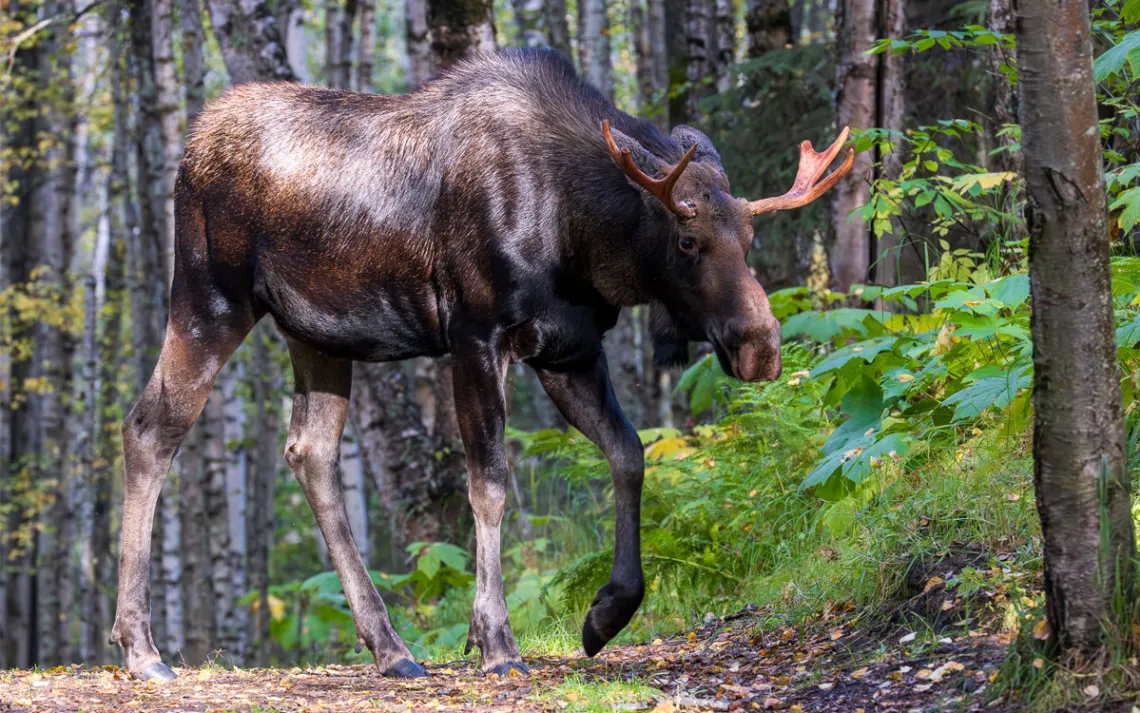
A young bull moose crosses an urban trail at Kincaid Park in Anchorage. | Photo courtesy of Heather Physioc
It’s a familiar scene for Alaska drivers: rounding a bend on a dark highway and suddenly spotting a moose, massive and silent, emerging from the spruce and lumbering across the road. Sometimes, these interactions can have deadly consequences. Each year on Alaska’s Kenai Peninsula, drivers strike and kill an average of 240 moose.
According to the Alaska Department of Fish and Game, more than 90 percent of the moose-vehicle collisions (MVCs) involve calves and cows. Each accident costs roughly $35,000 in vehicle damage and emergency services response alone, and collisions with moose are 13 times more likely to cause human death than those with deer.
Now, an ambitious effort to reroute traffic around the town is reshaping the road with human and animal safety in mind, adding a key environmental feature: wildlife crossings designed to guide moose, bears, and other species safely across the asphalt. Beyond protecting animals and people, the project will help preserve one of the nation’s last intact ecological connections.
“At one time, there were as many moose being killed by cars on the Kenai as by hunters,” said John Morton, retired 18-year supervisory biologist at Kenai National Wildlife Refuge. “Even though the numbers look the same, cars are killing cows and calves—the reproductive cohort.”
The roadway is a lifeline for local residents, anglers, and freight, but transportation research indicates this section may also create crash-related costs over $10 million annually—“and that’s not even counting the cost to life,” said Nicole Schmitt, Alaska Wildlife Alliance executive director.
In 2009, after a spike in fatal crashes and moose collisions, Alaska designated this especially dangerous stretch of the Sterling Highway a “Traffic Safety Corridor,” making it one of the state’s highest-priority roads for redesign and safety investment.
“We’re just now waking up to the scale of impact for wildlife-vehicle collisions and are starting to do things about it with wildlife crossings,” Schmitt said.
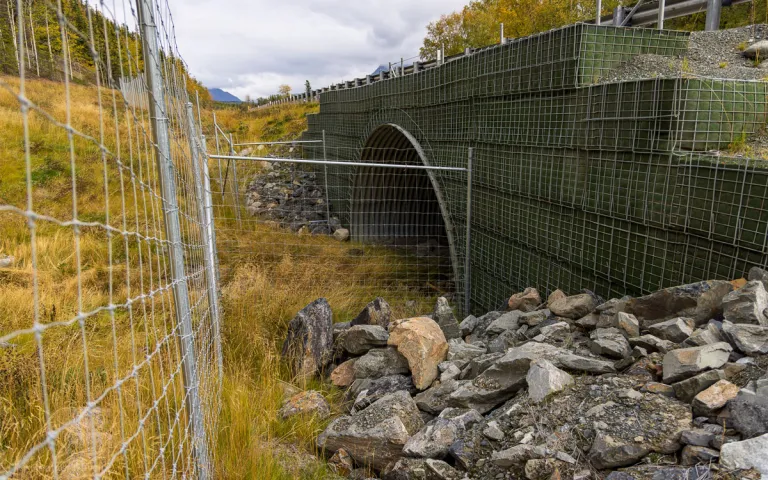
A new wildlife underpass with fencing around it to funnel animals under the Sterling Highway roadway on the Kenai Peninsula. | Photo courtesy of Heather Physioc
Preserving wildlife corridors
Although the riverside town of Cooper Landing, about 50 miles as the crow flies south of Anchorage, has only a few hundred permanent residents, a segment of the Sterling Highway near town carries more than 1.2 million vehicles per year. The new bypass will help alleviate some of the congestion through town, featuring wider shoulders, passing lanes, and updated guardrails to enhance driver safety and facilitate winter maintenance.
“Fewer cars along the Upper Kenai is a big win,” Scotty Daletas, owner and guide at Kenai Drift Anglers in Soldotna and secretary of the guide association, said. “A constant flow of vehicles right next to your fishing trip takes away from the experience. Less traffic there will feel more like the Kenai should."
Of several possible routes for the bypass, state and federal agencies chose the Juneau Creek Alternative, a 10-mile stretch of new roadway that swings north of Cooper Landing and the Kenai River and through the Juneau Creek canyon. Approved in 2018, it required a network of wildlife crossings to connect the Kenai National Wildlife Refuge and the Chugach National Forest, one of only three remaining landscape-scale corridors for north-south wildlife movement on the Kenai Peninsula.
Roads are so problematic that one split a population of moose near Anchorage in two. A genetics study by the US Geological Survey and Alaska Department of Fish and Game found that traffic from Glenn Highway divided the area’s herds enough for them to become genetically distinct. Research in Alces revealed that Anchorage moose possess alleles, genetic material, not found on the Kenai Peninsula—a sign of growing isolation that the researchers warn could one day limit their adaptability and reproductive health.
“Reducing unnatural mortality makes populations more resilient because they can move more freely across the landscape,” Schmitt said. “If moose aren’t being taken out by cars, they’ll be somewhere else in the landscape; they can reproduce and flourish.”
On a comparable stretch inside Kenai National Wildlife Refuge, biologists reported moose collisions fell by about half since a different set of crossings opened in 2019. That segment included five underpasses, a bridge over the East Fork Moose River, and eight-foot fencing with 22 wildlife jump-outs that allowed moose and bears to exit the corridor but not reenter. Monitoring inside the refuge has shown that moose, brown bears, caribou, lynx, and many smaller wildlife species are using the new passages.
The new Sterling Highway project plan includes five wildlife crossings, with 22 jump-out points at one-eighth-mile increments. It also calls for Alaska’s first-ever vegetated wildlife overpass, which many large mammals, including moose, bears, elk, and deer, prefer. The design also includes culverts and underpasses that emphasize a multispecies approach. “All fisheries culverts should be designed as wildlife culverts,” Morton said. “Not just for fish but for bears and moose too.”
The Alaska Wildlife Alliance led a multiyear campaign to create quarter-mile no-shoot zones around new wildlife crossings. After years of rejected proposals, they finally won in 2024. People cannot hunt, trap, or shoot within a quarter mile of any wildlife crossing and cannot stand outside that boundary and fire into it. “Otherwise they’d become population sinks instead of boons,” Schmitt said.
The design includes several infrastructure firsts for the state, including plans for the 928-foot Juneau Creek Bridge, Alaska’s highest and longest single-span bridge. It’s also Alaska’s first Department of Transportation & Public Facilities (DOT&PF) project to require certified weed-free gravel, ensuring no invasive seeds are spread during construction, an accomplishment Morton calls “a huge win.”
A massive collaboration
Building the wildlife crossings is a monumental, multidisciplinary effort. The DOT&PF, in partnership with the Federal Highway Administration, is leading a multiyear project to bring building partners together. Meanwhile, HDR Inc., an engineering company, is designing the highway, and Quality Asphalt and Paving, along with Traylor Bros., are constructing it.
In his role at Kenai National Wildlife Refuge, Morton co-led research on moose-vehicle collisions, wildlife movement, and corridor mapping across the Kenai Peninsula. His work scientifically validated the severity of the human-wildlife conflict on the Kenai Peninsula and provided the data necessary to justify an infrastructural solution.
He applauds the idea of Alaska’s first wildlife overpass but questions its location, which he says was chosen more for politics and convenience than actual animal movement. He argues that the design could push wildlife, such as moose and bears, toward Cooper Landing instead of allowing them to cross both highways safely. "I’m really glad we’re setting the precedent for an overpass in Alaska,” he said, “even if it’s in the wrong place.”
The Kenaitze Indian Tribe has also played a crucial role in establishing standards for the excavation and treatment of all materials recovered during construction. The tribe ensures that cultural observers are on-site during excavations. “Their presence represents the ts’itsatna, the ancestors. To protect the Kenai River is to protect the Kahtnuht’ana Dena’ina,” according to a statement from the Kenaitze Indian Tribe.
The project has also encountered significant hurdles. When it was first approved in 2018, the estimated cost was no more than $312 million. It is now expected to reach more than $955 million. Costs have tripled due to pandemic-era pricing, supply chain disruptions, and inflation. The project received about 90 percent of its federal funding through the Federal Highway Administration, and the state provided the remaining 10 percent. State and federal partners must continuously amend the Statewide Transportation Improvement Program to secure funding for upcoming stages.
Originally slated for completion in 2027, construction of the expanded highway is now scheduled to end in 2031, with final phases and monitoring extending to 2033. Steep canyon terrain requires short, seasonal construction windows, and right-of-way acquisition and contracting for the Juneau Creek Bridge were delayed.
The new overpass is scheduled for construction from 2026 to 2028. Recent project updates say work on the Juneau Creek Bridge will continue through 2027. When the roadway surfacing and striping work is complete, landscaping and native vegetation restoration will begin.
The US Fish and Wildlife Service, US Forest Service, and Alaska Department of Fish and Game will help manage wildlife and habitat along the roadway within Kenai National Wildlife Refuge. A five-year post-construction study will monitor wildlife use, crash reduction, and vegetation recovery. Final environmental and fiscal audits are expected in 2033 to close the project officially.
Locals say they expect the crossings to help, but “moose will always be moose,” Daletas said. “That’s just the reality of living with them.”