
Saving More Green Acres
Residents and advocacy groups stop the development of the last waterfront forest in Troy, New York
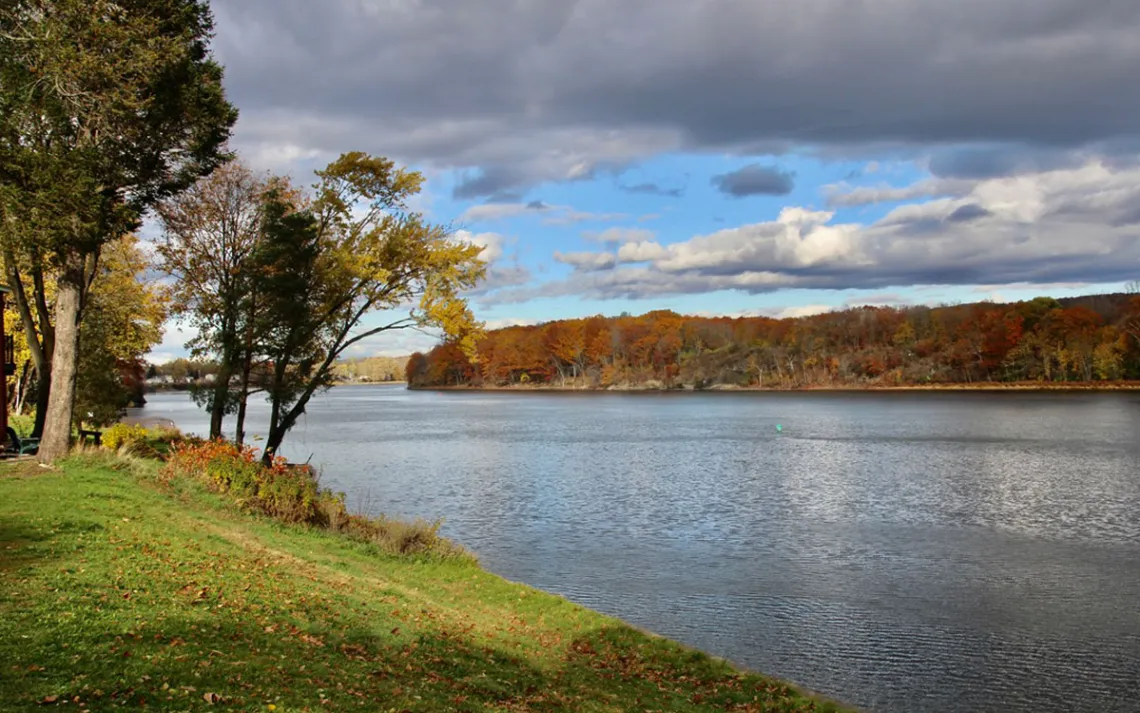
View of 1011 2nd Ave Forest from across the river in Waterford, New York. | Photo by Marigo Farr
Jessica Bennett, a massage therapist from Long Island, did not set out to become a defender of a forest. But the opportunity came right to her backyard. In 2006, she moved upstate to Troy, New York, a small city outside of Albany, the state’s capital. In 2019, she bought a house on the Hudson River next to an 11-acre, hilly parcel of forest.
“[I just] wanted a place to garden,” said Bennett. “But it turned into much more.”
After living there for just one month, her roommate texted her and said, “There're men in the side yard.” She went outside with her self-professed “subway attitude” and asked what was going on. The men were archaeologists, hired by the Florida-based owner of the land, Donnie Lucarelli.
According to one archaeological report, a portion of the site—called the 1011 2nd Ave Forest—was used as a quarry by Indigenous people during the Middle Archaic to the Early Woodland periods, roughly 4,000 BC to 650 AD. It contains projectile points as well as remnants of campsites and quarrying activities.
“The site maintains excellent integrity of these activity areas that make it eligible for listing on both the federal and New York Register of Historic Places,” said Jeffrey Bendremer, the tribal historic preservation officer for the Stockbridge-Munsee Band of Mohican Indians, whose ancestral homelands include that piece of land. It is, “a rare surviving cultural landscape, preserving evidence of Mohican ancestors’ lifeways along the Hudson River,” he added.
The forest is home to beavers, red foxes, and bald eagles, as well as the rare scrub oak. And it is a cherished green space in an otherwise developed area. Neighbors across the river from the forest sometimes watch boaters pull up on its shore for a rest.
What Bennett didn’t know at the time was that the year after she moved in, a developer named Kevin Vandenburgh would submit an application to the City of Troy to build a 231-unit, multibuilding apartment complex there. The proposal would involve razing over three-quarters of the forest, flattening out the hilly topography, and disrupting the archaeological site. She also didn’t know she would be the epicenter of a fight, one that would involve neighbors banding together, a lawsuit against the city, and a local conservation organization making a bid to protect the land.
When Vandenburgh’s plans finally surfaced in 2020, Bennett organized her neighbors to attend meetings and give comments. She also reached out to local environmental organizations and tribal groups for support. Along with two friends, Sarah and Leo Bachinger, she formed a grassroots group called Friends of the Mahicantuck, which is an anglicization of the Indigenous word for the Hudson River.
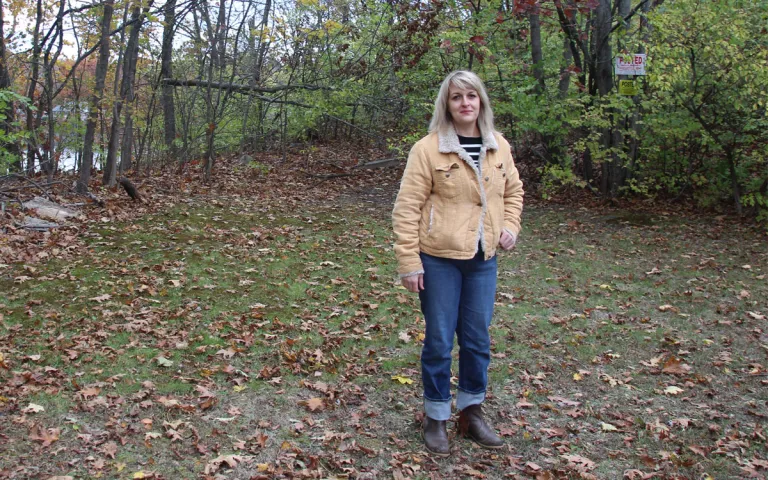
Jessica Bennett stands in her backyard near the property line of the 1011 2nd Avenue Forest. The Hudson River is behind her. | Photo by Marigo Farr
One of Bennett’s neighbors is Janet Null, an architect who moved to the area in the 1970s and lives directly across the river in Waterford, New York. Her firm works with historic buildings and sites all throughout the state. “I knew there was some development planned for the site, but I never expected it would be what they came up with,” said Null, speaking of when she first saw the plans. “Because it is so completely inappropriate.”
Null said that in years of attending meetings, she was struck by how unanimous the objection to the project was. “There has been huge opposition to this right from the beginning. There have been many, many meetings. People from the community, from Troy and also from Waterford,” Null said. “And also some other interests … have spent many hours commenting on this project over the years. And in all of that, I have only ever seen one public comment that was in favor of it.”
Sierra made multiple attempts to interview representatives from the City of Troy, but was unsuccessful.
The position of the Stockbridge-Munsee was that the forest should be totally protected because of its “invaluable sources of historic information and in recognition of and reverence for Mohican ancestors who once lived and worked in what is today Troy, New York," Bendremer said.
He added that one of the tribe’s objections to the city’s handling of the process was that the Troy City Council assumed the role of “lead agency,” a term used to refer to the entity that would be responsible for assessing environmental impact. He said that the tribe preferred a federal agency because only a federal agency has a responsibility toward federally recognized tribal nations. “[A federal agency] contrasts markedly from the City of Troy, which has not shown itself to be sympathetic to the tribe’s interest in preserving its heritage,” said Bendremer.
Other groups weighed in on the environmental review process. A coalition letter with dozens of signatories, including environmental advocacy groups and other local tribes, was sent to the city council president in 2021 expressing concerns. The letter specifically stated that they hoped the environmental review process would result in a “positive declaration,” which means that it would have required an environmental impact statement. But ultimately, the city council issued a negative declaration, saying there was no significant environmental impact from the project, and allowed the project to move forward.
In June 2022, the city voted to rezone the area from single-family to multi-family to make way for the development. Looking for a new strategy, Bennett turned to the Pace Environmental Litigation Clinic at Pace Law School, one of the few organizations that provides pro bono representation for environmental causes. Todd Ommen, the clinic’s managing attorney, said the case was a natural fit.
“The clinic's mission is to represent environmental groups in cases where the goal is to … protect the natural environment,” he said. “And so this type of case, protecting a green space along the Hudson River, was a case that we thought warranted our involvement.”
Ommen said that the city should never have skipped over the environmental impact statement. He said that a negative declaration “should not be a common occurrence … even just one potential significant impact should result in an EIS.”
In July 2022, Bennett sued the city, lost, and brought the case to an appeals court. In October 2024, a court overturned the city council’s rezoning of the land and rejected the city’s environmental impact findings. This ruling meant that Vandenburgh had to go back through the review and rezoning process.
“If it were ‘Jess Bennett [versus] Some Petty Cause,’ it would feel really cringe,” Bennett said. “But this whole thing has been: ‘It doesn't matter if this is in your comfort zone; this is for the forest.’”
After that, Vandenburgh made his way through the steps to get the project approved again and, according to Lucarelli, it got fairly close. But in June 2025, Lucarelli received a call that changed everything. It was from Jim Bonesteel, the executive director of Hudson Taconic Lands, a grassroots conservation organization that had been silent on the issue. Bonesteel expressed interest in his organization buying the property. “If he had never called, I would have never thought of it,” Lucarelli said. “And I would have … just kept barreling along.”
By September 2025, the two entities were under contract. According to Bonesteel, the land will be conserved with no development. It will be open to the public and will have parking and minimal trails, and it will be purchased with support from Scenic Hudson, a large land conservation organization.
“We're going to be working hand in hand with the [Stockbridge Munsee] to make sure that we do that in a way that's responsible for the archaeology on the site,” said Bonesteel. He added that part of his organization’s work with the Stockbridge Munsee will be, “to give them the option to own it in the end, if they want to.”
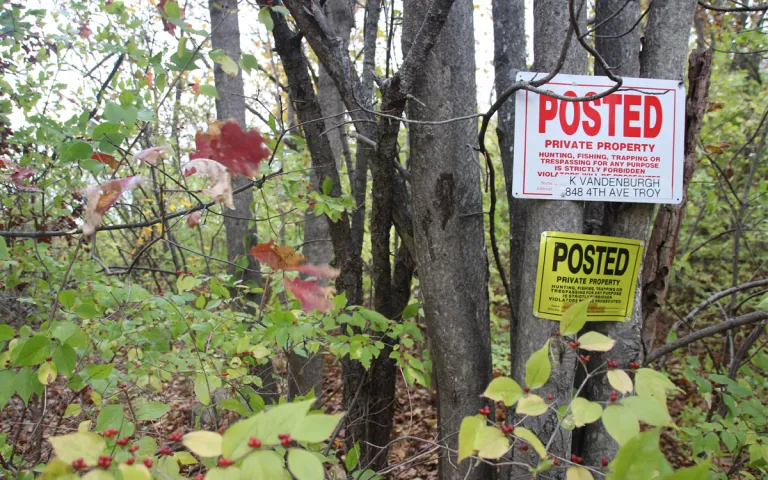
Signs at the 1011 2nd Ave Forest property line. | Photo by Marigo Farr
The Historic Preservation Office for the Stockbridge Munsee is in full support of the sale. “It's very gratifying to have allies who … are willing to make the investment—time, effort, and obviously resources to preserve the site,” said Bendremer. “We couldn't be more grateful.”
Lucarelli said that deciding to sell the land was not only a reprieve from an arduous process of trying to get the project approved, but that it was also the right thing to do. “I had a lot of frustration with this piece, getting it approved,” Lucarelli said. “But more importantly, I've never done anything like this in my life, along this line, where a bunch of people could benefit from a different standpoint than building an apartment project and people living there.”
The day Bennett heard the news, she saw two bald eagles circling her yard, which she took to be a good sign. She reflected back on almost six years of community organizing.
“It's a huge win for the community,” said Bennett. “I think it really speaks to the dedication and the perseverance of the community in Troy. But this is not just a Troy issue. We had people calling into city council meetings from Manhattan, from all up and down different parts of New York.… I certainly can't say what was the thing that punctured the wall, but many roads lead to Rome.”