 The Magazine of The Sierra Club
Scientists Name the Fish That Wears a Feather
Cherokee tribes help Western scientists recognize the sicklefin redhorse
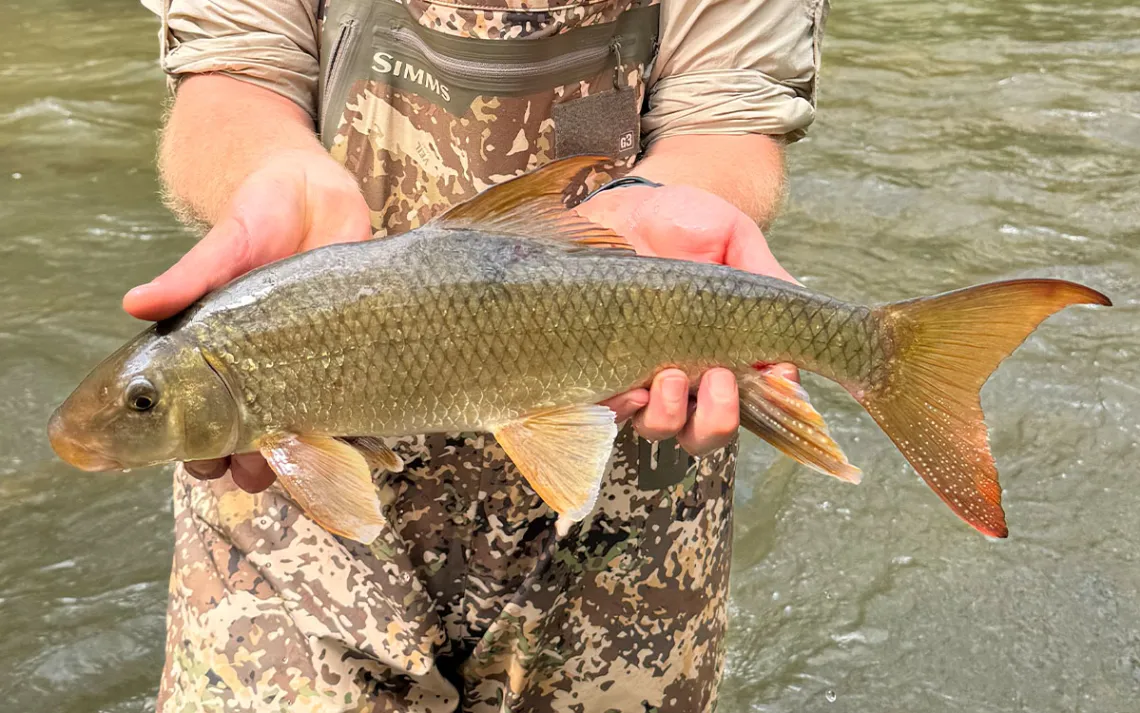
Chattahoochee Forest NFH deputy project leader Joseph Helseth holds a sicklefin redhorse sucker. | Photo courtesy of USFWS
The sicklefin redhorse—a fish long prized by the Eastern Band of the Cherokee Indians but only known to Western scientists for three decades—finally has a name. As of February, the shiny sucker with a fiery red tail and an olive-green body is now known as Moxostoma ugidatli.
Ugidatli (pronounced ooh-gee-dot-lee) is a Cherokee word that means “it wears a feather” and refers to the feather-shaped dorsal fin that stays visible above the water when the fish spawns in the cold mountain rivers of the Southern Appalachians. “We felt it important to honor the Cherokee name as it occurs on the unceded territory of the Eastern Band of Cherokee Indians, and it is right and proper to refer to the species using the name spoken by its true discoverers,” wrote Jonathon Armbruster, the Auburn University biologist who spearheaded the fish’s official description, which was published in the journal Ichthyology & Herpetology.
According to Caleb Hickman, a citizen of the Cherokee Nation and supervisory biologist with the Eastern Band of Cherokee Indians, it was one of the first times that a new species’ name went through an approval process with all three federally recognized Cherokee tribes, who confirmed it was linguistically accurate and appropriate for outsiders to use.
Hickman praises this kind of “coproduction” as a much-needed departure from the long-standing practice of scientists extracting knowledge from Indigenous communities without their input. “The tribe was a part of the process, not simply a recipient of goodwill,” he said. “That’s significant.”
For centuries, the Cherokee awaited the spawning runs of two-foot-long ugidatli, an important source of food for the region's native tribes that has sometimes been called the “salmon of the South” because of its cultural, ecological, and physical similarities to Pacific salmon. Hickman explained that during these migrations, the tribe would funnel the fish into stone weirs, gathering just what they needed to feed the community. “There are still people alive today who remember collecting thousands of fish,” he said. Once the tribe had had enough, they pulled the weirs down.
But the construction of hydroelectric dams across the tribe's ancestral territory severed the cultural and culinary ties between the Cherokee and the sicklefin redhorse—and cut the fish off from many of its most vital spawning grounds. Since then, pollution and predation by invasive species have caused the species to disappear from all but a handful of Appalachian waterways. Today, scientists estimate there are approximately 2,000 sicklefin redhorse swimming around the Hiwassee and Little Tennessee River systems.
The species is considered threatened in North Carolina and endangered in Georgia but has stayed off the federal endangered species list thanks to the work of the Sicklefin Redhorse Conservation Committee (SRCC). The group is a coalition made up of the Eastern Band of Cherokee Indians, the Georgia Department of Natural Resources, the North Carolina Wildlife Resources Commission, the US Fish and Wildlife Service, and several nonprofits, universities, and energy companies.
Since 2005, researchers with the partnership have studied the life history and identified the range of the large fish, which provides critical services to the ecosystems it inhabits. As it migrates upstream, the sicklefin redhorse transports vital nutrients like nitrogen, which fertilizes the plants and algae that form the base of the food web. The species also plays a role in the lifecycle of the Appalachian elktoe, a critically endangered freshwater mussel that requires a host fish to complete its metamorphosis from larvae to juvenile mussel.
In 2013, the SRCC launched a sicklefin redhorse propagation program at Georgia’s Warm Springs National Fish Hatchery. To date, almost 100,000 fish have been released into the wild, which has helped stabilize the fish’s numbers. Unfortunately, the effort has not yet succeeded in bringing the ugidatli back to Cherokee waters.
Hickman said that despite years of stocking, researchers who conducted a 2018 survey failed to locate the fish in the rivers and streams of the Qualla Boundary, the Cherokee’s 57,000-acre territory in western North Carolina. “That’s when we realized the dam was the issue,” Hickman said. “The dam has always been the barrier.”
He’s referring to the Ela Dam, a 100-year-old impoundment that sits on the Oconaluftee River, obstructing the river’s natural flow, dividing ecosystems, and preventing the sicklefin redhorse from migrating into its ancestral waters of the Qualla Boundary.
But that may soon change. In 2024, the company that owns the dam applied to the Federal Energy Regulatory Commission to surrender its license. It was the first step toward the dam’s eventual removal and the reconnection of 549 miles of rivers and streams across the region.
Hickman said that Cherokee leadership is working to prepare the tribe for their eventual reunion with the “fish that wears a feather” once the dam comes down. Eventually, he’d like to be able to host fish fries where discussions about the species and traditional fishing methods are front and center. “We’re hoping to revitalize those old philosophies,” he said.
And while the effort to conserve the ugidatli is very much a work in progress, the biologist is gratified to know that its Cherokee name will now be preserved forever.