 The Magazine of The Sierra Club
These Scientists Just Mapped Scorpion Hot Spots. Here’s Why You Should Care.
An international team working in Morocco produced findings that could have implications for public health
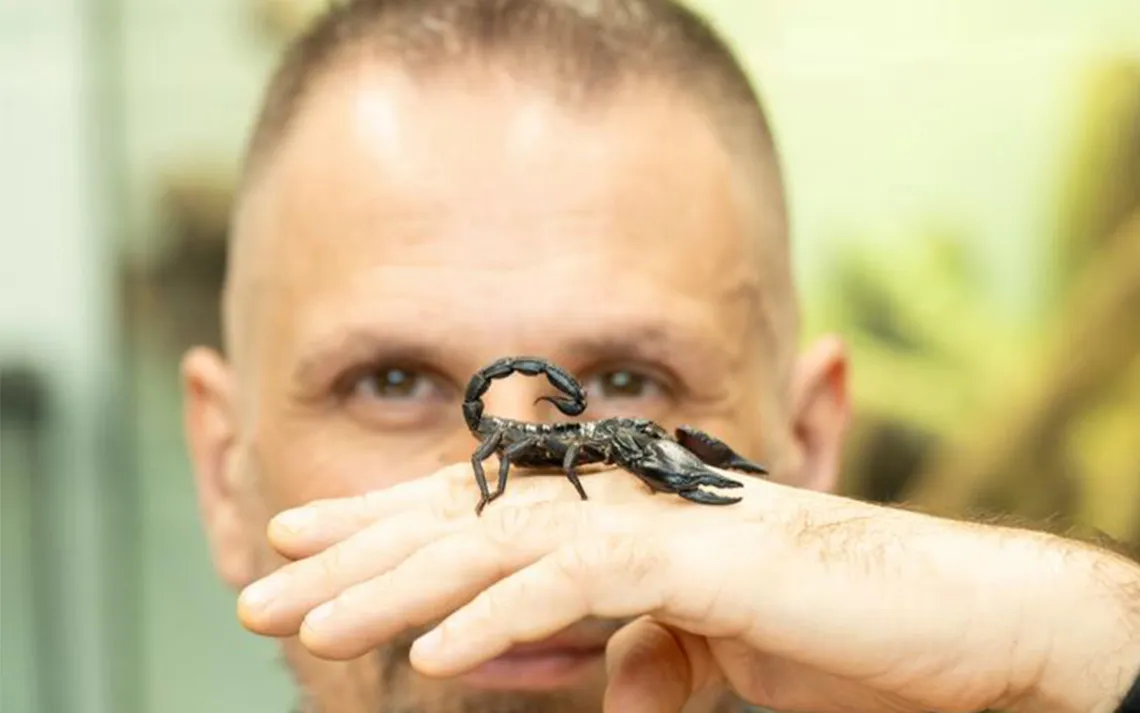
A giant Asian forest scorpion rests on the hand of zoologist Michel Dugon. | Photo courtesy of Andrew Downes, Xposure
A sting from a deathstalker scorpion, which lives in northern African and the Middle East, can kill a child. But the venom from the arachnid may help save lives too.
Peptides originally isolated from the scorpion venom have been shown to bind with tumor cells. Doctors can use a synthetic version, combined with a near infrared fluorescent dye, to light up harmful cells. A surgeon spotting the glowing masses may be able to better find and remove dangerous cancer cells without cutting out healthy tissue. Researchers are studying the imaging agent’s use on everything from pediatric brain tumors to skin cancers.
But more than a million people are likely stung by scorpions a year, with an estimated 3,000 or more dying. The arachnids have evolved over more than 400 million years to develop a potent venom that can wreak havoc in doses as small as a raindrop.
“That raindrop, once you let it in your bloodstream, within minutes can actually mess with your whole physiology,” says Michel Dugon, the principal investigator of the Dugon Venom Systems Lab at the University of Galway in Ireland. “It will mess up your organs; it will mess up your central nervous system; it will mess up your lungs, heart.”
Dugon and an international team of researchers have just published a study predicting scorpion distribution in Morocco with possible implications for conservation and public health. The team mapped out scorpion hot spots in the central part of the country and found that soil type was the most important variable for determining the likely distribution of almost 75 percent of considered species. Their findings also showed that while one species was a habitat generalist with a predicted distribution over more than half of the study area, many other species were expected to live in more restricted ranges.
Scorpions play a crucial role in the food chain as they are eaten by other predators, including birds. They also eat a variety of pests, including locusts, crickets, and cockroaches. And understanding where species may live is important as many scorpions look alike but have different venoms that require varied treatments.
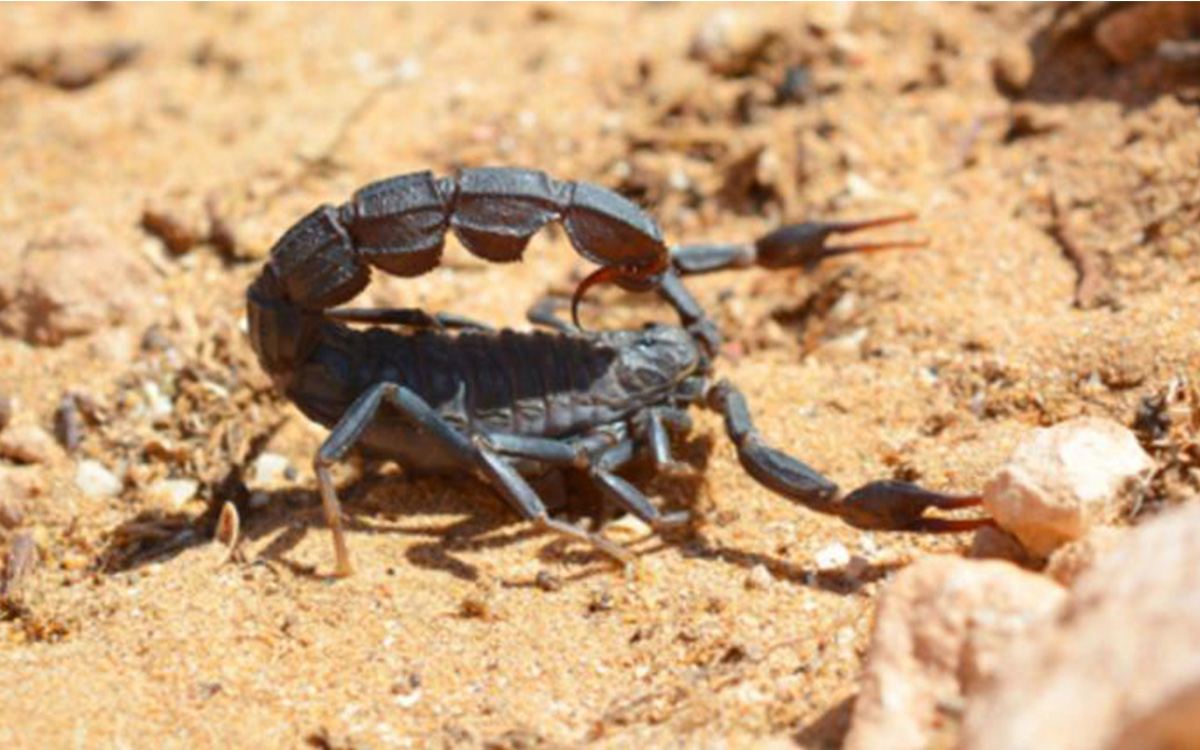
A Moroccan fattail scorpion is one of the deadly scorpions of North Africa. | Michel Dugon, University of Galway
While published statistics for stings in Morocco range from roughly 8,000 to 50,000 a year, Dugon says 25,000 to 30,000 people a year end up getting medical services due to stings, and anywhere from 50 to 100 victims may die in a year—most of them children. Many medically significant species have fairly restrictive distributions in areas where youngsters from rural backgrounds are susceptible to being stung. “The impact of scorpion stings is actually significant in those hot spots,” says Dugon. “And I hope that our results, in this context, will actually help the authorities to really see which areas require the most resources.”
For the study, Dugon’s team went out over a roughly four-year period and collected species from five regions in Morocco. Researchers donned boots and explored dunes, abandoned dwellings, coastal areas, steppes, and more to collect specimens. They used hooks to lift stones, check under bark, and rummage through litter. At night they brought ultraviolet lamps because scorpions glow under the light. Since they found six species less than five times, they added identifications from two databases with scorpion sightings. All told, they had 454 records of 19 species in different habitats.
Soil type was the biggest factor in determining distribution for 13 species. The next biggest factor was a temperature measurement. Scorpions are incredibly specialized for their environment. Some burrow and need soil that will hold its shape. Others live on sand that wouldn’t be good for burrowing, while others favor areas where they can hide under rocks.
Studies that produce data sets like these will become important as the climate changes from global warming. The distribution of scorpions around the world might shift. About 25 to 50 species are known to kill a person, says Lorenzo Prendini, the curator of arachnids and myriapods at the American Museum of Natural History, who was not involved with the study. But more than 2,800 species have been identified. “The vast majority have never been studied,” says Prendini, “and one of the important points is that many species are disappearing as a result of climate change and human habitat destruction, before we actually get to study their venoms.”
Prendini notes that scorpions are highly adapted to their surrounding soil. “You can basically look at a scorpion's legs and tell what kind of ground it lives on,” he says, “if it's on a rocky slope or lives on a sand dune or whatever.”
He adds that over time many scorpions become isolated in small habitats and can’t cross over to other areas, and that drives them to speciation. Populations diversify to match their individual environments.
“When we talk about habitats, we always think big areas that often apply to mammals or reptiles, right?” says Stephanie Loria, an arachnologist at the University of Central Oklahoma, who also wasn’t involved with the study. “But then when you look at small organisms like scorpions or even other arachnids, most of them are living in small, little, tiny, micro habitats within a habitat itself, and they all have these very specific preferences that they require.”
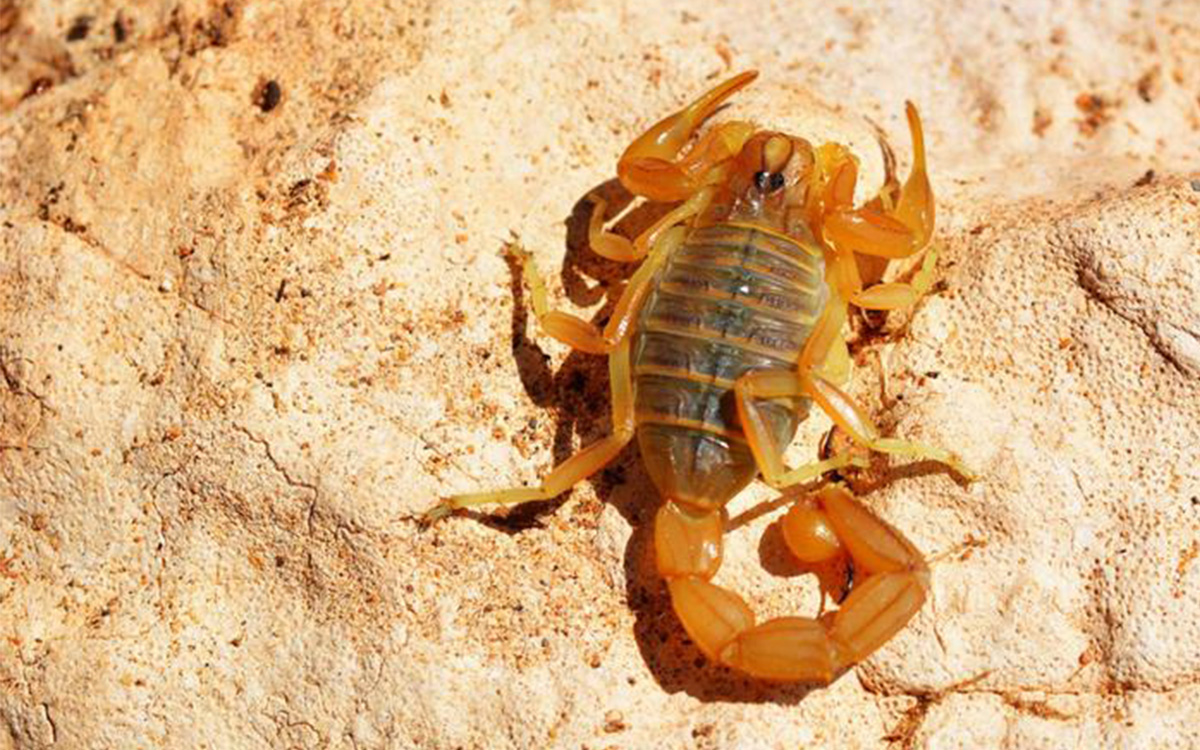
A golden Moroccan scorpion (Buthus sp.) rests on a rock. | Photo courtesy of Michel Dugon, University of Galway
Knowing what species live where has significant implications for public health. “If a dangerous species, like some of the Androctonus, are actually present in very small areas, well then why would you disperse all of your resources in order to help people that are stung throughout the country,” says Dugon. “when actually the species is only present in a very small part of the country.”
A yellow scorpion may look like a different yellow species that lives somewhere else. And a black scorpion may look like a different black species that lives in another area. Expecting members of the public, or even health professionals, to be able to identify each species is unrealistic, so having maps of the species distribution could help with diagnoses, treatment, and allocation of resources.
Prendini does note weaknesses with the study. For example, some of the data incorporated into the model doesn’t have a high level of resolution, meaning it might cover too large of an area. The authors do note that future studies would benefit from smaller scale data. Another issue, says Prendini, is that a scorpion specialist or arachnologist wasn’t an author on the study, and that may have led to errors in identifying species.
Dugon, a zoologist, says that’s a fair concern, but also that his team took great care in identifying the species they found in the wild. One of the reasons the sampling effort took almost four years was so his team could build their expertise, by reviewing literature that spanned more than a century and analyzing dozens of species.
Prendini was involved in a study in Iran—similar to Dugon’s—that put a species that lived near the Strait of Hormuz erroneously near the Caspian Sea, where it didn’t live. “I look at these kind of studies in general with a healthy degree of skepticism, frankly, about what they can tell,” he says.
But while there are caveats, Prendini says such types of studies still have value. “I think they are helpful,” he notes, “and you can definitely see they are pulling out some broad trends here that I think do make sense.”
Loria says the study was a good exploratory way to use the modeling tool, especially since the authors mentioned potential problems. Ultimately, the authors note, the model just predicts whether the habitat is suitable for the scorpions, not whether the creatures actually live in the places identified. The researchers write that what they have created is a foundational baseline, a first step in identifying the distribution of scorpions in the region. An important next step, says Dugon, is to double-check the paper’s results in the field.
He is also working to identify aspects of the venom that will help health professionals identify and treat stings. “Can we find the markers?” he says. “So in people that get stung by those scorpions, we know which species stung them, because a lot of them are children, and sometimes they are not even verbal.”
Loria, who studies scorpion biogeography, notes that fossils of these arachnids can be found roughly 440 million years ago, before the supercontinent Pangea formed and then broke apart. Just like many other arachnids, past scorpions likely had very specific microhabitat preferences, and probably weren’t good dispersers, with many species only moving when the continents began to separate. So their diversification is tied to geologic history. And by knowing where scorpion fossils exist and better understanding the relationships among scorpions living today, scientists can reconstruct how continents broke apart and drifted millions of years ago.
“They’re time machines, taking us back into the past and telling us what happened,” she says. “We can use them in that sense to understand the history of the Earth.”