What Drives People to Pursue Creatures That Slither and Slide?
One herpetologist embarks on a journey to find out why people are drawn to reptiles and amphibians
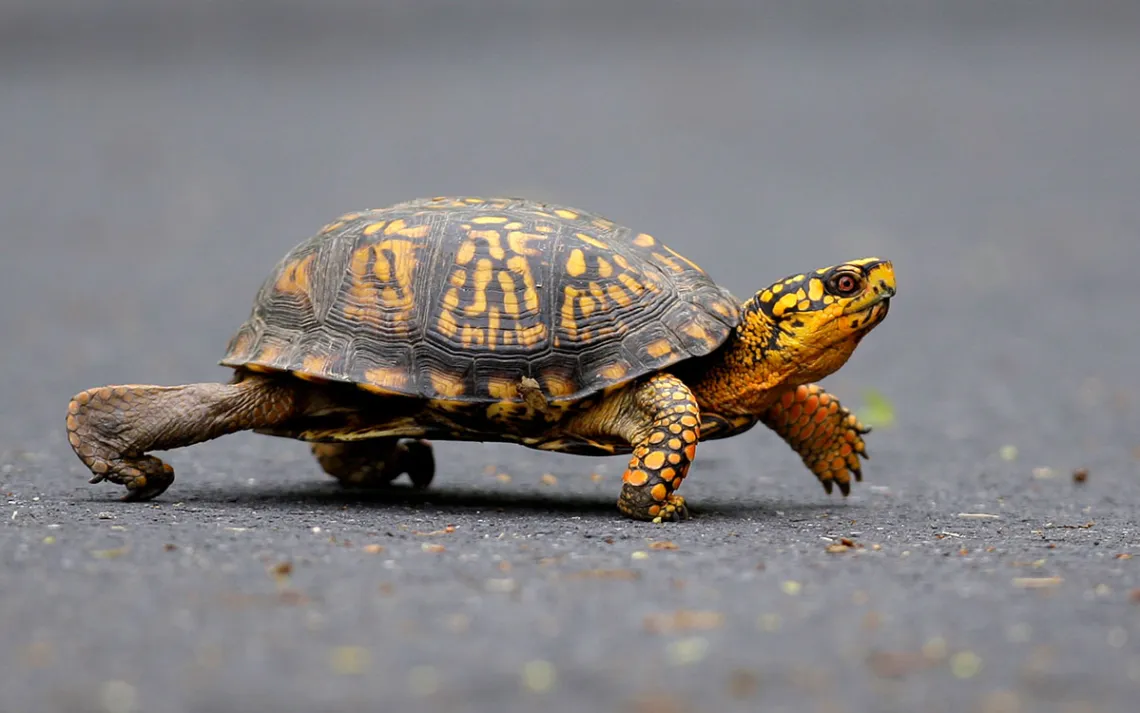
A male eastern box turtle moves across a path at Wildwood Lake Sanctuary in Pennsylvania. | Photo by Carolyn Kaster/AP File
While substitute teaching a few years ago in suburban Boston, I introduced myself to a class of tenth-grade boys. I told them I was a biologist and that my primary area of interest was the study of reptiles and amphibians. "Few things in life give me greater pleasure than flipping over a log or a rock and finding a snake underneath it," I told my teenage charges. "Really?" one student responded, in a Mr.-Lyman-needs to-get-out-more kind of tone. I laughed and said, “Yes, really.”
My interest in herpetology began as a young boy, when I spent long summer days exploring woods and creeks, searching for reptiles and amphibians—what we in the business call “herping.” That interest persisted into adulthood.
When I tell people I like to go herping, often traveling far from my home in Massachusetts to states including Virginia, Louisiana, and California, they usually ask why. I’m often at a loss for a coherent response, saying it’s something I’ve been interested in since I was a kid, and that I’m a biologist, and those are the kinds of things biologists do.
In search of a better answer, I began to wonder, “Why do herpers—people who have an interest in reptiles and amphibians—herp?” What compels us to hike for miles through woods and fields, flipping over logs, rocks, and boards, hoping to find a snake, lizard, or salamander? Or to drive along backcountry roads for hours late at night, hoping to see a snake or a frog in our headlights?
Personally, going herping and finding just about any kind of herptile gives me great excitement and pleasure—the way birders get excited about bird watching—especially if it's a species I've never seen in the wild before. But to understand the full range of reasons for why people enjoy herping, I decided to ask a few professional herpetologists what drives their interest.
Whit Gibbons, professor emeritus of ecology at University of Georgia, said that like many youngsters, he was enthralled by wild animals, especially snakes, turtles, and salamanders.
“I fortunately grew up in a family that tolerated and even encouraged me to keep an interest in all wildlife and allowed me to keep reptiles and amphibians for pets,” Gibbons said. “I continue to go herping, alone or preferably with others, because reptiles and amphibians still hold an overwhelming attraction for me.”
Herpers aren't usually content with just viewing reptiles and amphibians from a distance, the way birders watch birds. They often try to catch reptiles and amphibians to identify the species, photograph them, or move them out of harm’s way if they’re crossing a road, for instance. We tend to carry dip nets, lizard nooses, and snake tongs, instead of binoculars. Catching and handling herps seems ingrained in herping culture. Why is that?
“I do not think the drive to capture reptiles and amphibians and get a close-up view is any different than that for other animals,” Gibbons said. “Some of them are just easier to catch and handle.”
Bryan Windmiller, a herpetologist and conservation biologist with the Field Conservation Department at Zoo New England in Boston, echoed Gibbons’s feelings, saying, “I think … the biggest reason that herpers are more likely to feel the need to catch and pick up their quarry than say ornithologists or mammologists [is that] most herps are much slower than we are, and are thus fairly catchable.”
Windmiller added that he thinks catching and holding reptiles and amphibians is very atavistic. “It lets we herpers, or maybe fairer, it lets me personally, feel the excitement of hunting and to connect with the boyhood passion of chasing and catching things in a very direct way, but in a way that usually does the quarry no lasting damage.”
But Windmiller said that as he’s gotten older, his attitude about catching and handling herps has changed somewhat. “As I've aged, I've managed to get to a place where I am much more likely to resist instantly jumping on every poor snake and lizard that I see, which I'm sure the snakes and lizards appreciate.”
Mike Jones, state herpetologist at the Massachusetts Division of Fisheries and Wildlife, said it’s important to consider some of the ethical and legal considerations regarding herping.
“There are many naturalists in Massachusetts who observe amphibians and reptiles without capturing or handling them,” Jones said. “With the appropriate equipment (binoculars or long lenses), you can observe many species of reptiles, in particular, without disturbing them, or changing their behavior, or altering their habitats. Capturing and handling a reptile or amphibian elevates its stress levels and changes their natural behavior and can increase their risk from pathogens.”
Jones added that 15 of the native amphibians and reptiles in Massachusetts are protected under the Massachusetts Endangered Species Act and are generally protected from unnecessary handling.
Laura Kojima, a PhD student in ecology at UC Davis, said her interest in herpetology started at a young age from what she calls a brief “dragon phase”, when she thought dragons were real.
“I was thoroughly convinced that the bearded dragon must be a distant relative of actual dragons. I managed to convince my mom to let me have one as a pet, and the love for these critters never went away.”
Kojima said that when she first started out doing herpetological research as an undergraduate, she had friends who introduced her to ethical herping. And when she partakes in opportunities to teach, she passes that philosophy on.
“I am a firm believer in training the future generation of herpers to practices in ethical herping behavior,” said Kojima, “which includes disinfecting gear, respecting habitat and not flipping every cover object, having clean hands to reduce disease spread, and if handling an animal, to recognize potential signs of stress and to not handle in general for more than a couple of minutes.”
Some herpers feel that catching and handling herps, especially at a young age, can be the spark that creates a lifelong interest in herpetology, biology, and nature in general.
“My first live herps were a Texas horned lizard and a three-toed box turtle, encountered with my East Texas grandpa when I was about six or seven,” said Harry Greene, professor emeritus of ecology and evolutionary biology at Cornell University and adjunct professor of integrative biology at the University of Texas at Austin. “It was seemingly love at first sight.”
Greene, who pursued an academic career in herpetology, said he’s pretty much always herping whenever he’s outdoors, even in his urban Austin neighborhood, inspired ultimately by curiosity.
“To some extent, the attraction seems intellectually inexplicable, which is fine with me,” Greene said. “But I suspect that their [herps’] general lack of external indicators of subtle emotional states (like lips, eyelids in some) and that they generally don’t communicate audibly, adds to the allure.”
Greene has mixed feelings about the issue of catching and handling herps.
“Certainly, handling can be significantly negative for some herps, such as when it causes a desert tortoise to empty its bladder, or when a manhandled snake fractures bones struggling,” Greene stated. “On the other hand, I’m not convinced some kinds of careful direct examination can’t have minimal impacts, and if so, shouldn’t they be evaluated in terms of positives, as in terms inspiring appreciation and conservation of herps?”
Asked if he thought he would have developed an interest in herpetology if he had been discouraged from catching or handling reptiles and amphibians, Greene said, “The truth is, I am sure that being actually able to hold that first box turtle lit a spark in me that simply watching it through binoculars would not have done—and mind you, now I rarely catch animals of any sort, preferring to simply observe them.”
Greene also wondered how the costs and benefits to herps of handling them stack up against other threats to their well-being, as species and as individuals. “Those other threats, especially climate change and habitat destruction, seem likely to be devastatingly huge by comparison.”