The Pending Extinction of the Northern Spotted Owl
These are the researchers dedicating their careers to protecting the bird
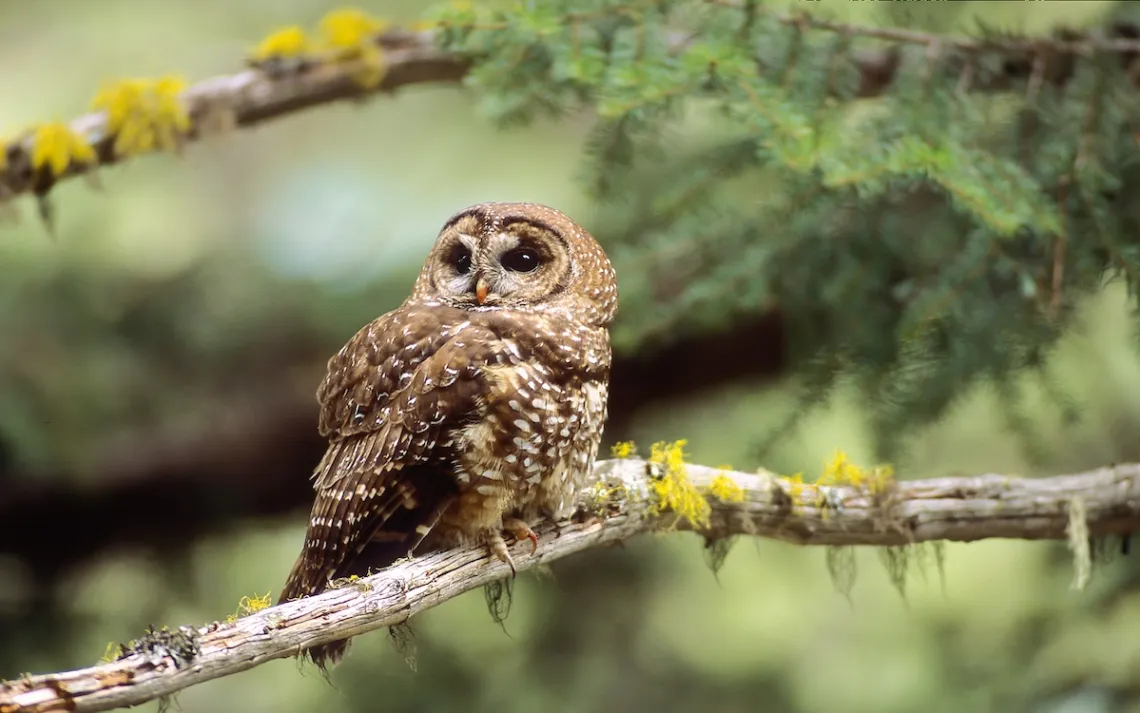
All Photos by Jared Hobbs
One night, on his family farm in Mount Lehman, British Columbia, Delbert Ryder heard something call from the red cedars, hemlocks, and firs growing between his bedroom window and the Fraser River.
This was an owl, certainly, but neither the great horned nor western screech sounded anything like this. Hooting as if through a kazoo, muffled and urgent, it sounded like the distant barking of a dog, and as Ryder listened, the bark was returned, one mysterious owl responding to another in the black beneath the red cedars.
“During the night, I heard some calls coming from the big old-growth woodlands,” he wrote on March 8, 1903. “Sounded like that of an owl or two. What we have is likely a pair of Spotted owls.”
This is the earliest written record of the species in British Columbia, an educated guess that Ryder confirmed a few days later, with field trips among the monoliths, old-growth forest, fast becoming rare in the Lower Fraser River Valley. He’d end up following these owls for years, climbing trees and taking notes, and would soon discover other pairs entirely, missing many a night’s sleep.
“Calling went on until it started to get light out,” he wrote on March 21, 1903, “then all was silent in the woodlands.”
One hundred and twenty-two years later, and only a couple kilometers west, Jasmine McCulligh was on another farm south of the Fraser River. Like Ryder, she was listening to spotted owls, albeit via heart monitor. Like Ryder, she wasn’t sleeping much, though naps on the floor were by no means uncommon. Unlike Ryder, she was covered in blood.
Since 2013, McCulligh has served with the Northern Spotted Owl Breeding Program, a provincially funded initiative from its outset in 2007. First an intern, now facility coordinator, she’s doing whatever it takes to turn a dozen spotted owls into several dozen. On April 21, 2025, one of these owls was trying to hatch in spite of a wicked blood clot. It took entire days, but they got him out alive, pale and weak and in sore need of a good meal.
“It was a bloody mess,” said McCulligh. “This chick definitely wouldn’t have survived in the nest.”
What a difference a century will make. In Ryder’s time, any farm boy in the British Columbia’s extreme southwest could, with a little luck, waltz into neighboring woodlands and call out a couple spotted owls. In McCulligh’s time, this could only be done on a single farm in all the province, the semi-forest acreage supporting the Northern Spotted Owl Breeding Program near Fort Langley.
Outside the program's cages, no spotted owls are left in British Columbia.
Timber
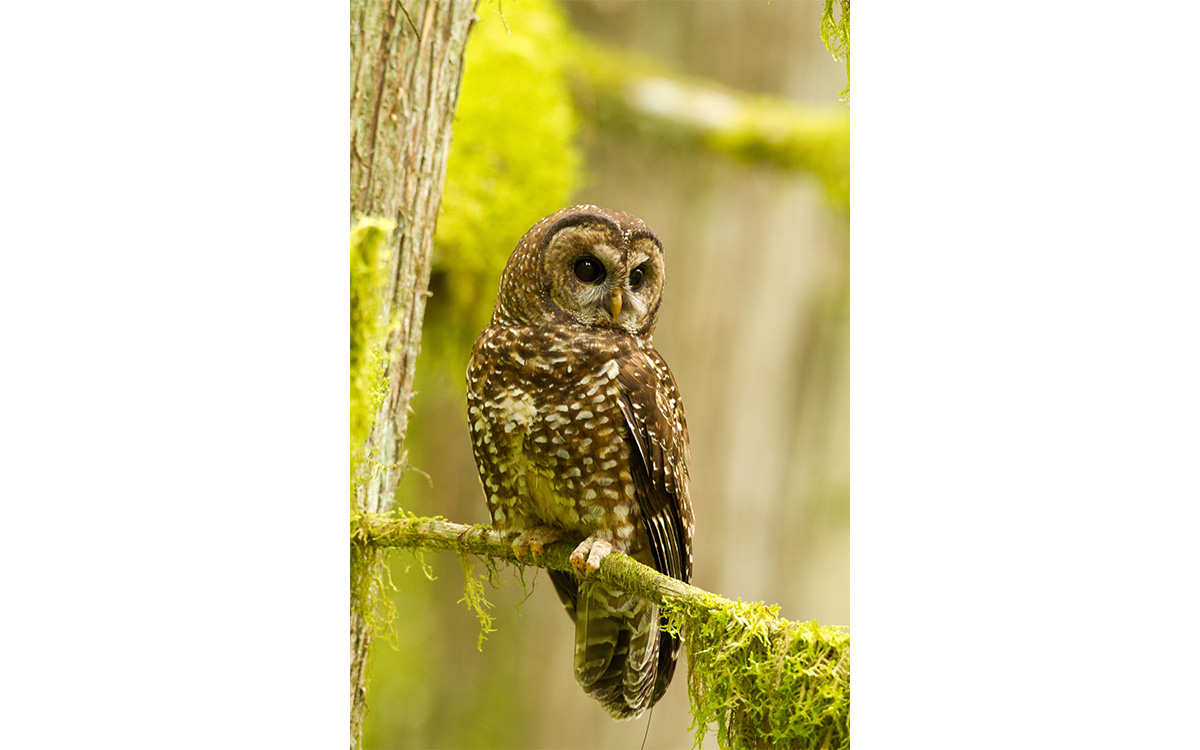
It was logging that did it, the progressive fragmentation of those “big old-growth woodlands” on which the northern spotted owl wholly depends. The scattered second growth replacing it was too dense for them to navigate, too poor in their preferred prey (Neotoma cinerea), and honeycombed with cut blocks for their young to safely disperse.
The province set aside habitat—almost 400,000 hectares specially for management of the northern spotted owl—but as critics point out, half this territory was inside preexisting provincial parks at the time of their “protection,” and of the remaining half, most had already been logged. Even where genuine old growth was newly managed for spotted owls, some form of logging was often still permitted.
“If we had actually protected hundreds of thousands of hectares of old growth,” said species-at-risk biologist Jared Hobbs, “we would have had a fighting chance.”
Hobbs began work with spotted owls in the mid-1990s, at which point they were known at 40 sites in British Columbia. He was employed by the province then, surveying viable habitat as it was slowly disassembled by the logging industry, and forming bonds with individual owls in Boulder, Copper, Enterprise, and Sockeye Creeks in particular, among the coastal mountains north and east of Whistler.
The one at Boulder Creek stands out in his memory, a kind and playful juvenile who would soar overhead and gently brush his hair with its tail feathers. One time, this affable owl even perched on a log right next to Hobbs, saddling up to him with an excess of interspecies trust.
“It was incredible,” said Hobbs, “and I think it got that owl killed.”
A local logger, resenting any effort to protect spotted owl habitat—and Hobbs was doing exactly that—found this juvenile, shot it, dismantled the corpse, and laid out the remains near Hobbs’s car. The car itself was keyed and the tires slashed.
Hobbs was establishing Wildlife Habitat Areas (WHAs)—the best protection mechanism on hand—for what nests he could find, but rarely were they large enough to accommodate the sprawling home ranges of the northern spotted owl (often exceeding 3,000 hectares), and rarer still did they encompass enough surrounding habitat for these owls to multiply and spread.
“I couldn’t do enough, soon enough, fast enough,” he said. “You invest every waking minute, seven months of the year for 10 years, looking for habitat for this owl, and you’re watching logging trucks drive by on their way to the mill with owl habitat on their backs. It’s so depressing.”
After 15 years leading northern spotted owl surveys in British Columbia, establishing a few thousand WHAs, and serving on the Spotted Owl Habitat Management Team (provincial), Hobbs left government in 2013. At that time, the owls left in British Columbia could be counted on both hands. The last wild individual—a lone female—vanished in 2022.
Continuing his surveys as a private consultant, or else on his own time, Hobbs acted as scientific adviser to the Northern Spotted Owl Recovery Team (federal) in hopes of having spotted owl habitat recognized under federal law, specifically the Species at Risk Act (SARA). This was achieved in 2024, when 417,258 hectares of “critical habitat” were formally designated, though not much changed. SARA only protects critical habitat on federal land, and the overwhelming majority of the hectares identified are provincial.
“There are 500 cut blocks proposed in the critical habitat I fought for 20 years to get mapped for spotted owls,” said Hobbs. “They’re still logging it.”
Hoot de grâce
The last time wildlife biologist Eric Forsman found a spotted owl on Washington’s Olympic Peninsula—over a decade ago now—it absolutely would not hoot, nor would it respond to his hooting. It came, it saw, it left, all without a sound.
“That kind of behavior was really weird,” said Forsman, then with the US Forest Service, now retired.
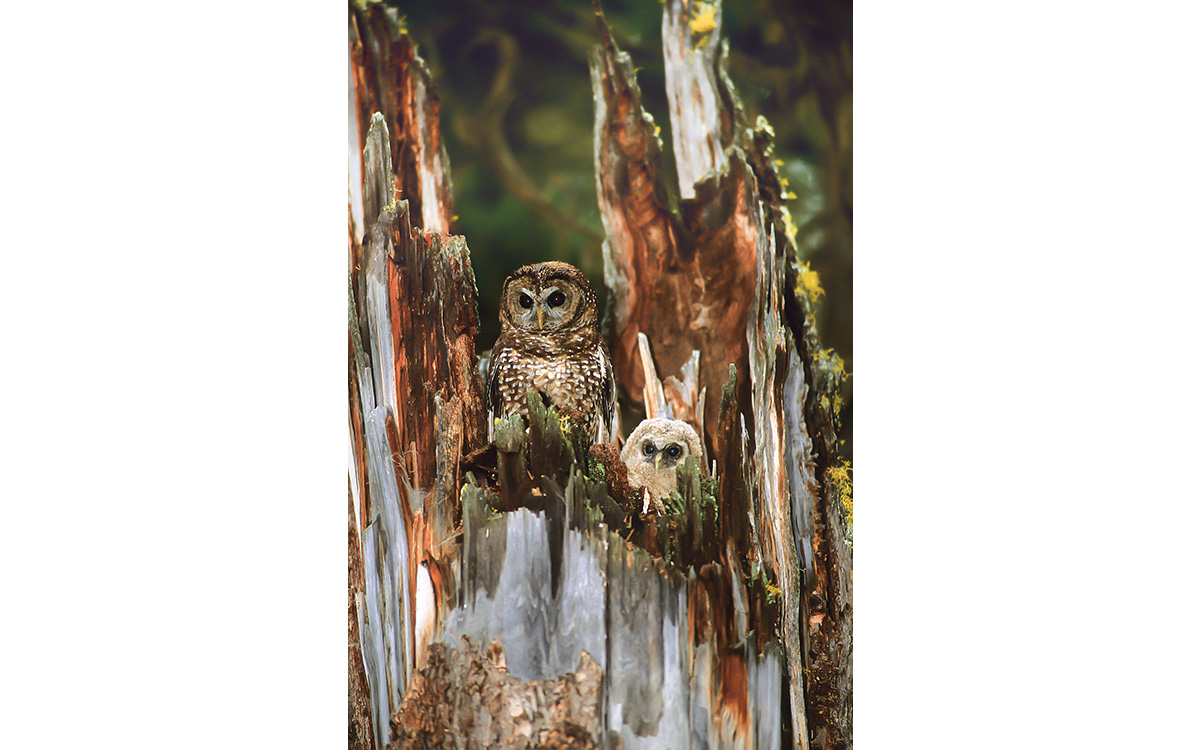
The spotted owl is a famously talkative creature. Even a poor imitation of its bark-like hoot is usually enough to call one out, but on that occasion, Forsman had been hooting for hours. Nothing, except for that one chance encounter, a result more of luck than labor. Nor was this an isolated case. Across the range of the northern spotted owl, they’ve simply ceased to hoot, to human beings or to each other, the result not of habitat loss, but of plain, pragmatic fear.
Barred owls are visually similar to spotted owls, except they’re bigger. They’re also more aggressive, require smaller home ranges, and eat pretty much anything that moves. In a word, they’re more flexible, comfortable in the fragmented forests of the Pacific Northwest and perfectly competitive in unfragmented ones.
Barred owls are native to the woodlands of eastern North America, but have, for reasons not well understood, leapt over the Great Plains to colonize the Pacific Northwest. They were first detected in British Columbia in the 1940s, and now, with very few exceptions, occupy the entire range of the northern spotted owl, from British Columbia to California. In their presence, spotted owls have learned not to hoot, lest they be detected and killed.
“The only way a spotted owl can hold its territory is to vocalize, to announce to other birds, 'Here I am!'" said Forsman. “If they’re intimidated to the point that they can’t do that, they might as well be dead.”
It was Forsman’s pioneering research into the northern spotted owl in the 1970s, '80s, and '90s that first established its utter dependence on the old-growth forests of the Pacific Northwest, and which first sparked controversies between this affable owl and the logging industry. It began with an energetic young researcher, essaying the lives of entirely unknown owls, and ended with the 1994 Northwest Forest Plan, conserving several million hectares of old-growth forest across Washington, Oregon, and Northern California on behalf of that same owl—a kind of thing unimaginable in the current political climate of the United States, and far beyond anything attempted in British Columbia.
“It protected some fairly extensive areas of old-growth forest,” said Forsman, “and all of us who were involved in that effort expected the spotted owl to do pretty well in those forests.”
And they did, for a while, surviving in satisfactory numbers after those of British Columbia began their nosedive, but with the arrival of the barred owl after about 2000, even these strongholds began to crumble. Spotted owls have been completely displaced in most of the habitats protected on their behalf, said Forsman, and the conquering barred owls are so ubiquitous that efforts to control them can only buy time, except, maybe, in parts of California.
“I think the northern spotted owl is on its way to extinction,” he said. “It’s nearly there.”
Brave young men
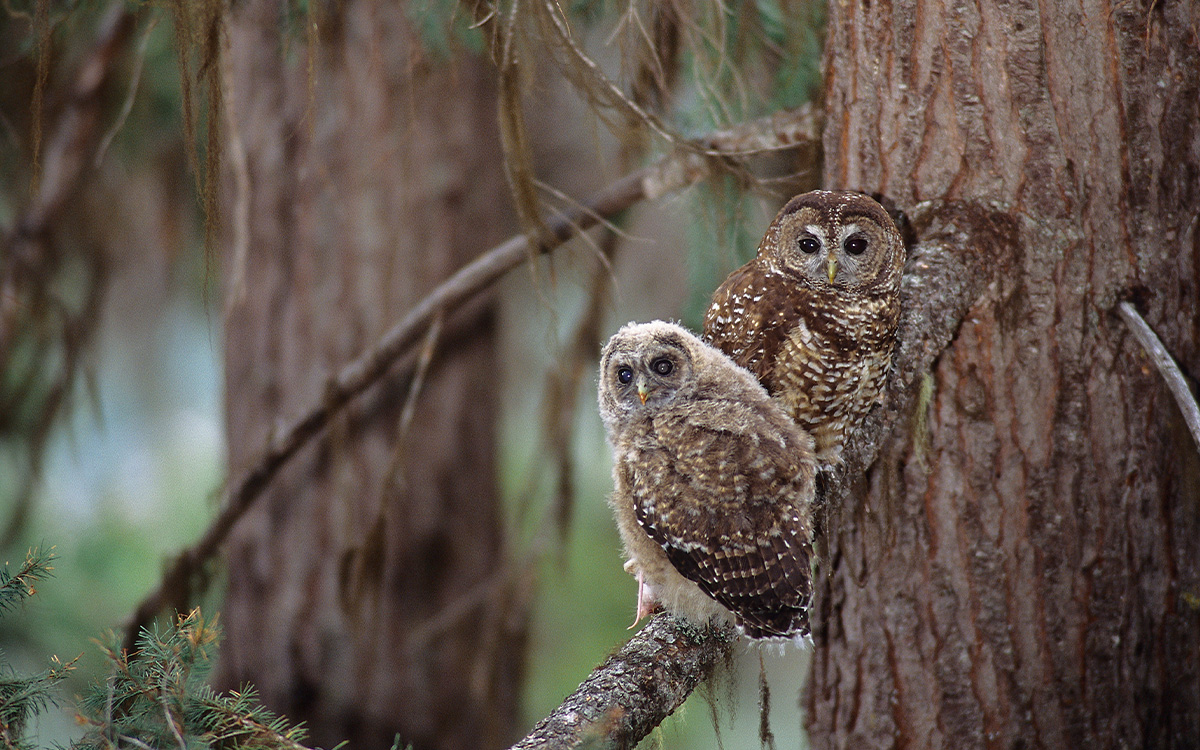
Spotted owls mate for life, which is probably why they’re so damn choosy. Females are difficult to impress, said Jasmine McCulligh, so much of her work goes into matchmaking. Once two are chosen to become a pair—genes have the final say—they’re placed in adjacent enclosures, between which a tunnel is eventually opened.
Every trick is employed to make the magic happen. Owls receive fertility supplements to boost libidos. Most food is given to the male, so he can share with the female to gain her favor. Enclosure sizes are reduced over time, bringing potential pairs into closer and closer proximity. They’re even introduced to each other for the first time each year—no kidding—on Valentine’s Day.
When pairs are eventually mated, and eggs are lain (two per clutch), these eggs are stolen by staff, encouraging the owls to lay a second clutch that same year, “double clutching,” a survival strategy compensating for eggs lost to predators. Instead of two eggs per pair, the program gets four.
“We need to manipulate nature as much as we can,” said McCulligh.
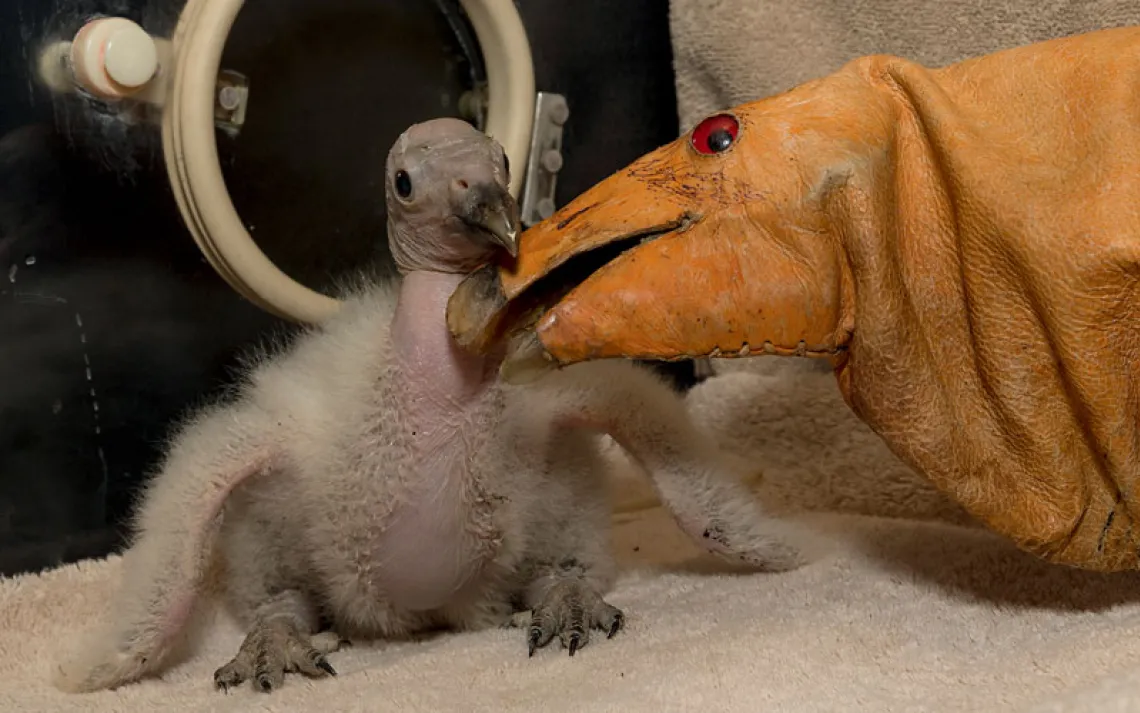
The eggs themselves don’t stay with the adults, some of whom are keen and responsible parents, some of whom are not. Instead the eggs are artificially incubated in a dedicated facility, where they receive constant care, and where emergencies like the blood clot of April 21 can be tackled with the full force of veterinary medicine.
“We’re working with an endangered species,” said McCulligh. “Every egg is super valuable.”
As captive breeding programs go, this one is fairly young and only began releasing owls in 2022 in the traditional territories of the Spô’zêm First Nation, in the Fraser Canyon upstream of Delbert Ryder’s family farm. The breeding program, with more surviving males than females, has only released males so far, four years in a row. Brave young men, all of whom died in their first winter, or else returned to captivity following serious injury.
“This isn’t going to be solved in a generation,” said McCulligh.
Jared Hobbs agrees that the northern spotted owl won’t recover without a captive breeding program, but, he said, such programs must go hand-in-hand with forestry reform and widespread habitat protection, neither of which has happened. Without these things, Hobbs believes the program cannot succeed in reestablishing the northern spotted owl in British Columbia, and it was unethical, he said, to cage some of the province’s last remaining wild individuals back in 2007 for a program so structured. This task—the trapping of owls for the breeding program—was initially assigned to him in 2006, but he refused.
“They have not addressed forestry,” said Hobbs. “They have not reversed the decline of available habitat. In fact, they’re accelerating it. That’s my problem with the captive breeding program.”
Complicating this narrative is the barred owl. Hobbs expects that, had the old-growth forests of the Pacific Northwest not been so degraded, the spotted owl might have kept the barred owl at bay, holding intact habitats as only native species can. Forsman, though, convinced by the wholesale displacement of spotted owls from unfragmented forests in the United States, expects the arrival of barred owls would have been calamitous either way. The man who put spotted owls on the map is beginning, reluctantly, to look beyond them.
“I don’t think there’s much we can do,” said Forsman, “but the whole debate over spotted owls was never really about spotted owls. They were used as a weapon to force agencies to change, but the debate was really about forests and how we manage them. It was about tree voles and flying squirrels, and everything else out there. I think we need to focus on the big picture. We’ve got these forests, and we need to manage them to maintain as much biodiversity as we can.”