How to Train Your Condor
A bird-loving boy went from picking up trash at a zoo to saving endangered California condors

A puppet helps parent a condor chick at the San Diego Zoo Safari Park’s “condorminium.” | Photo courtesy of San Diego Zoo Wildlife Alliance
Bill Toone's love for birds began when he was just six years old. His parents took him to the San Diego Zoo and could not pull him away from a hen that was clucking and puffing up her feathers to protect her chicks. The zoo’s bird keeper, also called a curator, gave him a box of Silkie bantams—small, fluffy chicks—to take home. When he was eight, Toone applied for a job as a curator at the zoo.
“Needless to say, they did not hire me,” he said.
As Toone grew up, his enthusiasm for birds turned into a passion for protecting them. At 16, he got a job picking up litter at the zoo’s new Safari Park. “I was the best trash picker you’d ever run into,” he said. He worked his way up to driving the park’s tram and later helped care for animals.
Twenty-five years after he received those bantam chicks, Toone became the zoo’s bird curator. Throughout his career, he has played a major part in saving endangered condors from extinction.
California condors are massive birds. Their wingspan can reach nearly 10 feet—the height of a basketball hoop. They have scarlet-red eyes, bare heads, and piercing beaks. Below their fleshy necks, their frilly plumage is all askew, like a black feather boa.
Condors have a funny habit of vomiting when they are nervous. And unlike mammals that sweat or pant to stay cool, these birds chill out by peeing acid on their legs.
Most people never forget the experience of seeing a condor in the wild. But it’s a rare sight. Condor populations declined rapidly in the 1900s, largely because people shot the birds. They became one of the first animals protected under the Endangered Species Preservation Act of 1966. Even after that, condors continued to die. Scientists discovered that it was largely because human activities were harming the birds’ habitat and what they ate. For example, when condors feed on animals shot by hunters, they can swallow bullet fragments and die from lead poisoning. By the early 1980s, only 22 condors remained.
During a break from his work at the zoo, Toone was studying the reproductive behavior of birds when he learned about the plight of the California condor. He wanted to do something about it. For months, Toone hiked through the Southern California wilderness, looking for condors. He didn’t see one bird.
Then one day, climbing a mountainside, he saw a shadow. A condor glided above. Cocking its head, the bird checked him out, then soared upward and disappeared. Toone was moved. He understood why the native Californian Chumash believe their spirits are carried to the Sky People on the wings of a condor.
Back at the zoo, Toone, who has a way with words, often spoke publicly about the need to protect the birds. “He was able to talk to people and make them realize this has to be done,” said Don Sterner, a zoo animal caregiver. “There won’t be any condors left if people don’t do something.”
Toone and a team started working on a captive-breeding program to boost bird populations. Condors usually mate for life, and females lay just one egg every other year. If her egg is taken or fails to hatch, though, she will sometimes lay another one. The team decided to use this to the condors’ advantage. They carefully removed some of the eggs laid by condors in the wild and hatched them in incubators at the zoo. Their efforts paid off: Toone’s team was often able to quadruple the number of chicks produced by a breeding pair of condors.
But they had to overcome a challenge. Baby condors imprint on the first creature they see. If the chicks raised in captivity bonded with humans, they might not survive in the wild. The team needed a mama condor to sub in. Toone approached two sisters running a puppet theater nearby, who agreed to help. The women nailed it—they crafted a hand-painted leather condor puppet, red eyes and all.
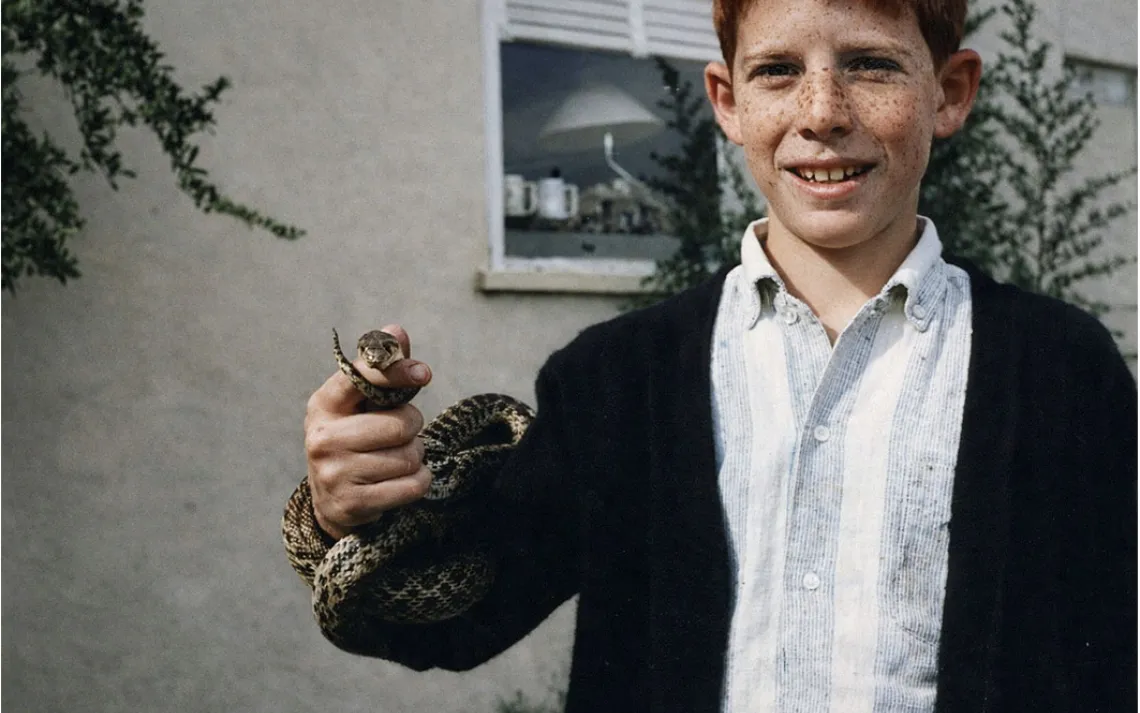
Bill Toone also loved snakes and lizards as a child.
Back at the “condorminium,” as they called it, the team got to work. When an egg hatched, Sterner used the puppet parent to interact with the fuzzball chick—using techniques he and Toone had developed. This was a tough job; they worked around-the-clock shifts for months. Slowly, the population of captive condors rose.
Thanks to Toone and others, the number of California condors continues to increase. Puppet designs have improved. Other zoos have gotten involved. Today, more than 350 condors fly free in California, Arizona, Utah, and Mexico. In 2022, Toone captured his story in the book On the Wings of the Condor.
Although condors still face a variety of threats, “The win is that we still have condors,” he said.
Bill Toone shows how anyone—even someone who started on trash duty—can make a difference. All it takes is persistence and a little bit of grit—and in his case, a love for the winged creatures among us.