 The Magazine of The Sierra Club
Why Is Canada on Fire, Really?
Trump and the Republican Party blame poor forest management. The science shows otherwise.
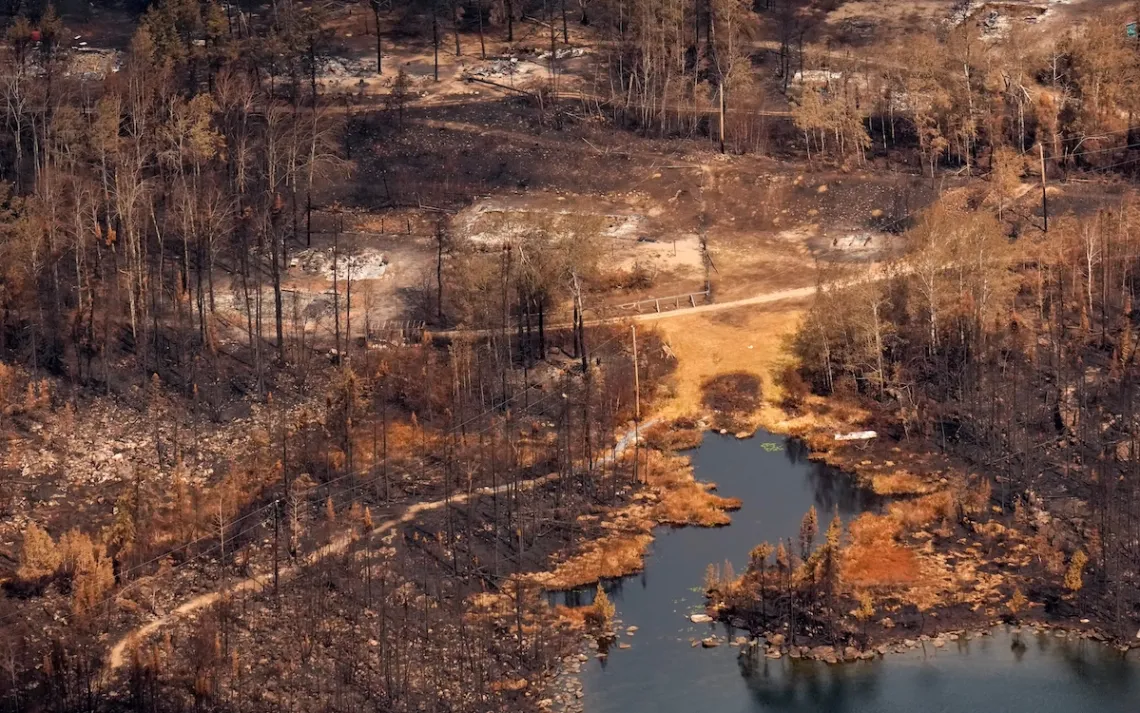
Wildfire damage in Collins First Nation, a small, remote Ojibwa community located in northwestern Ontario, on July 22. | Photo by Chris Young/The Canadian Press via AP
Canada is on fire, again. Flames are burning across the country. A record-breaking summer has set the province of Ontario in particular ablaze. In July, over 190 wildfires burned through 1.8 million acres of the province’s sub-arctic boreal forest, sending toxic smoke south for the third summer in a row.
As wildfire smoke blanketed parts of the Northeast and Midwest United States, Donald Trump and the Republican Party pointed fingers at Canada's leadership, claiming the country’s poor forest-fire management is worsening US air quality. The president chastened Canada for not “properly maintaining” its forests and brush and threatened retaliatory tariffs in response to “filthy, polluted, and unhealthy air.” Several other members of the Republican party—including Bernie Moreno, who has received $445,823 from the oil and gas industry since 2024—joined the blame game.
Over the years, Trump has often claimed that proper forest management involves raking or cleaning forest floors—a point of view that has been a head-scratcher for experts. In the case of Canada’s fires, what does the science actually show?
Climate change driven by fossil fuel emissions is creating hot, dry, and flammable conditions in a once-wet and sub-Arctic ecosystem. The Canadian boreal forest spans roughly 1.3 billion acres—about three times the size of Alaska—and is made up primarily of coniferous tree species like spruce, fir, pine, and tamarack. The majority of acreage is inaccessible by road, meaning it has never been logged, thinned, or suppressed from fire. In fact, only about one-fifth of Canada’s total burned area over the last 40 years has been managed at all.
While fire management in the boreal isn’t necessarily futile, mismanagement isn’t to blame for smoke drifting south, said Zeke Hausfather, a climate scientist and energy systems analyst at Berkeley Earth. “This idea that Canada should have been managing their forests better, and that it would have prevented these smoke incidents from happening is just misguided. There's no practical management strategy that could manage the boreal,” he said, referring to the sheer size of it.
Fire-management strategies like controlled burns and vegetation thinning can be effective for other forest ecologies, especially in the western states. California's ponderosa pine forests and the Southeast’s longleaf pine forests, for example, contain a wealth of fuel build-up on the forest floor after a century of forest mismanagement and fire suppression.
“A lot of what we think of as wildfire challenges in the US really has to do with western US forests,” said Hausfather.
Canada’s boreal forest is a completely different ecosystem. In its natural state, the boreal is boggy, wet, and frigid. But in recent years, climate change and rising temperatures have created drier conditions and prolonged periods of drought, which make the boreal more vulnerable to fire.
“The main change is longer seasons,” said Lee Frelich, the director of the University of Minnesota Center for Forest Ecology. “In other words, the warm season starts earlier and ends later, and that means there's more evaporation, so fuels are dry for longer periods of time.” Decades ago, snow used to last well into May, whereas now it often melts in late March or early April and falls again in mid-November instead of October.
Climate change has also led to more erratic precipitation patterns in the boreal, which means there are periods of heavy rain and extended drought, rather than more evenly distributed rainfall of the near-past, Frelich added.
“When you combine that with warmer springs, so the vegetation can start drying out sooner, and longer falls, so that there's more evaporation at the end of the season, you end up with some pretty extreme dry situations,” he said.
Dry conditions are more vulnerable to lightning, particularly in remote areas where human activity is minimal. Lightning is responsible for just under half of all wildfires in Canada and results in far larger spanning burns. About 81 percent of the total burned area in Canada is from lightning.
“When we do have these lightning-start fires in more remote areas, they have more time to start spreading before fire crews can get out there and start suppressing them,” said Adam Scott, a researcher at the Fire and Ecosystems Lab at Simon Fraser University. “And usually, when there's a lightning storm, you can have multiple strikes in one storm. The following day, once it gets to a peak drying period mid-afternoon, a bunch of fires will start at the same time.”
That’s exactly what happened this summer in northern Ontario. The region received less than 40 percent of normal precipitation and faced above-average temperatures, creating disastrously flammable conditions when lightning struck repeatedly in mid-July. The same phenomena occurred in 2025, which was one of Canada’s worst fire seasons on record, second only to 2023.
“If high-intensity fires continue to hit the boreal forest at shorter intervals, the entire makeup of the boreal is at risk,” Frelich said. “Those places on the landscape that happen to get hit by fires more often, the conifers are not old enough to be seed bearing at the time the second fire occurs.”
That means conifers will likely die out and be replaced by aspen, which spreads through root sprouts, and birch, whose seeds can travel long distances. If temperatures get even warmer over time, the southern part of the boreal could even be replaced by grasslands or deciduous trees like maple and oak. It would be a huge loss for biodiversity.
To protect the boreal as it is, a true, global commitment to emissions reductions is needed, Frelich said. “Switching to renewable energy and reducing emissions in combination could have a big impact on the future of the boreal forest, in terms of keeping it kind of similar to what it is now. But I wouldn't hold my breath waiting for that to happen because countries would have to cooperate with each other.”
Though the majority of the boreal’s forest fires are happening in remote, uninhabited areas, the flames have been catastrophic to a handful of nearby towns. More than 2,800 people were evacuated from more than a dozen communities, the majority of which were Indigenous. Namaygoosisagagun First Nation was entirely destroyed, with residents narrowly escaping the flames by boat. As of August 3, 1,800 remain displaced from their homes.
The tragedy highlights the need for better community preparedness and climate adaptation, Hausfather said. “Canada is not blameless here. They have not spent nearly as much as they should in protecting communities from wildfire risk.”
He pointed to a number of effective fire-management strategies that are crucial to protecting the few communities in Canada's boreal: controlled burns; thinning vegetation; creating a buffer zone between property and the surrounding wildland area; implementing vents and filters to prevent embers from getting into fences and houses. Other experts highlight better evacuation communication and building relationships between Indigenous communities and fire response teams.