Wildfires Have Lasting Psychological Effects on Farmworkers
Farmworking communities face a long struggle to overcome mental and emotional impacts
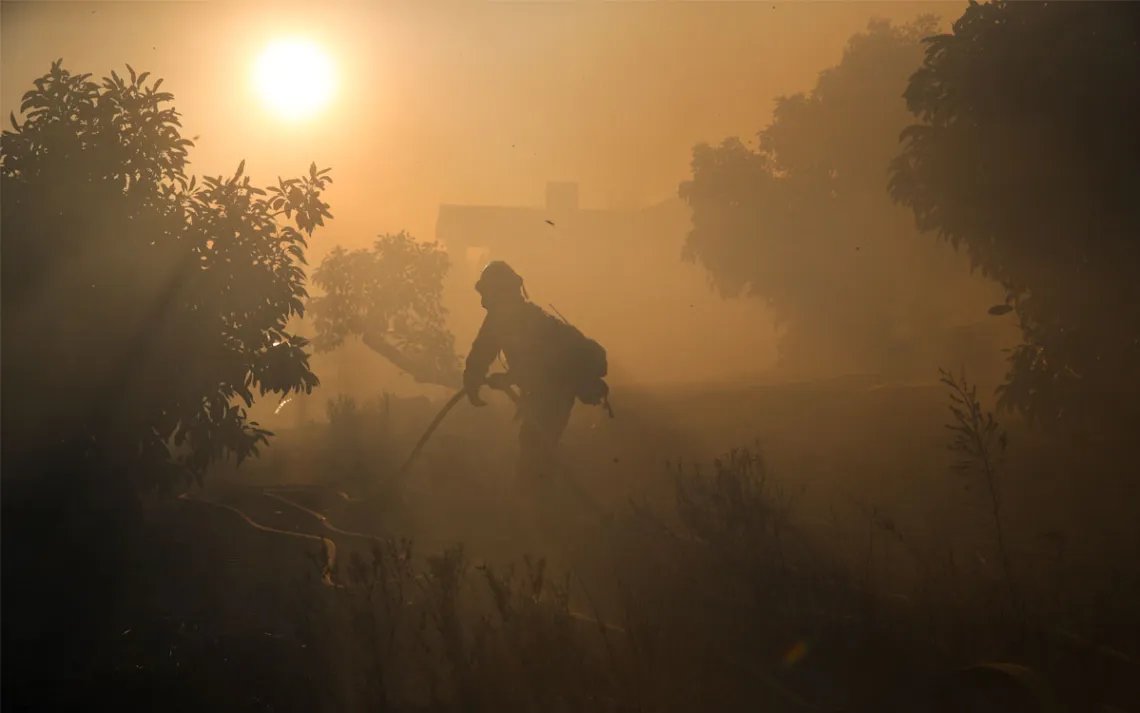
Photo courtesy of Jae C. Hong/AP Photo
When the massive Thomas wildfire hit Ventura County, California, Yuridiana Alvarado remembers feeling anxious and stressed. She worked on a berry farm when the December 2017 fire burned more than 200,000 acres.
“I was working in the field when the fire came, and we didn’t know we had to wear masks,” Alvarado said. “I remember ash falling on the fruits. . . . The fire was burning super red and . . . we had fear that the fire would reach us, and we didn’t know what was happening.”
Alvarado said many farmworkers didn’t know about the resources available to them to cope with wildfires. At the time, emergency warnings were available in Spanish and English, but many farmworkers speak Indigenous languages such as Mixtec, Zapotec, and Purepecha. Workers didn't have N95 masks to protect against wildfire smoke, and many, pressured by employers to save the harvest, continued working during the fire. People faced health issues such as respiratory illnesses and eye irritation from being exposed to smoke, said Alvarado.
Farmworkers—many of whom are undocumented immigrants—face disproportionate health concerns when confronted with wildfires. The outdoor nature of the work, coupled with a lack of safe working conditions, makes wildfires a significant health hazard for these communities. Even though the California Occupational Safety and Health Standards Board requires employers to provide N95 masks to outdoor workers when air quality exceeds unhealthy levels, researchers say this requirement is often not sufficiently enforced. In Sonoma County, farmworkers were issued temporary permits to enter mandatory evacuation zones during wildfire season so they could continue working in conditions deemed dangerous for the general population.
But health workers and community organizers say that, beyond how farmworkers are affected physically by wildfire, mental health concerns arising from wildfire smoke remain pervasive and unaddressed in farmworker communities. Wildfires are known as superspreader events when it comes to mental health, directly causing challenges that need psychological support and treatment.
Another member of Alvarado’s community, Amy Gomez, remembers how her family watered their roof to stop the fire from reaching their house, but the ash affected her lungs and gave her severe asthma. An ambulance took her to the emergency room because she was unable to breathe and had lost consciousness. A week later, her children also needed to go to the hospital.
“My children coughed and vomited pure ash. I have many emotions, and I cried. Will there be an end to this?” Gomez asked. “We are not educated in how to deal with these catastrophes. These were very difficult experiences for me.” Gomez is now a member of Líderes Campesinas, a nonprofit focused on improving the lives of farmworking communities.
A survey of farmworkers in California's Napa and Sonoma Counties reported the biggest effect of wildfires to be loss of income, followed by impacts on mental and emotional health. Recent research finds that exposure to particulate matter (PM2.5)—specifically from wildfire smoke—can trigger depression, anxiety, and other mental disorders. In 2020, scientists studied more than 80,000 emergency room visits for mental health issues during the California wildfire season to understand the effects of PM2.5. In six months, from July to December 2020, wildfire smoke was associated with increased visits to the emergency room for mental health conditions.
The study found racial disparities in how wildfire smoke affects communities. According to their research, Latino people were at increased risk for emergency visits for depression, a vulnerability exacerbated by wildfire smoke. Meanwhile, Black patients showed a higher risk of going to the emergency room for other mood disorders.
The relationship with fire is at an unconscious level, said Ruth Zúñiga, a licensed psychologist who specializes in working with the Latino community and farmworkers. For people who work in the field and are surrounded by smoke for days, it’s difficult not to worry due to recurring thoughts, memories, fear, and nightmares related to wildfires.
“When it gets very hot, the community gets hyper-activated and is constantly looking to see if there is smoke, if there is any indication that a wildfire can happen. We see it in mothers; we see it in children,” Zúñiga said. “[Some] farmworkers might not talk about it, but I see it in the sense of overwhelm that people have.”
The level of anxiety is heightened for the entire community, not only the individuals affected by wildfires. But for communities that have multiple stressors—including the threat of deportation and the pressure of losing income—seeking mental health support during or after a disaster often takes a back seat. Scholars argue that farmworkers are “invisible”—an afterthought both in terms of receiving evacuation information and disaster aid. There are about 2.9 million agricultural workers in the United States, and more than 65 percent were born outside the US and are Latino. Recent immigration raids have led farmworkers to feel like they’re “hunted like animals,” reported The Guardian.
Behavioral health experts say that farmworkers experience anxiety during climate-induced disasters because of their connection to the land and the harvest. During wildfires, the loss of crops and their livelihoods can cause significant stress, anxiety, and depression. Preexisting mental illnesses can heighten the risk from wildfires; this is coupled with structural inequities such as constantly having to move for work, inadequate housing, being socially isolated, and working in unsafe conditions.
“Wildfire cannot be separated from discrimination, oppression, and experiences of not being valued,” said Zúñiga.
Farmworkers face significant barriers in accessing medical or psychological treatment. Most lack health insurance, and there exists a cultural stigma in seeking support for mental health. The Federal Emergency Management Agency excludes undocumented immigrants from receiving disaster aid—and the agency itself is facing extensive cuts to its programs and staff under the Trump administration. Many farmworkers do not have the privilege to pay attention to how mental health conditions might be affecting their lives, and primary breadwinners continue working until their bodies or relationships break down, said Zúñiga.
Researchers and health specialists argue that local, on-the-ground organizations with existing and trusted relationships with farmworkers tend to be more equipped than federal officials to respond to the needs of farmworking communities. Líderes Campesinas, for example, started using a farmworker-led emergency system in Ventura County that sends out audio and text-based alerts in Spanish, Mixtec, and Zapotec. The notifications inform farmworkers about air quality, fires, heat waves, and strong winds.
Zúñiga suggests that community health workers who go to the community, rather than expecting people to come seek care, are effective bridges that support the first step to recovery. But the focus should also be on how resilient farmworking communities can be, given how people come from cultures that have survived years of colonization.
“The strength is in [their] roots with culture, with community, with spirituality, and that [they] do all of this for our future generations,” Zúñiga said. “Look at how beautiful and powerful that is.”