Yellowstone in Winter
Guided cross-country skiing from a cozy base camp offers rare wilderness immersion
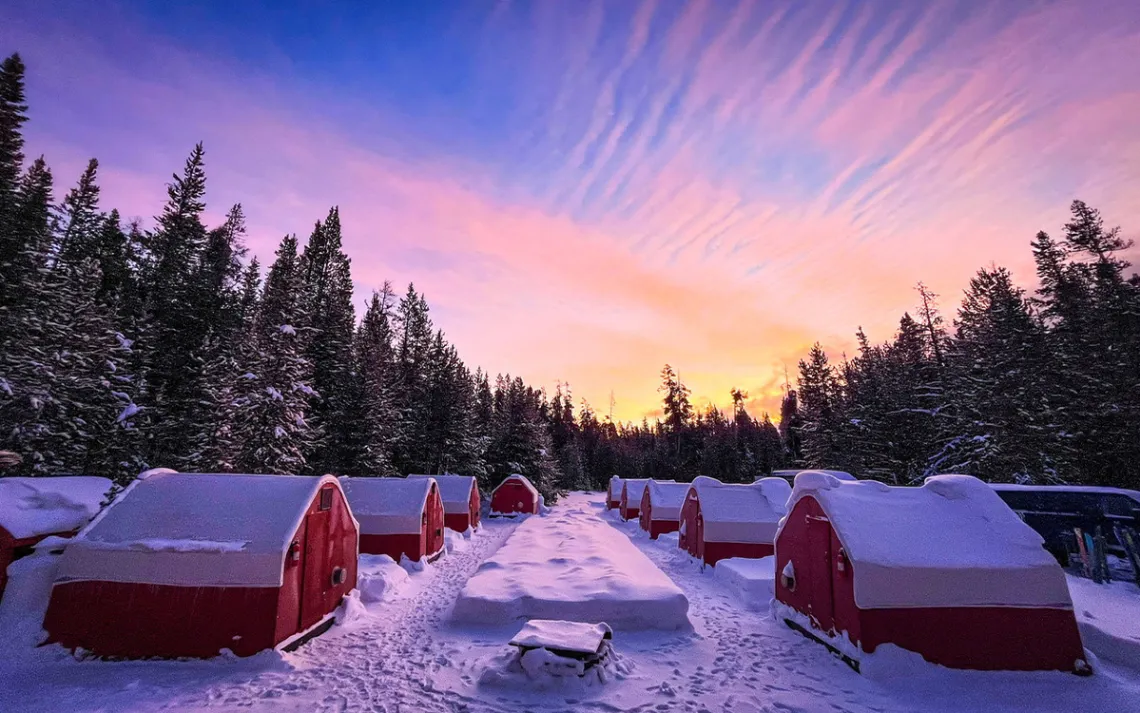
Yellowstone Expeditions’ yurt camp. | Photo courtesy of Nadia Garbaj
The thermometer had read 8°F just after dawn, and it was still bone-chilling when we’d begun cross-country skiing. Yet here we were, in the dead of winter, near the geographical center of Yellowstone National Park, stripping off our clothes. This wasn’t a crazed reaction to hypothermia—it was a perfectly sane response to arriving at a creek just below a thermal spring, where the water was a perfect 104°.
Sure, we were shivering for a moment as we undressed, but the second we dipped into that creek, with waters warmed from the spring just upstream, we giggled like kids and our hard-working muscles relaxed.
It had been a four-mile ski from our cozy yurt camp through the park’s Hayden Valley to the creek. Every exertion was worth it to soak in that mineral-rich spring. We were among a select few who were overnighting in Yellowstone during a season when far more bison than people inhabit the park.
Our group of six—my wife Jackie, four of her college friends, and I—had skied past a herd of about 40 bison on the way in, their exhalations forming clouds of steam in the frigid air. Trumpeter swans poked their heads into the icy Yellowstone River, seeking bits of food, then honked so sonorously it would have made Louis Armstrong proud.
Skiing was arduous, as this is a natural wilderness without groomed tracks. Our guide broke trail for us. I volunteered to create the grooves for our skis and took the lead but was winded after a few minutes, feeling the elevation (about 8,000 feet) and the effort of compressing the powdery snow.
So the temperate creek was a welcome relief—until we got out. Thankfully, we were warmed to our core. The main challenge was getting dry enough to put on our clothes and pull up our socks. Outfits reassembled and boots in place, we clipped back into our skis and propelled ourselves toward our lodgings, the pastel hues of the distant Absaroka Mountains intensifying in the late-afternoon sun.
Our trip had begun the day before on a blustery morning in the town of West Yellowstone, Montana, where Jackie and I met her friends. Ashley had planned to do the trip someday with her husband, Steve, whom she’d met in her twenties when they were teaching skiing in the Rocky Mountains. He died of cancer at age 59, before they could do the trip together, but Ashley clung to her dream of skiing through Yellowstone in winter.
“The day after Steve died,” she told me, “I asked myself, ‘What matters to me? What is my life going to be like? What's important?’. . . The two things that were very primary were, ‘I'm going to take care of our kids,’ who were 23 and 21 at the time, and ‘I want to spend as much time as I can in beautiful places, outside, with the people I love.’”
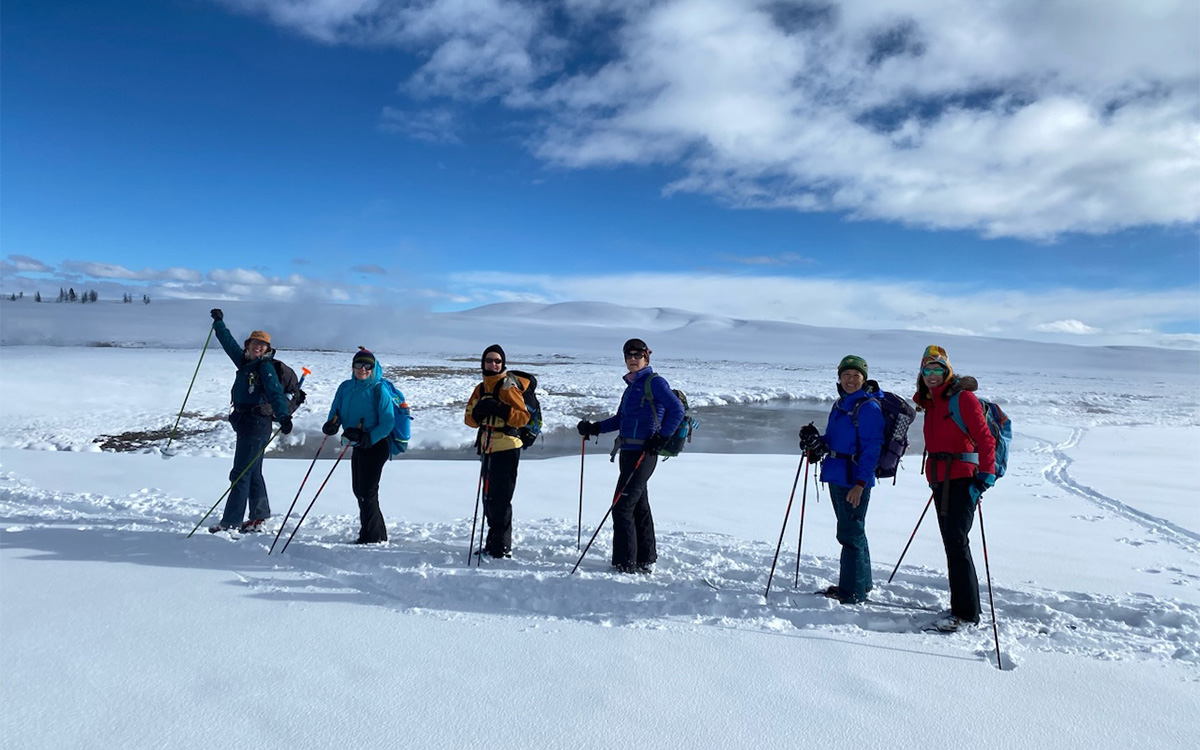
Skiing in Yellowstone. | Photo courtesy of Michael Shapiro
*
Arden Bailey, the founder of Yellowstone Expeditions, met us on a blizzardy morning with a “snowcoach” customized to drive over snow-covered roads. There were two vehicles: one with oversize low-pressure tires, the other with broad skis replacing the front tires and tank-style treads in lieu of rear tires.
Avuncular and bearded, Arden shared his vast knowledge of Yellowstone, especially its geology, on the 40-mile drive to the yurt camp. En route, we stopped at Norris Geyser Basin, where he described how thermal depressions formed over millennia. We hiked for about an hour, at times on boardwalks over steaming thermal pools, the sharp scent of sulfur reminding us that the land around us was alive.
Founded in 1872, Yellowstone is the country’s first national park and the only place in the United States where bison weren’t eradicated. About 5,000 of these magnificent animals live in the park today, and they’re easy to spot during the winter.
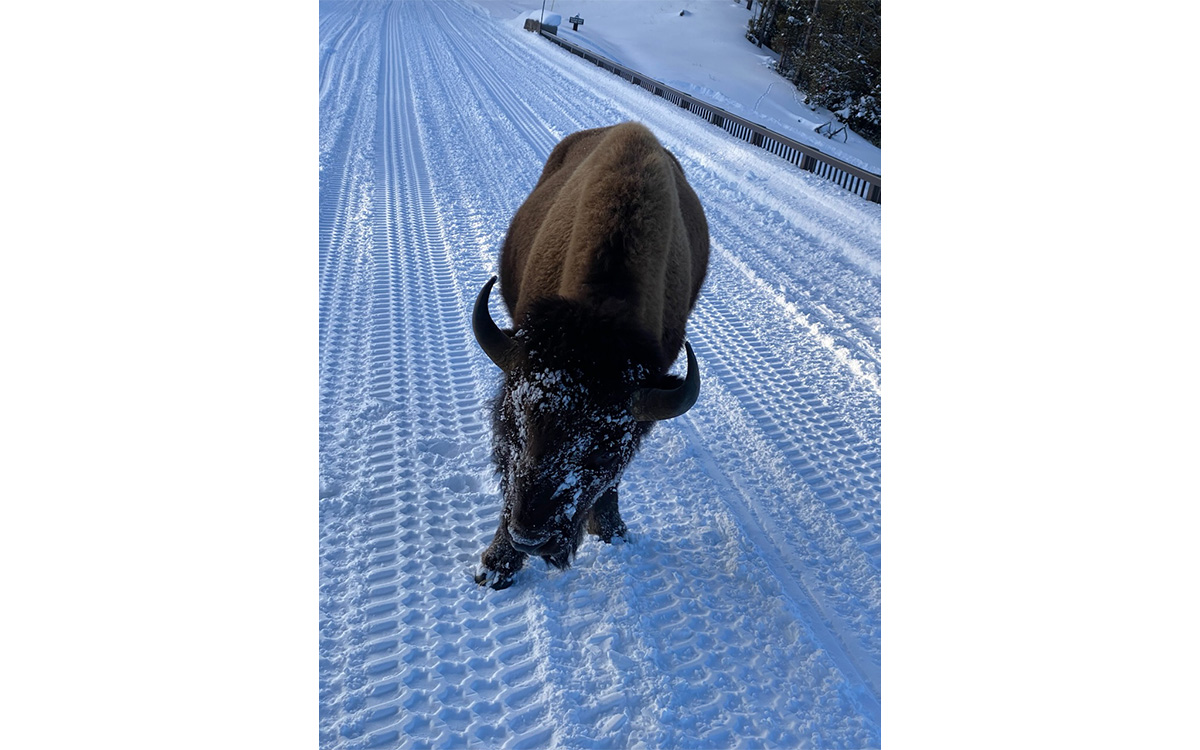
Bison. | Photo courtesy of Michael Shapiro
Arriving at camp felt like coming upon a magical village. A large yurt, with three long tables that could seat more than 20 people total, was the center of this winter wonderland, heated by a stout wood stove. An adjacent yurt served as the kitchen. Eight “yurtlets” (small cabins) for guests were a few steps away. These yurts, built and managed by Yellowstone Expeditions, offer a rare opportunity to stay overnight in Yellowstone during winter.
Jackie and I were assigned a yurt with the number for Pi, 3.14159 (π), which was perfect as we affectionately call each other “Pie” (short for “Sweetie Pie”). Our yurtlet had two single beds with sleeping bags and a flannel sheet insert that Arden had sewn himself, extra blankets, and a powerful heater with pegs above it for drying wet clothes and boots. All cabins had electricity with lights and outlets for charging phones so we could take photos.
Just before sunset, we skied up to a ridge on the north rim of the Grand Canyon of the Yellowstone for a view of the dramatic Lower Falls. This broad cascade on the Yellowstone River plunges more than 300 feet, sending up a shimmering mist that envelops the surrounding cliffs.
I noticed our guide, Nadia Garbaj, observing us and asked if she was evaluating our ski skills. “Yeah, 100 percent,” she said, “We’re totally judging you. Everyone says, ‘I’ve been skiing for 25 years, and I’m super good, and I want to ski 20 miles before breakfast.’ It turns out, well, no, actually, you haven't skied in 20 years, and camp’s at 8,000 feet. So, yeah, it’s an assessment.”
All of our guides were women. Later, I learned that 12 of the company’s 17 guides are women. “They get along with others without big egos,” said office manager Erica Hutchings, who has been working with Arden for more than 30 years. “We're not about how fast or how far you can go. We're about nurturing the Yellowstone experience. Certainly, we've got wonderful male guides as well."
Each day, three levels of skiing were offered at various distances and speeds: “a pretty easy, chill one; a medium one; and if you want a death march, we can do that too,” Nadia said. Guides encouraged us not to overdo it and to consider the easier treks, which allow more time for enjoying the park’s beauty.
“We humans are continuously writing our own stories,” Nadia said. “You arrive here with blank pages. You get to gently write, or heavily write, your impact on how closely you've connected to Yellowstone. . . . People aren't going to remember specific facts. They're going to remember feeling seen, that experience of connection that’s so hard to find.”
After our euphoric first full day of skiing, the day we soaked below the hot spring, Ashley began hyperventilating in the dining tent before dinner. “I started getting anxious and worried that maybe I had altitude sickness. I definitely had a panic attack: ‘What if something happens to me and I need medical care? Here I am, in the middle of Yellowstone park, and I have these two kids who are relying on me, and I can't die because their dad just died.’ It wasn't rooted in feeling physically sick, but somehow I convinced myself I was.”
She considered leaving yurt camp. “The emotion of it all just overwhelmed me,” she said afterward. Her girlfriends went with Ashley to her yurtlet and “talked me off the ledge,” Ashley recalled. “We talked about Steve, and I cried. When I woke up the next day, I wanted to go back out.”
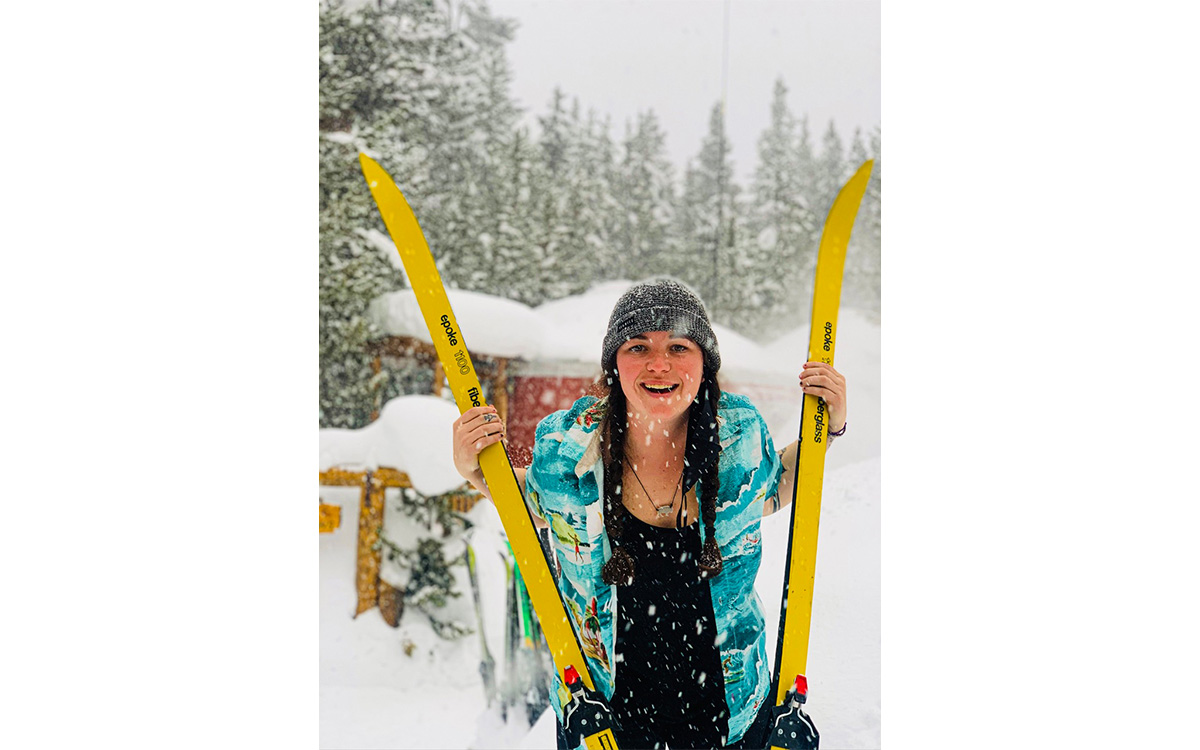
Guide Nadia Garbaj. | Photo courtesy of Nadia Garbaj
*
We awoke to another clear day with temperatures clocking in below zero at 10 a.m. and prepped for the day’s ski jaunt at a warming hut. As we skied out through a tree-lined area called the Keyhole toward Pelican Valley, we passed a huge solitary bison and gave it a wide berth. After skiing vigorously in the sunshine for about a half hour, we warmed up.
I looked up and saw a crimson glint high in the sky; soon I could see it was a red balloon. “It was a bluebird, beautiful day,” Nadia recalled. When the balloon appeared, suddenly, “The air felt thicker. It felt quieter. Our ski felt more intentional.”
Slowly, almost timelessly, the heart-shaped balloon descended, landing about 30 yards to Ashley’s right; then a light wind blew it to within a few yards of her feet. Nadia picked up the balloon, handed it to Ashley and said, “I think this is for you.”
The closest town was West Yellowstone, nearly 40 miles away. “It was like it wanted to be found, like it had a destination. We were the only ones out there, just slipping through that keyhole. There wasn't a recreational skier as the crow flies for probably 30 miles,” Nadia said. Ashley told us that before the trip, she’d seen a psychic medium who advised her to look for a sign from Steve. We were all in tears, even the two skiers we’d just met on the trip. “I just felt like Steve was there,” Ashley recalled, “like there’s some way we're connected to the people we love who die, and it felt really good to feel like he was there, watching over me and sharing the experience with me.”
Nadia tied the balloon to Ashley’s pack and invited her to lead our group. That moment wasn’t just “magic” for Ashley, Nadia said. “Sometimes those moments don't belong to just one person. . . . That balloon belonged to all of us on that trip. When it touched the snow, it touched all of us.”
Our last day in the park came too soon. We skied for about two miles along the Yellowstone River through a forest that opened to a view of Upper Falls. Then we piled back into snowcoaches bound for West Yellowstone.
We’d spent only four days in the park, yet somehow we felt our connection to it—to the eagles, the coyotes, the bison, to the gurgling geothermal pools and roaring falls, and to Yellowstone’s ineffable spirit—would remain with us forever.