Zone Zero, Defensible Space, and Other Ways to Protect a Home From Wildfire
In California, fire experts and policymakers are looking for solutions as temperatures rise
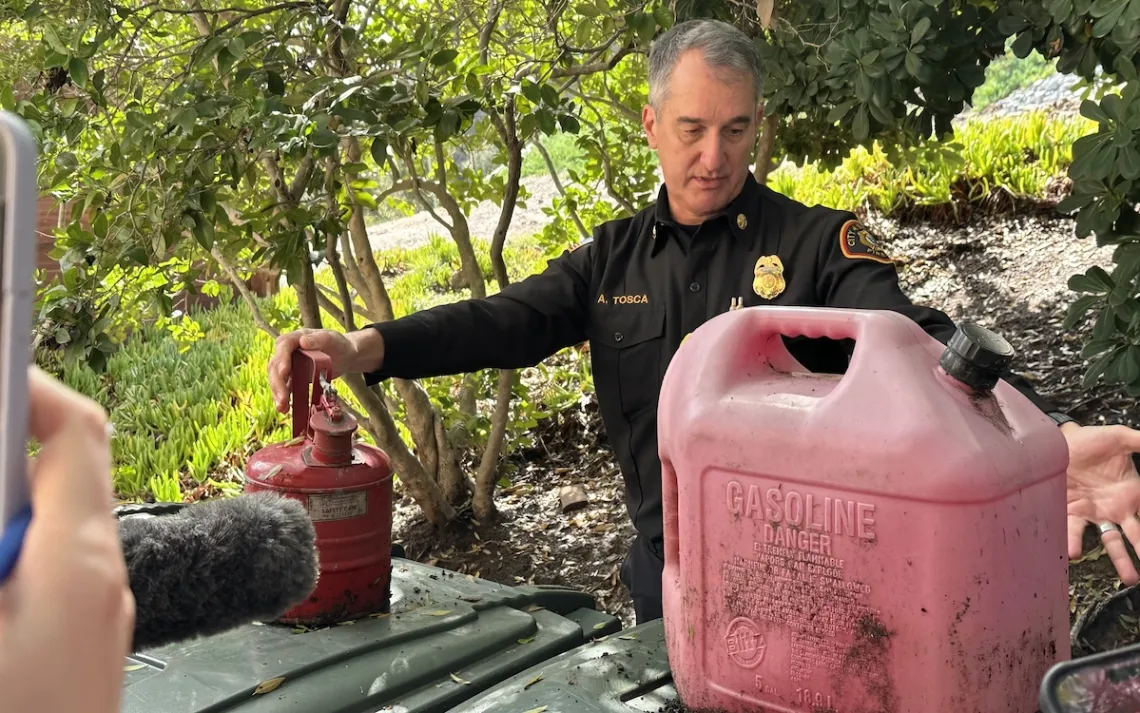
Tony Tosca, deputy chief and fire marshal for the City of San Diego, points to fire-prone items he found in zone zero at a house. | Photo by Jennifer Oldham
Chrysa Mineo and her husband didn’t know that a pair of trees near the front door of their cliff-side home in La Jolla, California, were flammable until Alex Kane pointed it out.
“I’m just going to be straightforward with you guys,” Kane, the assistant fire marshal for the City of San Diego Fire-Rescue Department, told them. “It is not recommended for planting in defensible space zones, especially within five to 30 feet of structures in wildfire-prone areas.”
Kane had surveyed the neighborhood looking for anything that could be ignited by embers floating ahead of a wildfire. The Mineo home in particular was situated at the mouth of a canyon overgrown with shrubs and trees. Combustible material within five feet of the residence compounded this vulnerability: vehicles parked on the driveway, garbage cans stored against a wall, and pine needles clustered under the eaves. He suggested guards for the gutters, fire retardant covers for the patio furniture, removal of a plastic dryer vent, and rock instead of mulch in planter beds.
The area from zero to five feet around a home—known in California as “zone zero”—has become a political flashpoint after the Eaton and Palisades wildfires, the second and third most destructive in the state’s history. The wind-driven blazes, which scientists determined were made more intense by human-induced global warming, torched 16,246 structures and killed 30 people.
The January conflagrations prompted Governor Gavin Newsom to issue an executive order that directed the California Board of Forestry and Fire Protection to draft new regulations by December 31 that require an ember-resistant zone within five feet of structures in areas most at risk of wildfire.
Analysis of past conflagrations by fire experts, federal officials, and the insurance industry—which conducts experiments to determine how structures combust and how fires spread—found that neighborhoods are most vulnerable to tiny firebrands, known as embers. Wind events break off these smoldering particles from burning vegetation and building materials. They can float through the air for as many as five miles ahead of the more visible fire front and land in a five-foot area around a home, putting the entire building at risk.
“Embers are the leading cause of ignitions within the community,” said Steve Hawks, senior director for wildfire at the Insurance Institute for Business and Home Safety, in a March presentation to journalists organized by the Institute for Journalism and Natural Resources. Hawks spent 30 years at the state’s firefighting agency, CalFire, in roles from firefighter to assistant deputy director. “Once a home ignites, there is a greater than 90 percent chance it will result in a total loss.”
The institute concluded, based on his analysis of structures lost in the Eaton and Palisades Fires, that establishing a zero-to-five-feet ring of protection around a residence is so crucial to home survivability that the city and county of Los Angeles should develop a zone zero standard independently of the state. Some municipalities, like Berkeley, have already done so.
A hotter, drier climate and overgrown areas around housing developments are fueling larger, more frequent, and more destructive wildfires. Entire communities have been wiped out by wind-driven blazes this decade, including the Marshall Fire in Colorado in 2021 and Hawai'i’s Lahaina Fire in 2023.
Fire experts agree that a cultural shift must take place in how people landscape their properties. “We have to live differently—this doesn’t mean all vegetation is gone,” Yana Valachovic, a director at the University of California Cooperative Extension in Humboldt and Del Norte Counties, said while testifying at a July 24 hearing in front of a zone zero advisory committee. The committee had been created by the state’s Board of Forestry and Fire Protection. “The issue is about what fuels are within the first five feet.”
More people in California live in what’s known as the Wildland Urban Interface, or WUI, than in any other state. This fact shows up in wildfire statistics: Fifteen of the 20 most destructive fires in the state, in terms of structures, occurred in the last decade.
A growing number of deadly blazes prompted state lawmakers to require most homes in the WUI built after 2008 to use fire-resistant construction and defensible space. The legislature also voted in 2020 to require residents in high-risk areas to clear a zero-to-five-foot area around their homes, but the regulations were never finalized.
Today, zone zero restrictions proposed by the state’s advisory committee are proving controversial. Residents submitted thousands of comments decrying potential mandates that could require the removal of trees, potted plants, and privacy hedges. Many opposed a “one size fits all” approach, particularly for urban areas that are not adjacent to wildland fuels, and some asked that the new law be voluntary for all but new homes.
“Based on our experience and research into fire ecology, we object to the residential vegetation clearance mandates being developed,” wrote Thelma Waxman, president of the Brentwood Homeowners Association, in an April letter to the committee. “In a wind-driven fire like the recent Palisades Fire, where homes burned due to flying embers, totally clearing the area will carry embers right into the house.”
Committee members, who have been meeting and taking testimony since March, expressed frustration at the July 24 hearing about what parameters were best to decide what will be allowed to be in the five-feet zone around a home.
“We’ve been vacillating back and forth,” said Elicia Goldsworthy, whom Newsom appointed to the State Board of Forestry and Fire Protection in December. “Particularly because we are tangling with vegetation being allowed in there. I’m a plant person, I want plants next to my home, they make me happy. I don’t want to take that away from anybody.”
While debate takes place on the state level about how to better protect neighborhoods, Kane is working on the ground in San Diego to help homeowners understand how implementing zone zero voluntarily could help their home survive a fire. His efforts are made all the more urgent by newly released maps, compiled by CalFire, that found that about 200,000 homes in his department’s 60-square-mile service area are in a high-risk wildfire zone.
Kane trains firefighters in his department, and those from other regions, how to conduct an assessment that focuses on combustible items in a five-foot radius around a residence. Such reviews are voluntary and accompanied by written reports that outline recommendations.
The fire marshal is also working with FireSafe councils—community-led organizations that mobilize neighbors to take measures such as installing mesh covers on vents and clearing areas around their homes of vegetation. And he’s in search of “ambassadors” who will talk with neighbors about the importance of home hardening practices.
One such resident is Steve Nottoli, a defense contractor who had his home stripped to the studs and rebuilt to ensure it’s better able to withstand a wildfire. The hillside residence was threatened by the Montezuma Fire on Halloween that required everyone in his Alvarado Estates neighborhood to evacuate. Now he has the highest-rated wildfire-resistant roof, siding, and dual-paned windows, along with fire breaks around his two-and-a-half-acre property and a zero-to-five-foot zone around the house cleared of vegetation. The cost was about $25,000.
“We are surrounded by a canyon. We have to learn to live with fire,” Nottoli said during a March visit with journalists. “This is a generational shift. We are hoping there is a domino effect over time, and my hope is everyone will do it.”
Not everyone can afford such a remodel. Kane is out to change that. He applied for grants that will allow him to broaden his efforts into disadvantaged areas that satellite imagery shows are particularly vulnerable to wind-driven urban conflagrations. Limited egress routes, which are often crowded by overgrown vegetation, and closely spaced homes are among the fire marshal’s concerns.
On an overcast June day, within a few miles of one of the busiest border crossings between the United States and Mexico, Kane guided his white sport utility vehicle up a winding road into a hilltop development near San Ysidro. The suburb tops the fire marshal’s list for in person-visits to offer wildfire home risk assessments. Not even halfway up the access road, he began to note areas of concern.
“There is only one way in and one way out, and quite a few people live here. It’s an island on top of a hill,” Kane said.
At the top of the rise, he pointed to areas within five feet of homes cluttered with combustible items, vegetation, wooden gates and vehicles. The fire marshal, who grew up nearby, said that there’s an urgency to helping these residents ensure their neighborhoods can withstand the next urban conflagration.
“They don’t have the time, or resources, to spend thousands of dollars,” Kane added. “We are looking for progress, not perfection. It’s the little things, and we need to get started.”