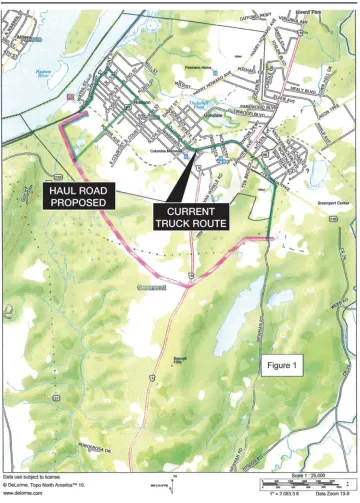
Industry versus the Public’s Health and Safety
This is an issue that has embroiled Hudson for 11 years.
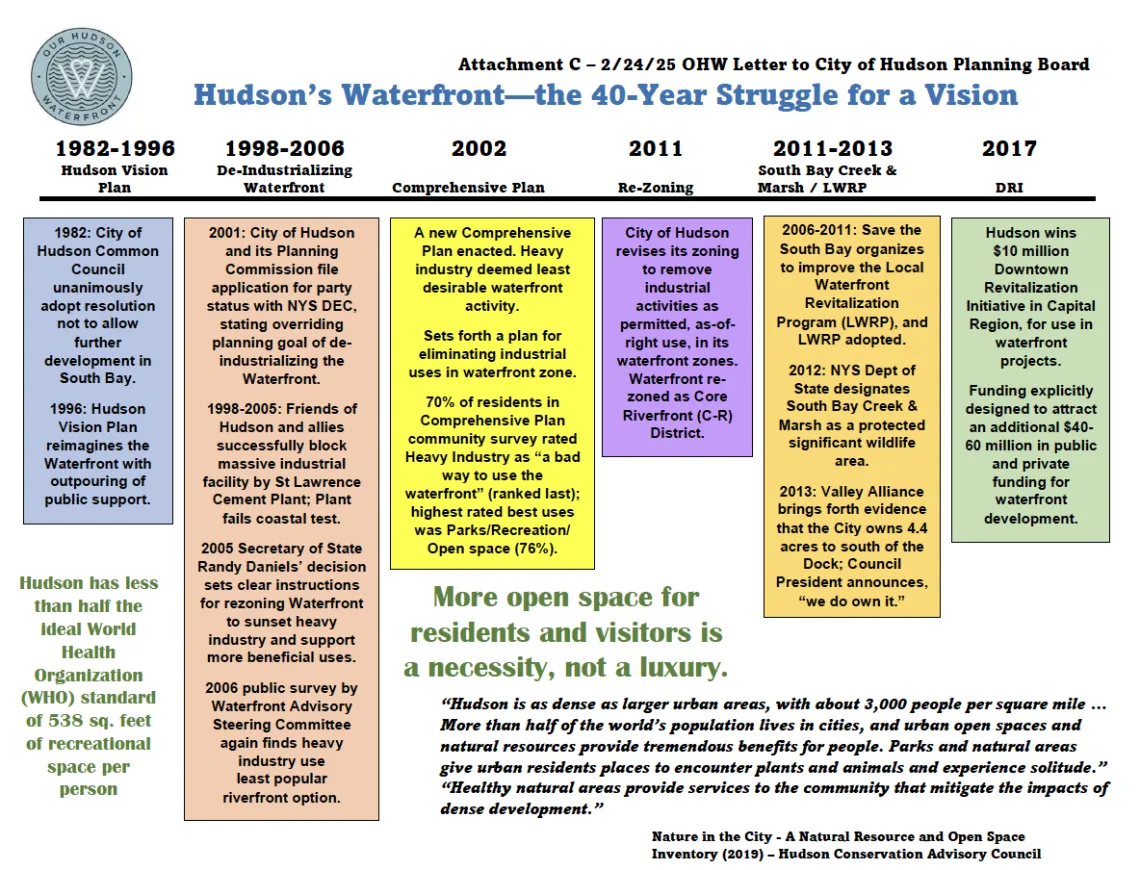
The dock, owned by A. Colarusso & Sons, receives crushed rock from the 113-year-old company’s quarry in neighboring Greenport. The family business did work on the dock’s bulkhead in the Hudson River without seeking permission from the Hudson Planning Board in 2014, requiring it to go before the Planning Board.
Before the repairs, A. Colarusso & Sons operated the dock on a “non-conforming” basis, grandfathered in after the city rezoned the industrialized waterfront in 2011 to encourage recreation and “protect the visual, cultural, natural, ecological and historical resources of the city’s core riverfront area,” according to city code. But when the company did the work on the bulkhead without the Planning Board’s permission, it lost that status and had to apply (in 2016) for a conditional use permit, which can carry special restrictions, unlike projects that more closely align with zoning.
Since the initial May 2016 filing, the dock permit application faced years of delays due to lawsuits, a year-long public hearing without truck data (volume of truck traffic), and only two public hearing days in 2025. Although vital truck data was finally provided in July 2020, the public has only had the chance to comment on it during those two 2025 hearings. More importantly, much has changed with the waterfront in the five years since the initial public hearing ended.
The residents, many of whom live near the dock, have complained of noise, light pollution and rock dust wafting off the dump trucks that deliver crushed stone to the dock. They feared the dock operation would only increasingly impact their businesses, the popular waterfront park and their health.
UPDATE:
The Hudson City Waterfront: Industry versus the Public’s Health and Safety
[The following update and historical information have been contributed by Donna Streitz of Our Hudson Waterfront]
OUR HUDSON WATERFRONT FILES ARTICLE 78 LAWSUIT AGAINST HUDSON PLANNING BOARD
On November 18, 2025, the Hudson Planning Board approved the Colarusso Dock Conditional Use Permit (C.U.P.) with no limits on truck volume and allowing operations on weekends, despite overwhelming public opposition and no meaningful protections for public health, safety, or access.
The approval opened the door for a massive increase in truck and barge traffic at the dock, threatening a shared public space that generations have fought to protect.
If Colarusso is allowed to expand its dock operation into a major profit-driven concern, which the board’s decision would allow, the dock could become an acquisition target of a large multinational cement or aggregate corporation. This would hand control of our waterfront to a firm based abroad that has no connection to the life of our city—a fate narrowly avoided 20 years ago after a six-year battle was fought and won by hundreds of Hudson and other Columbia County residents against St. Lawrence Cement, a Swiss corporation, for that very reason.
The board's actions were objectionable for many reasons, especially their failure to evaluate the dock permit without connecting such use to the continuation of use as existed in 2011, as required by City Code §325-17.1(D)(1).
On December 19, Our Hudson Waterfront and its community partners, filed an Article 78 legal action in New York State Supreme Court "for a judgment to annul, vacate, and in all respects void the City of Hudson Planning Board resolution to grant site plan and conditional use permit approval" for Colarusso's dock operations. Our hope is that the suit will be successful and the dock Conditional Use Permit will be returned to the Planning Board for a proper review.
For more information, check out our new Our Hudson Waterfront webpage: What’s a Waterfront Worth? Help Secure Its Future.
PLANNING BOARD APPROVES DOCK PERMIT AT NOVEMBER 18th MEETING – IGNORES PUBLIC INPUT
Despite a decades long outcry from the public to protect and revitalize our waterfront for the benefit and enjoyment of the public, the Hudson Planning Board approved the Dock Conditional Use Permit, currently owned by A. Colarusso and Sons, without imposing annual limit on truck volume, and allowing operations on weekends. See related Gossips - Nov. 18 here, and Nov. 19 here.
UPDATE FOLLOWING THE OCTOBER 14th HUDSON PLANNING BOARD SPECIAL MEETING AND PUBLIC HEARING:
Key Issues of Concern
1. Local Waterfront Revitalization Plan (LWRP)
The Board’s attorney, Victoria Polidoro, asserted that Hudson’s 2011 LWRP has “no effect of law” because its map was not filed with the Secretary of State—meaning no LWRP area exists to trigger City Code provisions.
As Jamie Larson wrote in Rural Intelligence (Oct 20) - click here for article:
“For residents who spent years shaping the LWRP, the notion that it may not hold legal weight is both baffling and demoralizing. If Hudson’s long-term plan for its riverfront can dissolve over a missing map, what was all the effort for?”
See excellent articles (required reading) by Gossips and Rural Intelligence on this: October 18th - click here, and October 20th – click here.
A few points to keep in mind when reading the Rural Intelligence article about A. Colarusso & Son, Inc.:
Colarusso bought the dock in 2014—three years after Hudson’s LWRP was adopted—so the company fully understood the regulatory framework in place (thus their appearance before this Planning Board).
Denying or limiting the dock permit would not appear to threaten the company’s survival. Colarusso earns millions annually from public projects and operated successfully for over a century before acquiring the dock.
According to the NY State Comptroller’s Office, revenue from commodity road materials has made up approximately 11% of Colarusso’s total income over the past 15 years.
Highlights from discussion:
Hoffmann argued the State Coastal map defines Hudson’s waterfront as part of the state coastal area:
Hoffmann: “The State official coastal zone boundary map clearly delineates Hudson’s waterfront as part of the State Coastal area.”
Polidoro responded, “I don’t know what you’re reading from. If you share it, that would be helpful.”
Hoffmann asked if this could be taken to a judge and added: “If that’s the case, I would love the Zoning Board of Appeals to clarify that. Because it’s in the Zoning Code. Unless a judge says we have to take this out, it doesn’t make sense to me.”
Joyner dismissed Hoffmann’s input: “If we have members that don’t want [our attorney’s advice]—it’s like taking fiction and trying to make it into fact. You can find anything on the internet to support your decision when you want to make a point.”
Hoffmann replied: "I’m not finding stuff on the internet. I’m looking at boundary maps, coastal maps, and executive law.”
Board members Concra and Michael admonished Hoffmann for questioning counsel:
“We have to listen to her (Polidoro’s) interpretation.” — Concra
“It’s disappointing when someone goes online and reads... and pressures to know more about the issue...” — Michael
Concerns
This issue is too important for Hudson’s waterfront to be brushed aside. It demands further review—by the Board’s attorney (considering Hoffmann’s findings), and possibly independent legal counsel, the Zoning Board of Appeals, and the Common Council.
Also, it’s deeply troubling that Planning Board members are discouraged—or even admonished—for conducting independent research, including basic fact-checking whether through online research or other means.
Informed decision-making relies on diligence and independent judgment—not on willful ignorance or unquestioning deference to the “professionals” in the room, as Joyner advised (referring to the Planning Board’s attorney and engineer).
Recommendation: Planning Board members should be encouraged to seek understanding, ask questions, and raise concerns as issues emerge—not be discouraged or penalized for doing so.
2. Barges and Public Safety
For background information, see Gossips of Rivertown Oct 11th (click here) and Oct 18th (click here) posts on the October 10th barge accident.
Highlights:
Randall Martin raised kayaker and public safety concerns, requesting a report about the accident to assess inherent risks. (No report was requested by the Planning Board)
Hoffmann noted a potential ten-fold increases in barge volume (resulting from increased truck volume)—a serious risk that cannot be ignored.
At the 9/23 meeting, the Board had discussed up to 142 truckloads/day and possibly six barges “perpetually coming and going” at the dock.
At the 10/14 meeting, Ruane acknowledged it could be “6 barges, or 7, 8 or 9.”
- Ruane claimed he didn’t see a safety issue, and that the Planning Board has no authority over the Hudson River, and that the Applicant is not going to agree to any permit conditions related to it.
- Martin replied that health and safety fall squarely within the Board’s authority, calling Ruane’s answer dismissive.
- Colarusso VP J.R. Heffner said, “It’s a mixed-use waterfront... it’s not safe to take a kayak into the river,” and implying that novice kayakers should not be allowed to recreate on the River—an admission contradicting the intent of City Code § 325-17.1-A which states:
District purpose
The purpose of the Core Riverfront C-R District is to encourage a mixture of compatible uses at the riverfront; to provide access to the riverfront for water-dependent transportation and recreational uses and water-enhanced uses…”
Chair Joyner repeatedly minimized concerns about public safety:
“We need to understand how this becomes a safety issue under our jurisdiction. … I don’t see where it is. But is there anyone else on the board that sees what Martin sees?”
“There’s going to be a decision by us. Because majority rule.”
“Are we ok with this constantly asking questions about the barge and safety issues? I don’t see where there is a safety issue.”
She even asked the Applicant: “How often does that happen—barge capsizing? It doesn’t happen that often, does it?”
Heffner replied, “No.”
Martin countered: “Your comment ironically was that it’s never happened. It potentially could have been a safety issue.”
Concerns
Planning Board decisions must rest on law, facts, and expert input—not personal belief or guesswork. A majority vote cannot replace sound, informed evaluation.
It’s also concerning that no one raised public health and safety, as well as viewshed protection, concerns about the potential for a ten-fold—or greater—increase in barge traffic at the dock. This could mean 6, 7, 8 or even 9 barges queued at once, and a near-constant procession of barges and tugboats coming and going to accommodate the worst-case volume of up to 142 aggregate truckloads per day.
Such activity would substantially heighten safety risks for recreational boaters, worsen air quality from diesel exhaust and dust emissions, and create a significant visual blight on the riverfront—diminishing views from both the Hudson River and the adjacent Henry Hudson Riverfront Park. It would also increase nuisance noise on weekends, if the Board approves weekend operations as requested by the Applicant. Based on online research, there are a myriad of other safety issues that should also be considered.
Recommendation
The Planning Board should request a formal report on the barge accident from the barge company and the Applicant, including specific details about the accident, what went wrong, and what procedures and controls will be put in place to prevent a similar occurrence in the future.
Also, given the complexity of river navigation and barge operations, the Board must consult independent experts (paid for by the Applicant) to evaluate maritime safety and environmental impacts from a potential surge in barge activity. Public safety and environmental (river and air quality) protection require expert—not speculative—judgment.
3. Slats or No Slats — Black vs. Green
The Applicant proposed adding plastic slats to the dock’s chain-link fence to screen the area. Hoffmann objected that slats would be ugly and block views of new trees proposed by the Applicant. The Board’s engineer said that alternatively a black cyclone fence would look better, but that discussion stalled. Only Hoffmann raised visual concerns.
§ 325-17.F(1) of the City Code requires the Board to consider:
“The quality and extent of views from adjacent public streets through the property to the water … and the relationship of development to the waterfront as viewed from the water.”
Despite this, the Board voted 5–2 to approve black slats.
Hoffmann asked for a visual rendering; Heffner said such renderings had previously cost $4,500, but that it probably wouldn’t be that much. Joyner replied: “If you come back and say extra cost, then no (you don’t have to do a rendering).”
Concerns
The Board showed little interest in the visual impact of plastic fencing along the waterfront—or in the environmental impacts of adding large amounts of plastic to the environment. The Chair’s deference to the Applicant over rendering costs (which will likely be modest) is troubling.
Recommendations
The Applicant should be required to submit a color visual rendering, and the Board should reconsider its decision in accordance with § 325-17.1.F(1) about requiring any plastic slats. If the existing cyclone fence is considered an eyesore, require replacement with a black cyclone fence (without any plastic slats).
Next Steps
The next Planning Board meeting on the Colarusso dock is a special meeting, Tuesday, October 28 at 6:30pm at City Hall.
We understand that the agenda will include multiple additional applications.
UPDATE FOLLOWING THE AUGUST 27th HUDSON PLANNING BOARD SPECIAL MEETING AND PUBLIC HEARING:
The Planning Board held its first special meeting on August 27th on the Colarusso (applicant) dock Conditional Use Permit (C.U.P.) review following closure of the public hearing on July 15th (click here to access recorded meeting). The three-plus hour session lacked an agenda and followed a loose back-and-forth with the applicant. While the applicant argued the C.U.P. applies only to bulkhead repair, the Board confirmed it covers the entire dock operation. In addition to the comments below, please see Gossips 8/28/25 post here.
Public Comments Ignored
In prior meetings, Chair Joyner had repeatedly said that the Board would review and discuss public comments and require applicant responses once the public hearing was closed.
Disturbingly, there was no discussion of public comments at this meeting, nor any Board direction to the applicant for a response. The public was also barred from offering questions or input during the meeting, even though this is typically allowed at the end of planning board meetings. With a six-year record of comments and testimony (2019–2025), this omission raises serious concerns about whether the Board will deliberate on the full record.
Conditions Process
After the applicant provided background information, at the Board Chair’s request, the Board immediately jumped into issues and conditions, but discussion was unfocused. Topics included truck volume, dust and emissions, landscaping, loading/unloading hours, lighting, visual impact, and public access. Suggestions often seemed off-the-cuff, with no reference to the many public proposals sent to them (e.g., OHW’s 5/27/25 conditions letter, which includes a compilation of conditions previously sent to the Board by the Valley Alliance (William Demarest, III Esq.), OHW, and C-R District business owners, and includes input from former Board Chair, Betsy Gramkow– click here to access).
Even more troubling, Board members repeatedly asked the applicant if they would be “agreeable” to certain conditions—treating the process as a negotiation, rather than the Board independently applying zoning standards (for overarching Code sections regarding the Board’s responsibilities (see Code sections—click here—§325-34, §325-34.A(2), §325-34.A(3)(a)).
Chair Joyner’s personal observations, such as “I’ve been in the park, I’ve seen the operation [Colarusso dock]. Well, at first when I saw it, I thought it was cute…”, often drove the conversation. Conditions should be based on facts, public safety, and the Code—not personal impressions.
Dock Operating Hours
For the dock C.U.P., the applicant seeks 7am–7pm, seven days a week, including holidays—a significant expansion over the haul road permit (Mon–Thurs 7am–6pm, Fri 7am–5pm; closed weekends and major holidays; 250 days/year). Allowing dock operations every day of the year would add 115 extra days, creating major risk of intensification and making the dock more marketable for future sale.
Past data show no need: between 2015–2019 Colarusso actually operated on only 77 to 133 days/year, despite having the ability to use 365 days. Occasional exceptions (e.g., transformer delivery) could be addressed by requiring one-time special permits, not by authorizing permanent weekend/holiday use.
Truck Volume
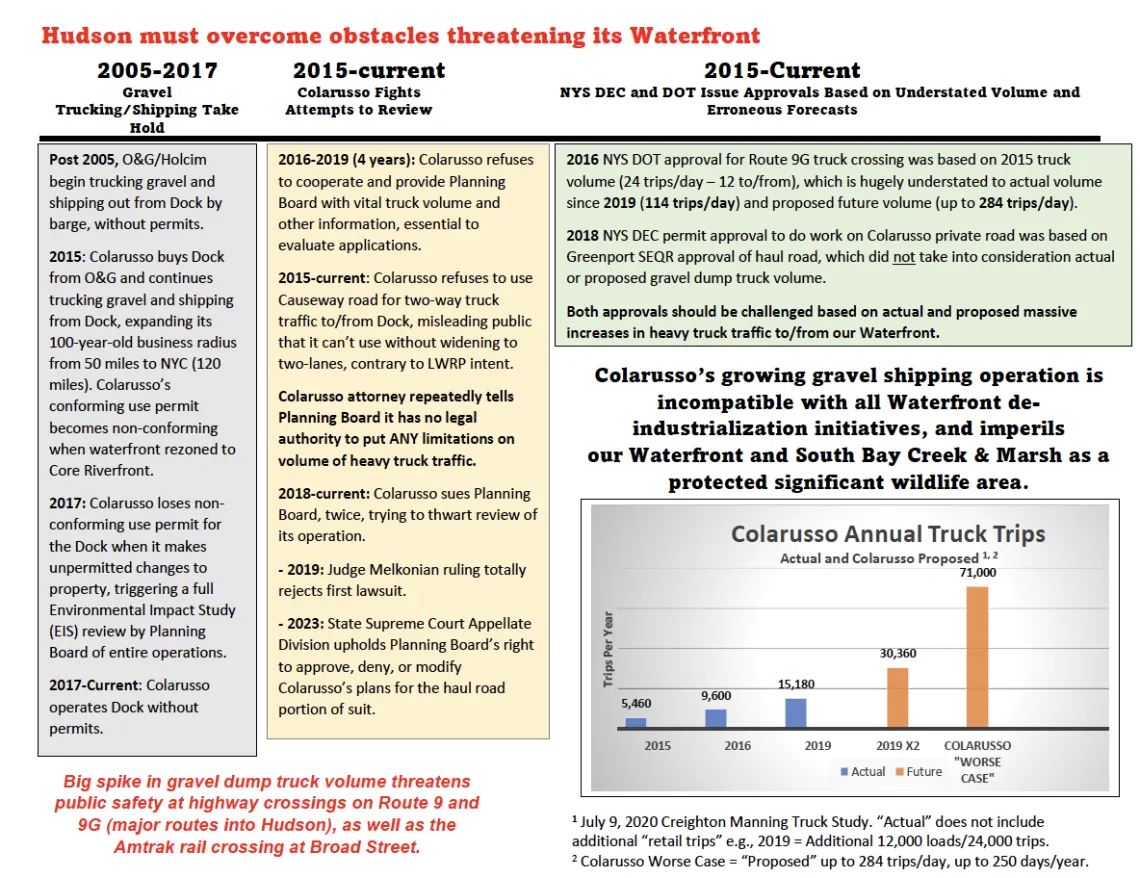
Colarusso’s attorney pushed for the 284-trips/day cap—previously set for the haul road—framing it as benign. But Creighton Manning’s truck study shows 284 trips/day occurred only TWO days in five years; actual daily averages were far lower (71/day in 2015, 114/day in 2019). (See OHW’s 5/6/25 letter to the Board here for truck volume history and reports).
Without an annual limit, approving 284/day at the dock could escalate operations to 71,000 trips/year—13 times 2015 levels—contradicting the LWRP and zoning restrictions on intensification (§325-34.A(2), §325-34.A(3)(a), §325-17.1.D(1) – click here and here).
Dust and Emissions
Dust and emissions are critical issues, and as stated by at least two board members the board has a duty and obligation to ensure compliance with the City Code and to protect the health, welfare and safety of the public.
Two board members proposed an emissions study to establish baseline data given public concerns over waterfront air quality. Others, including the engineer, were skeptical or dismissed its usefulness. Click here, here, and here for public concern letters.
The Board agreed to find out if such a study can identify sources of air quality issues (e.g., Colarusso trucks vs other). It’s unclear how they plan to go about this, though. Independent experts are needed to clarify whether sources can be distinguished (Colarusso trucks vs. other factors) and what corrective steps should follow.
The applicant’s attorney claimed environmental review was already completed, citing Greenport’s 2017 SEQRA review and the Hudson haul road approval. This is misleading: the 2017 Greenport Planning Board review assumed only 10 loads/20 trips per day; with assertion—from the Greenport Planning Board—that volumes would “not increase over time.” That projection has proven false.
Also, it’s important to remember the 2016 Letter from Basil Seggos (NYS DEC Commissioner) giving Lead Agency status to Greenport for haul road review (excerpt): “In designating the Greenport Town Planning Board to serve as lead agency for the haul road project, this decision in no way limits the jurisdiction or responsibilities of the other involved and interested agencies – particularly the City Planning Board, and I encourage the Town Planning Board to seek and use the expertise of the City Planning Board as well as the DEC and the DOT in evaluating potential impacts, if any, and developing viable alternatives to mitigate or avoid any identified significant adverse impacts.”
Public Safety and Access
The Board briefly discussed property ownership (nearby 4.4 acres) and access to the South Bay, but failed to address safety and public access at Henry Hudson Riverfront Park—a central concern.
Additionally, a board member raised a question about a City initiative involving Henry Hudson Riverfront Park and Colarusso, and some of the Board had a vague recollection of a presentation made to them about this. In fact, an excellent presentation was made to the Board on 3/11/25 on the City’s Climate Adaptive Redesign initiative, at the conclusion of a very long planning board meeting. This was the presentation where the Board Chair said, “too bad the public wasn’t here to see this.”
The March 11, 2025 presentation by Assemblage Landscape Architecture, detailed a proposed pedestrian easement and bridge across the north side of the dock, to be funded by Colarusso. The project would connect the park to the statewide trail system. OHW’s 5/27/25 letter spelled out conditions to safeguard this project, but Board members appeared to have forgotten the presentation entirely. Click here to access OHW’s 5/27/25 conditions letter, and here to access the 3/11/25 presentation.
Next Steps
Chair Joyner asked Counsel Polidoro to request from the applicant:
- An updated site plan,
- A landscaping plan,
- A list of conditions (Board’s to date plus those proposed by the public).
It remains unclear whether the applicant will also be asked to formally respond to public comments, though this has long been promised.
The Board scheduled another special meeting for Tuesday Sept. 23, 6:30pm at City Hall. Site visits to the dock with the applicant were planned with Gaby Hoffman (Aug. 28) and Veronica Concra (Sept. 4).
Bottom Line
The Aug. 27 meeting exposed serious issues: disorganized deliberation, reliance on applicant “negotiated (?) agreements,” disregard of public comments, and bias in shaping conditions.
Also, the Board members are admittedly not experts, and their counsel and engineer are not experts in all areas and should not be the sole source of reliance by the Board for input. The Board should call upon subject matter experts (such as environmental engineers, or other experts as applicable).
In addition, as the Board deliberates this permit, input should be allowed from key stakeholders, such as:
- C-R District business owners, who have well-established vested interests and who contribute immensely to our city economy, employment and waterfront development plans
- Nearby residents who live in proximity to the dock
- The public who utilizes the waterfront and Henry Hudson Riverfront Park
This C.U.P. permit has huge potential long-term consequences for our waterfront, the public and our city’s future.
Expanded dock hours, unchecked truck volume, and unresolved safety and air quality risks all signal the potential for unchecked industrial intensification—contrary to the City’s waterfront vision and zoning protections.
UPDATE FOLLOWING THE JULY 15th HUDSON PLANNING BOARD MEETING AND PUBLIC HEARING:
To view the hearing, click here for the recording, which is also located on the Board’s webpage.
Despite many appeals from the public to keep the public hearing open, the Board voted unanimously to close the hearing on July 15th, with the exception that it would remain open for written comments until July 31st.
When questioned about whether public comments would be allowed at the end of board meetings if the public hearing is closed (for example, to raise questions, remind the board about information in the record that it may have missed, or to address misinformation—as the applicant has been prone to provide such to the board in the past), Randall Martin (Planning Board member) advised that if he were the chair he would permit it, but that he can’t speak for others.
Based on a question from the public, it was learned that if the Board Chair does not agree to allowing public comments at the end of a meeting (as occurred earlier this year), under the NY State Open Meetings Law, any board member may make a motion for a vote to allow public comments.
There was considerable confusion and discussion regarding the Planning Board “process” for the Colarusso dock permit application, and why it differed from some previous applications whereby public hearings were left open during the board’s deliberation process (e.g., The Boulevards, Pocketbook Factory, Mill St Lofts).
What we gleaned from the discussion was that while the Colarusso dock permit application is a Type 2 action (not SEQRA), it’s up to the Planning Board to decide on how long to keep the public hearing open. If they choose to close it, a hearing can be reopened if any substantial changes occur or new information arises (e.g., by the applicant, the public, zoning, acts of nature). A summary of the “process” outlined by one of the Board’s two attorneys assigned to this project follows:
- Applicant’s proposal comes before the Planning Board.
- Code Enforcement Officer (Craig Haigh) reviews it—is it part of Zoning? If it’s determined that a special permit is required, in this case triggered by a Type 2 action, then it’s pushed on to the Planning Board.
- The Planning Board does their initial review (e.g., SEQRA, or in this case a Conditional Use Permit review as it’s a Type 2 action). A time limit clock for a decision (e.g., 62 days) does NOT apply.
- Next step is the public hearing, the purpose of which is for the public to make comments to the Board. The Board may choose to keep the hearing open or close it, at its discretion, during deliberations.
- Then the Board begins its deliberations. We understand this to include discussing public comments, reviewing the application against the Zoning Code, determining conditions, making requests of the applicant, etc. All deliberations take place during public meetings.
- All meetings are open to the public to attend, view via Zoom, and are recorded. (The attorney stated that depending on the size and complexity of the application, deliberations could last months or a year or more.) Deliberations for this permit have yet to begin.
The applicant’s attorney advised that they would respond to the Planning Board on the public comments once the public hearing is closed, even though they aren’t required to. They are, however, required to respond to requests from the Planning Board.
Regarding the recent public hearing, Randall Martin initially indicated that there was no “new” information, despite the fact that new information had indeed been brought to light. Case in point is the air quality testing information submitted to the Board by Yves Jacques—(click here). Mr. Martin subsequently agreed that the testing information was new, but the topic (air pollution) was not.
The applicant’s attorney made a number of concerning statements, including:
- “There's no plan to increase industrialization at the waterfront."
- "There’s no plan to increase the truck traffic.”
These statements are disingenuous and contradicted by facts. In its 2016 joint application to the NYS DOT and the U.S. Army Corps of Engineers for permits, the applicant indicated that it did not anticipate a substantial increase in truck volume. Yet, the Creighton Manning Truck Study submitted by the applicant to the Board in 2020 revealed that Colarusso truck volume at the dock was higher than the applicant had previously reported to agencies for permits in 2016, and had substantially increased (almost tripled) from 2015 to 2019. Based on the haul road limits agreed to by the Planning Board in 2023, future volumes could be drastically higher (up to 13 times 2015 volume) if strict daily and annual limits are not required for the dock permit, as volume will be driven by Colarusso’s client demands.
- “We would request, that the next logical step is for us to work with the Planning Board to come up with these conditions so we can make a determination on this permit… We respectfully request that the Planning Board close the public hearing, as at the next meeting we can start working on what those conditions are.”
The Applicant’s attorney appears to speak as if he or the Applicant are part of the Planning Board. Determination of conditions should NOT be based on a negotiation with the Applicant. Further, development of conditions should not begin until the Board begins its review of the dock permit application under the City Zoning Code, which includes thirty-three (33) applicable ordinances.
As Randall Martin said during the public hearing regarding the board’s responsibilities, “Our job is to make sure the application meets the Code. The Planning Board has to hold the applicant accountable to the Code."
The applicant continues to take the position that the dock permit application and any conditions are limited to the bulkhead repair of the dock. This is contrary to court decisions, as explained to the Board in independent legal opinions sent by attorneys Ken Dow (click here and here) and William Demarest (click here). The dock Conditional Use Permit applies to the entire dock operation, not just the bulkhead repair.
Lastly, the Board’s attorney made the following mischaracterization: “This public hearing has been going on for years.”
This is NOT correct. Aside from the initial year-long hearing for the combined haul road/dock operation permit (2019–2020), where the applicant did not provide vital truck data until the final day of the hearing, the public hearing for the dock operation permit was reopened for only two meetings with the public—May 6 and July 15, 2025. A quick recap:
- The Applicant filed its initial application in May 2016 to improve the causeway (also known as the haul road). In 2016, the Applicant undertook unauthorized repairs to the property, which triggered an Order to Remedy issued by Hudson’s Code Enforcement Officer on 1/24/17. The Order of Remedy required the Applicant to apply for a conditional use permit for the entire dock operation. That application remained in limbo for some time due to legal challenges by the Applicant. After the Applicant lost in court, its applications were taken up again by the Board in 2019.
- The Planning Board’s review was delayed for years due to the Applicant withholding vital truck volume data for three years and filing another lawsuit against the Board.
- The initial public hearing (haul road & dock operation) was opened from July 2019 to July 2020. (The applicant provided the Truck Study to the Board on the final day of this hearing.)
- In March 2025, the Board voted to reopen the public hearing for the dock operation permit on April 10th, but on April 8th voted to reschedule it to May 6, 2025, due to lack of a quorum. The hearing was closed on May 6th.
- On June 11th, the Board voted to reopen the public hearing on July 15, 2025, and it was closed that same day.
Of note, the Board allowed written comments to be submitted by the public during the periods of 2/12-5/6/25 and 6/12-7/31/25. (for a summary of public comments, see Hilary's 7/14/25 letter to the Board (click here)
UPDATE FOLLOWING THE JUNE 11th HUDSON PLANNING BOARD MEETING:
On June 11th the Planning Board voted to reopen the Colarusso dock Conditional Use Permit application review by a vote of 5 to 2.
On June 12th, Colarusso’s attorney wrote to the Planning Board indicating that they declined to participate in the proposed "key stakeholders" meeting with the mayor to discuss permit conditions. Further, they requested recusal of one of the Planning Board members, Gabrielle Hoffman, from the Planning Board due to bias and to annul the public hearing on the basis that the Board’s decision to reopen was to delay the Board’s review of the application to facilitate Mayor Johnson’s proposed “working group” meeting to negotiate conditions. Click here for the letter from the attorney for the Colarusso organization.
A FEW REMINDERS ABOUT THE RECENT PLANNING BOARD MEETING:
The public hearing will take place Tuesday, July 15th at 6:30pm at a location TBD. The Board advised that it would post an official notice soon. Please check the Our Hudson Waterfront website for an updated location.
The public was allowed to provide input at the meeting and comments expressed the desire to reopen the hearing to provide additional information to the Board, and to be able to provide input and ask questions throughout the Board’s review and deliberation process, including following receipt of the applicant’s response to concerns and the Board’s future requests of them.
The Board stated that they have received all public comments through May 30th and will discuss in open forum the comments at its regular July 8th monthly meeting.
The Board stated that they had been invited to attend a mayor initiated "work group" meeting to draft "conditions,” that would take place Friday June 13th. They approved a letter to the mayor advising of their agreement to send three Board members to the work group meetings, and that any recommendations made by the group would NOT be binding on the planning board's review and decisions.
CLAIMS OF DELAY TACTICS UNFOUNDED:
Colarusso’s attorney claims that “the decision to reopen the public hearing was made to delay the board’s deliberation on Colarusso’s application to facilitate Johnson’s working group, and to prevent public backlash on the working group’s meeting being held.”
In our opinion, this claim is incorrect. The Board repeatedly emphasized that the mayor’s work group is a separate and independent process, unrelated to the Planning Board’s duties under the zoning code. The Board’s attorney also made clear that neither the mayor nor the Planning Board has the authority to interfere with the application review process.
As stated, the Board made clear that its review would not be delayed or influenced by the mayor’s initiative. In our opinion, it is therefore both inaccurate and disingenuous for Colarusso’s attorneys to claim that the public hearing is being held solely because of a stakeholders meeting—and the record clearly shows otherwise.
The Board Chair said more than once that the Board is diligently reviewing the public comments submitted during the public hearing and will proceed with its review. The board’s attorney stated that its review would also include an open forum discussion on the "conditions.”
As stated in our May 14th update, the prior public hearing was prematurely closed by a vote of four of six Hudson Planning Board members—despite multiple requests to keep it open, and before:
Conducting a proper review under the City Zoning Code.
Clarifying the full scope of review (which must include all dock operations).
Receiving any response from the applicant regarding concerns raised.
NEXT STEPS?
Thank the Planning Board for doing the right thing by re-opening the public hearing. Require the applicant to reply to public concerns expressed thus far before the public hearing is closed.
The Hudson Planning Board not only can—but is obligated—to ensure that the applicant responds to public concerns before the hearing is closed. Just as importantly, the public must have the opportunity to respond to the applicant’s answers. That is the entire purpose of a public hearing: to allow for an open exchange before a decision is made. Closing the hearing without this exchange would undermine transparency and violate the spirit of the law. We strongly urge the Board to uphold this process.
PETITION:
We are keeping our petition open as many of our requests remain. Petition signatures have climbed to 450. If you haven't already, please sign and share.
If you'd like to send comments or questions to the Planning Board, email Board secretary Linda Fenoff at: lfenoff@cityofhudson.org.