This proposed project is a massive, ultra-luxury resort and high-density “residences” on the former Blackhead Mountain Lodge property in Round Top, NY, a hamlet abutting Catskill State Park. It involves constructing at least 87 new buildings—including a 91,000-square-foot lodge and a wastewater treatment plant—and re-engineering the mountainside, rerouting ponds and streams into a giant water basin. There will be 264 guest bedrooms—the former resort had only 22. In peak season, 700-800 people will be on site, including staff. (The population of Round Top is only 663 people.) At least 73.2 acres of land will be “physically disturbed” and more than 11 acres of forest will be cut down. The chairman of the Cairo Planning Board has informally shared with us that it will likely be operated as a Six Senses hotel and residences, or similar ultra high-end brand. Think of it as an exclusive subdivision for the world’s wealthiest people. Guests will have everything they need on site—they won’t visit Main Street, Cairo. These developers promote their projects as sustainable and in touch with nature and the “local community.” But don’t be fooled: This plan will extract Round Top’s most precious resources—water, nature, views, ancient mountains, peace and quiet—for maximum profit, while leaving the people who actually live here worse off.
The location is the former site of Blackhead Mountain Lodge, which abuts Catskill State Park and residential properties in Round Top, NY. It is 102 acres of land on three parcels. Currently the land use is approximately 6% buildings and roads; the applicant proposes to triple that number and develop approximately 70% of the property in total.
This redevelopment proposal for the is almost entirely brand-new construction that will replace green space. These are some of the proposed structures and land-use changes:
- 87 new buildings that will be approximately 320,000 square feet in total
- 91,500-square-foot lodge that will be 40 feet tall. It will have a spa, dining for 300 people, hotel rooms, and a bar
- 264 guest bedrooms in total—a 25% increase from the original application which had 212 bedrooms
- 127 lodging “units” spread across about 90 individual structures that range in size from 1,200 to 4,200 square feet. These are not glamping tents—they will be luxury chalets. 43 of these units will be sold for separate, individual ownership to be held “in fee simple.” They will come with HOA fees and can be rented out; similar “branded residences” start at $2.7 million. According to a 2022 industry report, these “residential projects” are an increasingly popular investment strategy for high-end hotel developers. Think of it as a dense subdivision of investment properties that each cost thousands of dollars a night to rent!
- 200-300 full-time staff, depending on the season, with on-site staff housing
- 288 parking spots
- A helicopter pad for guest transportation (May 2024 UPDATE: The helipad has been removed because it is not allowed per Cairo zoning laws)
- 4 existing buildings (the former Blackhead Mountain Lodge and Maassmann’s Restaurant) will be converted into operations facilities, staff housing, and a staff cafeteria
- An on-site sewage treatment plant that will discharge into local streams, including the Shingle Kill, which feeds into the only source of drinking water for Cairo
- At least 11.5 acres of forest will be cut down. According to the NY Department of Environmental Conservation (DEC), this “intensive tree clearing” involves “significant natural communities”
- Adding 3.1 acres of water storage by re-engineering existing ponds and streams into a giant detention basin. Such proposals to modify streams “are not likely to meet DEC permitting standards.” Further, the DEC states this action will involve “a significant amount of earth work, yet the applicant did not include a stormwater pollution prevention plan or details on where the spoil disposal locations will be located.”
- Tennis courts, walking trails, a “destination restaurant,” a “destination bar,” pools and other amenities (only the spa and one restaurant will be accessible to non-guests)
To get a sense of the enormous scale of the project, compare images of the existing land survey to the proposed site plan. Both of these images were submitted to the Cairo Planning Board on December 21, 2023. In total, 73.2 acres of land will be “physically disturbed.” Look closely to see how all of the existing ponds will be re-engineered into an expanded “water feature.”

Content and visuals in this section are sourced from the Save Round Top organization, and more information can be found at their web site https://www.saveroundtop.com/.
January 2026 Update: Applications remain incomplete
Applications remain incomplete for the development of the planned Blackhead Mountain Resort. The proposed resort consists of 102 acres, with a 66,270-square-foot lodge, 127 rooms, 280 parking spaces, a spa, tennis courts, swimming pools, and two restaurants, situated at 67 Crow’s Nest Road in Round Top, Cairo, NY.
Missing items from the developer, KARC, were listed from DEC and DOH prevented the developers from their desired construction commencement in the summer 2025. Missing items include an application for a stream disturbance permit, a state pollutant discharge elimination system permit, as well as plans for a wastewater treatment plant,
detailed descriptions for estimated wastewater generation and flow, a storm pollution prevention plan, and a general site plan, among others.
No updates on the ongoing lawsuit:
Friends of Round Top Inc., the Sierra Club, and Theodore Gordon Flyfishers have filed a lawsuit against KARC, the property owners, and the Cairo Planning Board. The lawsuit has seven claims that include a failure to comply with state environmental review procedures, a failure to look at water quality, water withdrawal, negative aesthetics, lighting impact, energy use, and the board’s failure to consider the project’s impact on the community’s character. The lawsuit also asks for a nullification of the board's environmental review declaration.
July 2025 Update: The Planning Board Gives Green Light to Developer
The opposition to stop the Blackhead development from moving forward without an Environmental Impact Statement is ongoing. On June 5th, the Planning Board’s approval of the final site plan and special use permit allowed the Article 78 lawsuit process to resume and triggered new actions. Read the legal petition and other letters here.
On June 18, in relative secrecy, the Cairo Town Board passed four resolutions related to the Blackhead development. Those resolutions allow the developers to move forward without adequately protecting the town. The coverage for remediating water wells, for example, is wildly insufficient—and puts the financial and legal onus on homeowners to prove their water is affected by the Blackhead development.
The Planning Board chose to allow the developer to start construction without any of the required permits from the state agencies. And the Town Board failed to protect its community from harms that arise during construction and beyond. It’s a dangerous situation, and groundbreaking could start any day. For more information, read FORT’s recent editorial in Porcupine Soup.
The "Friends of Round Top" are considering two legal options: A preliminary injunction or temporary restraining order (TRO). A preliminary injunction motion can be filed before construction begins, but it requires advance notice to the opposing party, a formal hearing, and a high standard of proof to show irreparable damage. In contrast, a TRO can be issued immediately without giving notice to the opposing party. It stays in effect for a short period to prevent immediate harm until a hearing can be held. The downside is that a TRO must be triggered by an event—in our case, breaking ground.
For the most timely information related to the Blackhead development, please go to https://www.saveroundtop.com/.
May 2025 Update: Cairo board shuts down Blackhead resort public hearing
Apparently, the Cairo Planning Board celebrated May Day by abruptly closing the public hearing on the proposed Blackhead Mountain Lodge resort during Thursday night’s meeting before allowing members of the public a chance to speak, but it claims it will continue to accept comments in writing.
“I think the notion that they (the planning board) schedule the public hearing and then refuse to let anyone speak is sort of indicative of the kind of corrupt process they've run all along,” Sierra Club Atlantic Chapter Executive Director Roger Downs said after the meeting. “And they're going to try to railroad this through, and they won't be successful. But it's a shame that they're causing the citizens of Cairo to spend tens of thousands of dollars in lawsuits to make them do the right thing. And you know, it's shocking. (I've) never seen anything like it.”
April 2025 Update: Planning Board sued over Round Top resort decision
The following is an excerpt of a story written by Andrea Macko for Porcupine Soup on April 7, 2025
"The Town of Cairo Planning Board is being sued over its recent determination that a proposed mega resort at the former Blackhead Mountain Lodge will not create any significant adverse environmental impacts. Filed in Greene County Supreme Court on Friday, the Article 78 lawsuit was brought by Friends of Round Top, Theodore Gordon Flyfishers, and Sierra Club, the oldest and largest environmental organization in the nation. The lawsuit seeks to annul the Planning Board’s March 6 issuance of a negative declaration under the State Environmental Quality Review Act (SEQRA) that allows the 102-acre luxury resort and spa to move ahead to site plan review without further environmental analysis.
In addition to the Planning Board, named in the action are RCBG Blackhead Owner LLC that acquired the Round Top property in 2023 and project applicants RCBG JV Manager LLC and R House Catskills LLC. Friends of Round Top and the Sierra Club have vocally urged the Planning Board to issue a positive declaration that would require the preparation of a detailed Environmental Impact Statement (EIS) for further review on a multitude of potential effects.
“The Blackhead Mountain Lodge application proposes to expand the existing Blackhead Mountain Lodge by nearly 500%. It includes construction for over two (2) years with over 70 acres of disturbances, the addition of over 80 new buildings, new roads and parking lots, new water withdrawal wells, a new wastewater treatment plant, extensive lighting, and traffic increases,” according to the lawsuit, filed by attorney William Demarest III of the law firm Rupp Pfalzgraf.
The 26-page lawsuit claims that the Planning Board failed to “take a hard look” at effects on water quality, water withdrawal, wastewater discharge, views from the Catskill Park and Escarpment Trail, lighting, energy use, and community character. “More than just not taking a hard look at impacts, the Planning Board ignored the recommendations and expert opinions of its own consultants' identification of impacts and questions of the applicant's consulting reports,” Demarest stated.
According to the lawsuit, SEQRA regulations call for a determination of significance within 20 days of the Planning Board declaring itself lead agency on the project in January of 2024, or upon “receipt of all information it may reasonably need to make the determination of significance.” KARC Planning Consultants, that represents the developer, has appeared at multiple Planning Board meetings and public hearings since December of 2023. They submitted thousands of pages of plans, reports and studies. “Upon information and belief, the Planning Board's delay in determining significance under SEQRA was intended to allow the applicant to provide information to support a negative declaration and avoid the issuance of a positive declaration, despite findings of potentially significant environmental impacts exposed in the original application and during the time period that this project application has been pending,” Demarest states, noting that the project application was updated a number of times up until November of 2024.
The Planning Board also reviewed an Environmental Assessment Form (EAF), which is required by lead agencies in determining significance under SEQRA. The EAF is used to identify potential adverse impacts that need further consideration and whether those impacts will have no impact or a small impact, or a moderate to large impact. According to the lawsuit, the project presents “significant potential impacts.” But in the EAF, the Planning Board repeatedly concluded that there was “no, or small impact” or “failed to consider the possible impact at all,” the lawsuit alleges.
Theodore Gordon Flyfishers, a non-profit that advocates for the health of cold-water fisheries in the Catskills, signed on as a petitioner in the lawsuit over concerns of wastewater discharge into the Shingle Kill, a trout spawning stream that feeds into the Catskill Creek. “The proposed project requires construction of a new wastewater treatment plant. The plan will ‘discharge into an unnamed on-site stream channel... which discharges into another unnamed stream and then ultimately to the Shingle Kill’,” the lawsuit states, noting that the resort will release more than 1,000 gallons of wastewater each day.
That wastewater treatment plant will require a State Pollutant Discharge Elimination System (SPDES) permit from the state Department of Environmental Conservation (DEC). According to the lawsuit, as per DEC, a “lead agency should note a ‘moderate to large impact’ when a DEC permit is required for such wastewater discharge.” Despite this, the Planning Board marked “no, or small impact,” the lawsuit states.
The lawsuit also alleges that the Planning Board has not issued a positive declaration under SEQRA “on any projects in recent memory.” In response to a recent Freedom of Information Law request for records of positive declarations under SEQRA since January 1, 2015, “the Planning Board acknowledged it has no responsive records,” the lawsuit states.
Natalie Quinn, KARC’s director of planning and development who spoke at previous public hearings, has said most of the buildings would be lower density, cabin-like units in a variety of styles and sizes, ranging from around 1,200 to 4,000 square feet. Forty-three units would be sold like condos and maintained similarly to a homeowner’s association, she said.
The proposal has garnered an abundance of public comment both for and against the massive resort. Supporters say that Round Top was long known for its tourism and the project will spur new economic development. Friends of Round Top has been the most vocal opponent with the non-profit organization initially formed as a grassroots group of local residents in response to concerns over the resort."
March 2025 Update: Cairo Planning Board Fails to Protect the Round Top Community
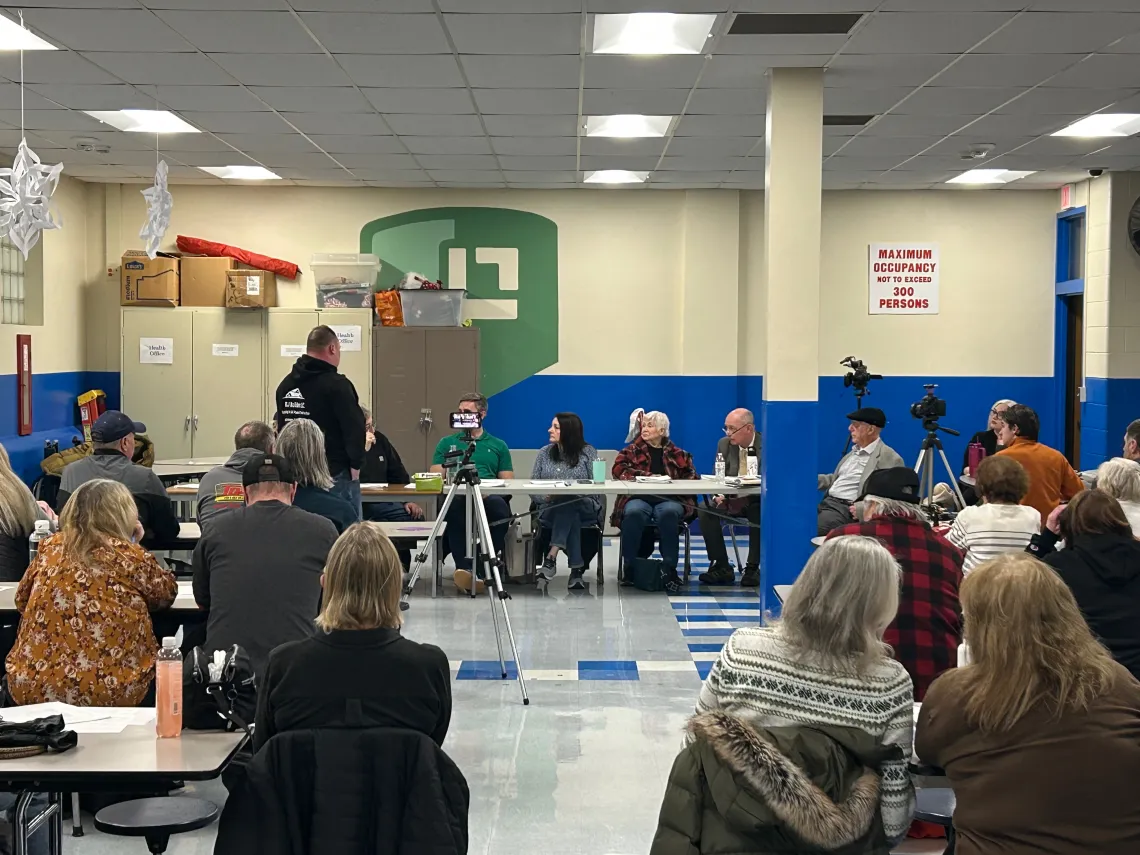
The Cairo Planning Board prepares for the contentious meeting that their ruling promoted
On Thursday, March 6th, the Cairo Planning Board held a public hearing to ostensibly hear opposition from the Round Top community regarding a proposed redevelopment of the former Blackhead Mountain Lodge and Country Club. However, they instead chose to vote (4-1 on a proposed negative declaration of environmental significance) on the project in advance of the public hearing, in effect rendering the hearing meaningless.
The comments and presentations from community members that followed questioned not only the Planning Board’s assessment that the project plan would mitigate any concerns regarding major environmental impacts, but also the level of their expertise and their motivations in making this decision. Many commenters claimed that the Board had failed in their responsibility to protect the environmental health of its citizens by not requiring an environmental assessment with a positive rather than negative declaration. By issuing a negative declaration under the State Environmental Quality Review Act (SEQRA), no environmental impact statement would be required. As the meeting was called to a close by the Board, the crowd responded with calls of “shame on you” and “you should resign.”
Prior to this meeting and hearing, area neighbors opposing the project had urged the Planning Board to conduct more robust testing by issuing a positive declaration, requiring the developer to complete an environmental assessment, a more comprehensive analysis of the issues than had been completed to date. It was clear that the community and environmental organizations such as the Sierra Club are prepared to file a lawsuit relating to the Board’s decision to forego a complete environmental assessment.