
California Students Are Ready to Lead on Climate
California’s Last Nuclear Plant Is Draining ALL Californians’ Pocketbooks
A Legal Reprieve for the Plovers
California Students Are Ready to Lead on Climate

California’s young people are growing up in a world shaped by climate change ranging from extreme heat and wildfires to flooding, drought, air pollution, and threats to public health. They deserve an education that helps them understand what is happening, how climate impacts their communities, and how they can be part of building solutions.
That is why climate literacy is such an important issue in the 2026 California Legislature. This year, lawmakers are considering bills that would strengthen environmental and climate learning opportunities for students across the state. SB 1048, authored by Senator Josh Becker, would create a voluntary State Seal of Climate Literacy for high school students. The bill would recognize students who demonstrate climate literacy and green skills, and will be heard on the Senate floor in the coming weeks.
AB 2158, authored by Assemblymembers Hoover and Lowenthal, would establish the Outdoor Learning and Environmental Literacy Act of 2026. The bill would encourage school districts, county offices of education, and charter schools to integrate outdoor learning into standards-aligned instruction, and it would direct the California Department of Education to develop statewide guidance on outdoor learning by July 1, 2028.
Together, these bills recognize something students already know, which is climate change is not an abstract future problem. It is shaping their classrooms, campuses, neighborhoods, and futures right now.
Climate literacy is not just about learning the science of climate change. It is about preparing students to think critically, understand how policy works, connect environmental issues to community health and justice, and build the skills needed for the clean energy and climate-resilient economy ahead.
For students in communities already facing pollution, extreme heat, wildfire smoke, flooding, or lack of access to green space, climate literacy is also about equity. Every student should have the opportunity to learn about climate solutions, outdoor environments, and environmental justice.
California’s climate education policies should help students move from awareness to action. That means pairing classroom learning with leadership development, civic engagement, outdoor learning, and real opportunities for students to influence the decisions that shape their schools and communities.
At Sierra Club, we know that climate education cannot stop at awareness. Young people need the tools, confidence, and support to turn what they are learning into action in their own schools, districts, and communities.
That is why the California Youth Climate Policy Leadership Program is such an important model. CYCP is a joint program led by the Sierra Club San Francisco Chapter, Ten Strands, and UndauntedK12, designed to empower high school students to take climate action into their own hands.
Through the program, students participate in a summer retreat and monthly workshops focused on foundational knowledge and skill-building related to environmental and climate action. They then apply what they learn by leading a campaign to pass new climate policies, or strengthen existing policies, in their school or district.
Students also receive mentoring from adult coaches, support in developing a personal leadership plan, and guidance as they build and implement their advocacy campaign. Participants who complete all program requirements are eligible to receive a $500 stipend.
The program is open to students entering 9th through 12th grade in the 2026–27 school year. Applications are due Sunday, May 31, and applicants can expect to hear back about acceptance in June.
California’s Last Nuclear Plant Is Draining ALL Californians’ Pocketbooks
By Gianna Patchen, Santa Lucia Chapter Coordinator, and Andrew Christie, former Santa Lucia Chapter Director
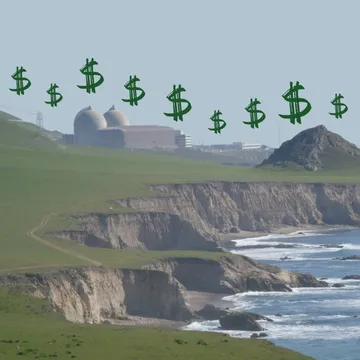
This article is accompanied by an action: Please join us in telling legislators across California, PG&E must stop overcharging ALL Californians to prop up the Diablo Canyon Nuclear Plant.
California’s last nuclear plant, Diablo Canyon, was slated to close in 2025. After backdoor nuclear lobbying in Sacramento and stoked fear about California’s energy supply – Governor Gavin Newsom and an obliging legislature pushed through last-minute legislation that extended Diablo Canyon’s life 5 years beyond its decommissioning date. But now they’re trying to extend the nuclear plant to 2045, while we’re still left with the lingering question: does anyone know what Californians are paying for the 5-year extension?
When PG&E originally decided to close the plant, they did so because their own analysis found it would soon be no longer profitable to operate Diablo Canyon and the plant actually impeded California’s ability to transition to renewable energy. In the plant’s shutdown plan, they stated:
“PG&E in consultation with the Parties has concluded that the most effective and efficient path forward for achieving California's SB 350 policy goal for deep reductions of [Green House Gas (GHG)] emissions is to retire Diablo Canyon at the close of its current operating license period and replace it with a portfolio of GHG free resources.”
Instead, we got Governor Newsom’s about-face and a 5-year extension of Diablo Canyon. On top of that, California gave PG&E a $1.4 billion interest-free loan to subsidize keeping the nuclear plant open. That’s one way to make an unprofitable plant profitable again – use California tax dollars to subsidize corporate profit!
Even after ongoing hearings and an array of potential offramps in the legislation that require updated assessment of the necessity, safety and affordability of the nuclear plant, the California legislature has never required comprehensive, independent analysis of the costs of the 5-year extension.
However, UC Santa Barbara has started that work for them. In April, a study written by UC Santa Barbara’s “2035 Initiative” economists found that “PG&E is overcharging Californians to keep the last nuclear power plant open” as reported by the LA Times.
“In the new white paper from UC Santa Barbara's 2035 Initiative, three climate policy experts analyzed PG&E's public filings and the Department of Energy's evaluation of plant costs. They find that PG&E inflated costs when it requested the state loan and is likely to come up $658.6 million short in repaying it, which will be borne by taxpayers unless the Legislature takes action.”
The report even found that PG&E added fees that “aren't necessary for plant operations, and without [the fees]…the authors find, it could save California utility customers an estimated $1.84 billion.” The big jump many saw in March’s PG&E electric bills was not great timing.
For those of you outside of PG&E utility territory, your bills are paid into the Diablo pot too, via volumetric performance fees that go towards PG&E district upkeep, but don't come back to your district.
Meanwhile, “PG&E has enjoyed record profits the last three years,” almost $2.5 billion in 2024 alone.
Despite all this, PG&E and their proponents are aiming for another extension – this time, 15 years. This effort is picking up traction in Sacramento, despite the growing evidence that Diablo Canyon Nuclear plant is too expensive and the still missing comprehensive financial and needs analysis.
Not to mention concerns about safety, public health and environmental impacts from the plant as Trump’s Nuclear Regulatory Commission reduces nuclear safety regulations, security measures and safety inspections. These issues don’t seem to be top of mind for the legislature, but affordability is a priority amidst the current state budget deficit.
Now is the time to stop PG&E from sucking up money from Californians to profit off of this aging nuclear power plant. But we need community members across the state pushing back on this shared affordability issue. Leave a personal message telling your state representatives you do not want to subsidize Diablo Canyon Nuclear Plant and PG&E corporate profits any longer.
A Legal Reprieve for the Plovers
By Sierra Club California and Santa Lucia Chapter

On April 9, a federal court ruled that the California Department of Parks and Recreation has violated the Endangered Species Act by allowing motorized vehicle use that harms the threatened Western snowy plover at the Oceano Dunes State Vehicular Recreation Area. The court granted an injunction halting off-road vehicle activity in snowy plover habitat.
This ruling is not just about one park or one species. It reinforces that California’s public lands must be managed in a way that protects endangered wildlife, coastal ecosystems, and nearby communities, not sacrificed for destructive off-road vehicle use. Oceano Dunes is one of the most visible examples of how outdated recreation policies can harm sensitive habitats, worsen air quality, and undermine California’s broader commitments to biodiversity, climate resilience, and environmental justice.
“The court’s ruling makes it clear that off-roading in snowy plover habitat violates the Endangered Species Act and must stop,” said Zeynep Graves, a senior attorney at the Center for Biological Diversity. “For decades, state officials have let off-road vehicles tear through protected habitat at Oceano Dunes, injuring and killing snowy plovers, harassing roosting flocks, and degrading their habitat. These threatened shorebirds will be safer and stand a better chance at survival thanks to this ruling.”
The Center filed suit in 2020 after providing notice of violations to State Parks in 2017 and 2020. At issue is the lack of an Endangered Species Act permit from the U.S. Fish and Wildlife Service to incidentally “take” protected wildlife, which State Parks can only obtain if it develops a Habitat Conservation Plan that protects the plovers.
Although state park officials began developing a habitat conservation plan in the early 2000s after being sued by the Sierra Club, the plan remains unfinished more than two decades later. The agency has continued to authorize motorized vehicle use at Oceano Dunes without a permit. Its own records document many incidents in which snowy plovers have been killed and harmed by vehicle activity.
Currently under federal review, State Parks’ draft Habitat Conservation Plan is severely flawed and any federal permit issued on that basis would share those flaws.
San Luis Obispo County can and should amend its Local Coastal Plan (LCP) to permanently end the harm to endangered species, the environment, and the community of Oceano caused by off-road activity in the Oceano Dunes.
Follow Us:
  |
Thank you for being a part of our work! Consider making a monthly donation. You may securely donate online or by sending a check to Sierra Club California at 909 12th Street, Suite 202, Sacramento, CA 95814.
