The August, 2025, newsletter from the Iowa Chapter of the Sierra Club is now available. In this issue, you will find:
Water Quality
NEW Cooperative Fined for Fertilizer Spill in Nishnabotna River - In March, 2024, 265,000 gallons of nitrogen fertilizer leaked from a fertilizer storage tank at NEW Cooperative, Inc. near Red Oak, Iowa, killing almost 800,000 fish, plus frogs, snakes, mussels, and earthworms. The State of Iowa recently settled with the Co-op for a $50,000 civil penalty and another $50,000 payment to the Montgomery County Conservation Board.
Pattison Sand Update - Pattison asked the Department of Natural Resources for a permit to withdraw 3.7 billion gallons of water annually. The Department put the permit application on hold for a year, while the Iowa Geological Survey undertakes a comprehensive evaluation of Pattison’s request and its impacts on nearby private wells, public wells, water levels, and regional aquifers. There will be a public meeting to discuss the Iowa Geological Survey study on August 22 from 2 to 6pm at the Keystone AEA, 1400 N 2nd Street in Elkader, Iowa; this is a come-and-go meeting and you do not have to attend all 4 hours. Staff from the Iowa Department of Natural Resources Water Use Program, DNR Field Office, and the Geological Survey will be present.
EPA removing large rivers from impaired waters list - On December 30, 2024, EPA finalized approval of the state's impaired waters list and added five additional river segments with 7 impairments to the list - Cedar River, Des Moines River, Iowa River, Raccoon River, and the South Skunk River - due to nitrate, nitrite, and nitrate plus nitrite pollution. The segments of these rivers are used for drinking water. A new administrator at EPA has reconsidered its decision.
Dead Zone - in the Gulf of Mexico is about the size of Connecticut this year. Nutrients from Iowa are a large contributor. Unfortunately, Iowa's network of sensors will be reduced from 80 sensors to 20 sensors if funding is not restored by the legislature in 2026.
Des Moines River and Coal Ash Pollution - The Ottumwa Generating Station is seeking permission from the Iowa Department of Natural Resources to give them an NPDES permit that would allow them to transport polluted water from its coal ash landfill to the sewage treatment plant which would then process the liquid and discharge it to the Des Moines River. The problem is that the sewage treatment plant does not have the technology to remove the pollutants and will be discharging them into the River. Attend the video public hearing on the Ottumwa Generating Station's plan for handling contaminated drainage water on September 3 at 10:00.
Reminder: Have your well water tested for nitrates
Pipelines
Judicial Review of Summit Pipeline Decision - All of the briefs have been submitted. We expect that the next step will be an oral argument to the judge. This allows the parties to highlight important points and for the judge to ask questions to clarify the arguments.
What’s the Fuss about Carbon Pipeline Corridors? Notification corridors are a critical aspect of the pipeline permitting process. The letters sent to those in the notification corridor are typically how people find out about a project, and the rights they have as targeted landowners. Without this initial notice, many Iowans would be deprived of their due process rights to defend their land from being taken by the government for private profit. However, some of our opponents are trying to remove that notice requirement from the law - and we disagree.
Protecting the Environment
The Farm Bill - see the issues that Sierra Club members are discussing with our federal legislators on the Farm Bill.
Lunch and Learns Fridays at noon - every Friday we go live on Facebook discussing an environmental topic.
Book reading: Iowa's Changing Wildlife, September 17 - Tom Reardon, Executive Committee Vice-Chair of the Sierra Club Iowa Chapter, will lead a discussion and explore the book Iowa’s Changing Wildlife: Three Decades of Gain and Loss. The authors are James Dinsmore and Stephen Dinsmore. This discussion will dive into how Iowa’s wildlife and natural landscapes have evolved over the past 30 years—what species are thriving, which are disappearing, and what these changes mean for the future of conservation in our state. Pick up the book now and join us for the virtual discussion on September 17 at 6pm central time.
Experience Peak Hawk Migration at the Hitchcock Nature Center, Outing, Honey Creek, Iowa - September 20 from 11:00 AM to 1:00 PM. Mid-September marks the height of hawk migration, and we’ll be hitting the trails with naturalists and HawkWatch biologists to learn all about these incredible birds.
Plus
Contribute to the Iowa Chapter
Volunteer for the Iowa Chapter
Calendar of events
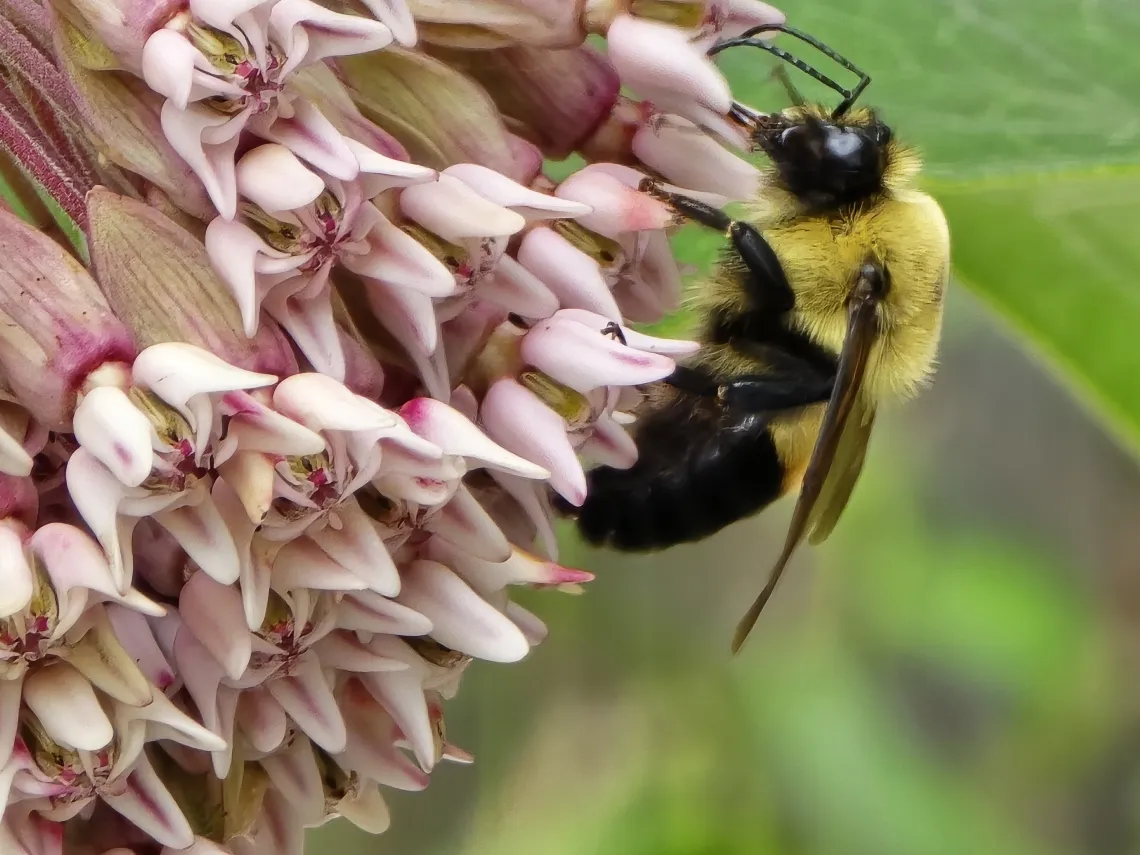
Photo of bumblebee on milkweed by Nick Graceffa.