Water issues remain in the news this month.
NEW Cooperative was given a slap on the wrist for the fertilizer discharge into the East Nishnabotna River earlier last year that killed 800,000 fish.
This year's dead zone in the Gulf of Mexico is about the size of Connecticut.
We are staring at a significant loss in the number of sensors testing for nutrients in Iowa's waterbodies in 2026 - from 80 to 20 - unless the Iowa legislature restores the funding it removed in 2023.
The Ottumwa Generating Station, a coal-fired power plant, is seeking permission from the Iowa Department of Natural Resources to give them an NPDES permit that would allow them to transport polluted water from its coal ash landfill to the sewage treatment plant which would then process the liquid and discharge it to the Des Moines River. The problem is that the sewage treatment plant does not have the technology to remove the pollutants and will be discharging them into the river.
On top of all of this, the Environmental Protection Agency is in the process of rescinding last-year's decision to place segments of the Raccoon, Des Moines, Iowa, Cedar, and South Skunk Rivers on the impaired waters list due to nitrate and nitrate pollution.
Throughout the summer, Iowans wanting to recreate on the state's lakes have been greeted with signs that warn them that swimming is unsafe due to E. coli and microcystins -- all signs of nutrient contamination caused by manure and commercial fertilizer reaching the lakes.
The Department of Natural Resources put Pattison Sand's request to withdraw 3.7 billion gallons of water on hold and is having a public meeting to discuss a year-long study of the aquifer, municipal water supplies, and private wells.
Our elected officials need to roll-up their sleeves and implement sensible policies that will improve Iowa's water quality. As I said in the last newsletter, Iowans expect that the water we drink is free of harmful pollutants. We expect to fish, boat, paddle, and wade in our streams and lakes without getting sick.
Take care,
Pam Mackey Taylor, Chapter Director and Newsletter Editor
Photo at the top of the page is Big Bluestem.
What you can do to help the environment
Attend the public meeting on Pattison Sand to discuss the Iowa Geological Survey study on August 22 from 2 to 6pm at the Keystone AEA, 1400 N 2nd Street in Elkader, Iowa.
Attend the video public hearing on the Ottumwa Generating Station's plan for handling contaminated drainage water on September 3 at 10:00
Ask your state legislators to restore funding for Iowa's Water Sensor Network which tests for nutrients
Send an email to r7actionline@epa.gov and ask EPA to leave the segments of the Raccoon, Des Moines, Cedar, Iowa, and South Skunk rivers on Iowa's impaired waters list for nitrate, nitrite, and nitrate plus nitrite pollution.
Sign up for the book discussion of Iowa’s Changing Wildlife: Three Decades of Gain and Loss. Pick up the book now and join us for the virtual discussion on September 17 at 6pm central time.
If you use a well for your drinking water, have your well tested for nitrates and other pollutants. Contact your public health department.
Sign up to Experience Peak Hawk Migration at Hitchcock Nature Center, Honey Creek, Iowa, September 20
Donate to the Iowa Chapter of the Sierra Club so that we can continue our work on protecting Iowa's environment.
Lunch and Learn presentations - Live-streamed on Facebook on Fridays at noon - https://www.facebook.com/IowaSierraClub
Missed the live-stream lunch and learn? No problem, find them on our YouTube: https://www.youtube.com/@IowaSierraClub/videos
In this issue of the Iowa Sierran
Water Quality
NEW Cooperative Fined for Fertilizer Spill in Nishnabotna River
Dead Zone - the size of Connecticut
Des Moines River and Coal Ash Pollution
Reminder: Have your well water tested for nitrates
Pipelines
Protecting the Environment
Lunch and Learns Fridays at noon
Book reading: Iowa's Changing Wildlife, September 17
Experience Peak Hawk Migration at the Hitchcock Nature Center, Outing, Honey Creek, Iowa - September 20
Plus
Contribute to the Iowa Chapter
Volunteer for the Iowa Chapter
Calendar of events
To see the archive of previous Iowa Chapter newsletters
Book reading: Iowa's Changing Wildlife
In September, Tom Reardon, Executive Committee Vice-Chair of the Sierra Club Iowa Chapter, will lead a discussion and explore the book Iowa’s Changing Wildlife: Three Decades of Gain and Loss. This discussion will dive into how Iowa’s wildlife and natural landscapes have evolved over the past 30 years along with what species are thriving, which are disappearing, and what these changes mean for the future of conservation in our state. The authors are James Dinsmore and Stephen Dinsmore. Pick up the book now and join us for the virtual discussion on September 17 at 6pm central time. Sign up today to join the virtual discussion.
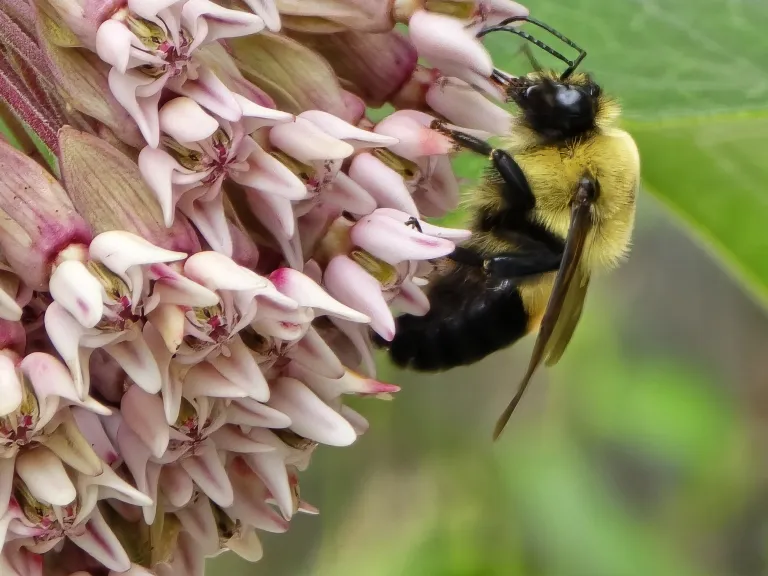
Photo: bumblebee on milkweed by Nick Graceffa
NEW Cooperative Fined for Fertilizer Spill in Nishnabotna River
Between March 9 and March 11, 2024, a valve was left open on a large fertilizer storage tank at NEW Cooperative, Inc. near Red Oak, Iowa. The open valve allowed 1,500 tons (265,000 gallons) of liquid nitrogen fertilizer (32% solution) to drain from the tank into a drainage ditch, which then flowed into the East Nishnabotna River. Not only was the valve left open, nobody was monitoring the site over the weekend. The company had not installed any detection equipment for monitoring open valves.
Over the next few days, the pollution traveled all the way downstream in Iowa, through Missouri, and to the confluence of the Nishnabotna River with the Missouri River – a distance of 60 miles. Along the way, it killed almost 800,000 fish, plus frogs, snakes, mussels, and earthworms.
The Iowa Attorney General settled with New Co-op, resulting in New Co-op paying a $50,000 penalty and another $50,000 to the Montgomery County Conservation Board to support an environmental project. Additionally, New Co-op agreed to a state-wide injunction prohibiting future violations of Iowa’s water-quality laws. Given the large number of fish killed, this appears to be a mere slap on the wrist. A penalty should be sufficient to encourage violators not to violate the law in the future.
This comes on the heels of the settlement the State of Missouri made with New Co-op in May, 2025. NEW Cooperative will pay an administrative penalty of $14,000 to the Atchison County School Fund, a penalty of $9,001 which will be suspended for two years if the NEW Cooperative does not commit further pollution incidents, and an assessment of $18,493.86 to be paid to the Missouri Department of Natural Resources to pay for investigative costs and expenses related to the fertilizer spill. There may be further costs assessed for the damages to the natural resources and the costs and expenses of the Missouri Environmental Emergency Response staff.
There may be additional assessments made by the Fish and Wildlife Service that will recover the restoration of the river and its resources. The Sierra Club will continue monitoring the status of the restoration process.
Pattison Sand Update
Pattison Sand Company mines silica sand in Clayton County. The sand is used for fracking for oil. The sand is combined with other substances as a lubricant to allow drilling between layers of rock to reach oil deposits that regular drilling equipment cannot reach. Pattison currently has a permit to withdraw 976.8 million gallons of water per year for its mining operation.
In September, 2024, Pattison applied for a permit to withdraw 3.7 billion gallons of water per year from several sources, including the Jordan Aquifer. The water will allegedly be used for Pattison’s mining operation. But the application does not explain why almost four times the amount of the current withdrawal limit is necessary for the mining operation. This is especially puzzling when Pattison’s water withdrawal records show that Pattison has not even been using as much water as allowed by its present permit.
The Iowa Department of Natural Resources (DNR) was on the verge of granting the permit, but took public input first. The public comments by Sierra Club and others showed concerns about adverse impacts to the water supply of the City of Garnavillo and private water wells in the area of the mining operation. There also was concern about the health of the Jordan Aquifer.
As a result, the DNR has put the permit application on hold for a year, while it has asked the Iowa Geological Survey to undertake a comprehensive evaluation of Pattison’s request and its impacts on nearby private wells, public wells, water levels, and regional aquifers. The study should be completed by June 30, 2026.
This shows the importance of public input during public comment periods. Thank you to those who attended the public hearing, to those who spoke at the public hearing, and to those who wrote to the DNR. The Sierra Club will continue to monitor the status of this permit application and the Iowa Geological Survey evaluation.
There will be a public meeting to discuss the Iowa Geological Survey study on August 22 from 2 to 6pm at the Keystone AEA, 1400 N 2nd Street in Elkader, Iowa; this is a come-and-go meeting and you do not have to attend all 4 hours. Staff from the Iowa Department of Natural Resources Water Use Program, DNR Field Office, and the Geological Survey will be present.

Photo: Pattison Sand, by Larry Stone
Judicial Review of Summit Pipeline Decision
On June 25, 2024, the Iowa Utilities Commission granted a permit and the right to use eminent domain to Summit Carbon Solutions to build a pipeline to carry carbon dioxide to North Dakota.
Sierra Club and other interested parties intervened in the Utilities Commission proceeding to prevent the issuance of the permit and eminent domain. Despite all of the evidence that was presented, the Commission ruled in favor of Summit anyway.
The legal procedure for challenging the Commission decision is to request review in the Iowa District Court. Sierra Club and other intervenors all filed petitions for review.
The next step in the review process was for all parties on both sides to file written arguments called briefs. Those briefs have now been filed. Sierra Club’s brief pointed out that the Commission’s decision made an incorrect interpretation of the law, was irrational, did not consider relevant evidence, made an unjustifiable application of the law to the facts, and was arbitrary, capricious, unreasonable, and an abuse of discretion.
The briefs filed by the Commission, and by Summit and its supporters made a very weak argument, essentially telling the court that the court must give deference to the Commission decision.
We expect that the next step will be an oral argument to the judge. This allows the parties to highlight important points and for the judge to ask questions to clarify the arguments.
The judge will then take whatever time he needs to consider the facts and arguments and issue a written decision.
No matter which way the judge rules, the case will assuredly be appealed to the Iowa Supreme Court, which means more briefs, more argument, and a decision either affirming the district court judge or reversing his decision.
This entire process could take another year.
What’s the Fuss about Carbon Pipeline Corridors?
Hint: there isn’t one.
By Jess Mazour, Conservation Program Associate, Iowa Chapter of the Sierra Club
Iowans have powerful traction in their fight to ban eminent domain for carbon pipelines. Many landowners on Summit Carbon Solutions' proposed expansion route are refusing to sign away their land. Instead of accepting that its project is not wanted, Summit is doubling down on false solutions like expanding the notification corridor for pipelines. Let’s make it clear: The solution to Iowa’s carbon pipeline crisis is a ban on eminent domain for carbon pipelines.
Four years ago, thousands of Iowans in Summit’s chosen “notification corridor” received a life-changing letter stating that Summit had targeted their land for a risky carbon pipeline. Those unwilling to go along with Summit’s plan would face having their land forcibly taken via eminent domain. This initial letter is required by law to inform landowners of their rights, describe the Iowa Utilities Commission permitting process and extend an invitation to an informational meeting to learn more about the proposed project.
Notification corridors are a critical aspect of the pipeline permitting process. The letters sent to those in the notification corridor are typically how people find out about a project, and the rights they have as targeted landowners. Without this initial notice, many Iowans would be deprived of their due process rights to defend their land from being taken by the government for private profit boondoggles like Summit.
Summit, like all hazardous pipeline companies, picks its own notification corridor. It determines the “preferred route” and sets a buffer distance of the company’s choosing. The pipeline company can then reroute the pipeline, as necessary, anywhere within that corridor. Currently, a pipeline company cannot route its pipeline outside of the notification corridor without approval from the Iowa Utilities Commission and going back to square one to ensure Iowans have due process.
This process works. It allows targeted landowners time to research the project, obtain legal counsel, and participate in the permitting process. No Iowan asked for this system to be changed.
Expanding the corridors without a notice to the public is the brainchild of an industry desperate to protect its unconstrained power.
After landowners successfully put a property rights bill on a path toward Gov. Kim Reynolds' desk in 2025, state Senator Mike Bousselot and allies proposed a new idea: removing the notification corridor. Some senators even dropped the first part of the phrase and just called it a corridor — forget the notification part!
This is nothing more than a distraction. Removing the notification corridor would not be a gift to Iowans concerned about carbon pipelines. It would be a gift to Summit in its struggle to find landowners willing to sign a voluntary easement agreement.
Summit’s carbon pipeline does not provide a public good or protect our planet from climate change. Summit provides private profits to a handful of wealthy investors at the expense of everyday people — our land, our climate, our safety, and on our dime. They should not qualify for eminent domain. Iowa must ban eminent domain for carbon pipelines.
Legislators who believe removing the notification corridor is the solution are probably listening to Summit more than the people who elected them. Iowans aren’t asking for a change in notification corridors. We’re demanding a ban on eminent domain for carbon pipelines. Nothing less.
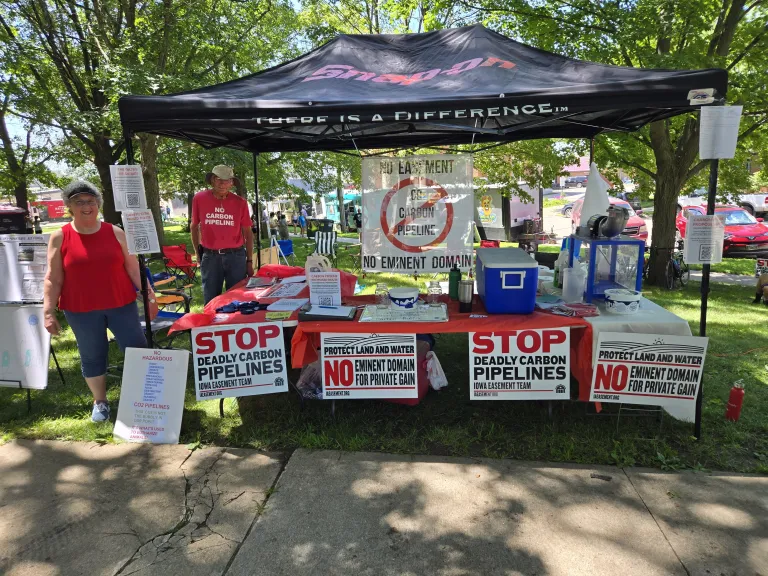
Photo: No CO2 pipeline tent at the Iowa Falls RAGBRAI stop
Dead Zone - the size of Connecticut
This year, the Dead Zone in the Gulf of Mexico is 4,402 square miles, about the size of Connecticut. The dead zone is located south of Louisiana and south of eastern Texas. The Dead Zone is an area so devoid of oxygen that no living animal is able to survive in the water.
The culprits that cause the Dead Zone are nutrients - nitrogen and phosphorus. Nutrients spur the growth of algae in the water. When dead algae decompose, the process depletes oxygen in the water.
Iowa is a large contributor to the Dead Zone, from manure and commercial fertilizer which runs off farm fields into streams and rivers.
There is a national effort and a plan to reduce the Dead Zone in the Gulf called the Gulf Hypoxia Action Plan. The goal is to reduce the size of the Dead Zone to 1930.5 square miles by 2035. This Action Plan led to Iowa's Nutrient Reduction Strategy, which has a goal of reducing nutrients entering Iowa's waterways by 45%.
Currently Iowa has a network of 80 sensors that measure nutrients in the state's rivers, streams, and lakes. In 2023, the Iowa legislature reduced funding for the network. A temporary source of funds was found which kept the sensor network in place. Unfortunately, that funding is ending in 2026. When the funding ends, Iowa will have only 20 sensors left in place.
Ask your state legislators to restore funding for the nitrate sensor in Iowa's water bodies.
To look up your senate member, see www.legis.iowa.gov/legislators/senate
To look up your state representative, see www.legis.iowa.gov/legislators/house
to find your legislators, see www.legis.iowa.gov/legislators/find
EPA removing large rivers from impaired waters list
Every two years, Iowa Department of Natural Resources (DNR) creates a list of impaired waters, also called a 303(d) list. Those are water bodies that are not meeting water quality standards; in other words, they are polluted. Under the federal Clean Water Act, the Environmental Protection Agency (EPA) reviews the list and gives final approval. On December 30, 2024, EPA finalized approval of the state's list and added five additional river segments with 7 impairments to the list - Cedar River, Des Moines River, Iowa River, Raccoon River, and the South Skunk River - due to nitrate, nitrite, and nitrate plus nitrite pollution. The segments of these rivers are used for drinking water.
The Iowa Department of Natural Resources resisted the inclusion of those rivers on the impaired waters list and provided additional materials to the EPA in May of 2025. A new administrator at EPA has reconsidered its decision. In a letter to Ed Tormey who is the Division Administrator for the DNR's Environmental Services Division, the EPA's Regional Administrator James Macy stated ". . .the EPA is seeking additional information from IDNR and whether "good cause" exists to not include the seven referenced waters on its 2024 Section 303(d) List".
Once a water body is placed on the impaired waters list, the DNR is required to create a Total Maximum Daily Load for the water body, which is a plan to reduce the contaminants and return the water body to meeting water quality standards. Obviously, that would require cracking down on the polluters. The largest source of nitrates and nitrites in Iowa's waters are manure and commercial fertilizer.
Even though the DNR and EPA are removing those waters from the impaired waters list, it is clear that the water bodies are polluted and are not meeting water quality standards. In particular, this summer the Des Moines River and Raccoon River were so polluted with nitrates that the Central Iowa Water Works water treatment plant did not have the capacity to remove the nutrients from the drinking water and thus restricted lawn watering for 600,000 residents and businesses in central Iowa.
What you can do
Send an email to r7actionline@epa.gov and ask EPA to leave the segments of the Raccoon, Des Moines, Cedar, Iowa, and South Skunk Rivers on Iowa's impaired waters list for nitrate, nitrite, and nitrate plus nitrite pollution. The Department of Natural Resources is trying to manipulate the numbers showing nitrate and nitrite pollution in these water bodies in order to deny the level of pollution. Although municipal water treatment facilities are currently able to remove the nitrate and nitrite pollution from finished drinking water, that should not be the determination of impairment.
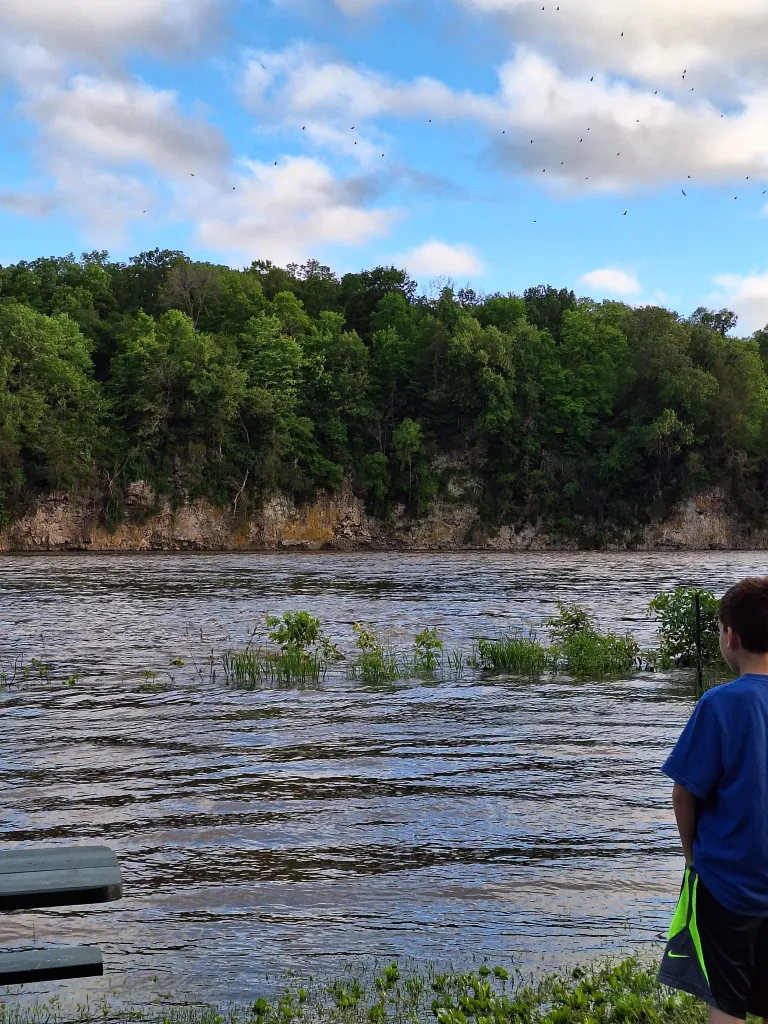
Photo: Cedar River flood waters at Palisades-Kepler State Park, by Pam Mackey Taylor
Des Moines River and Coal Ash Pollution
The Ottumwa Generating Station is seeking permission from the Iowa Department of Natural Resources (DNR) to give them an NPDES permit that would allow them to transport polluted water from its coal ash landfill to the sewage treatment plant which would then process the liquid and discharge it to the Des Moines River. The problem is that the sewage treatment plant does not have the technology to remove the pollutants and will be discharging them into the River. The Sierra Club and our allies are challenging this permit request.
- The DNR will be holding a public hearing on September 3 at 10:00am
- video call link: https://meet.google.com/jhs-bqei-ydo
Or dial: (US) +1 585-667-0159 PIN: 322 930 241# - You will be allowed to speak for 3 minutes.
The Ottumwa Generating Station is a coal-fired power plant located north of Ottumwa, Iowa. It is co-owned by Interstate Power and Light (a subsidiary of Alliant) and MidAmerican Energy (owned by Berkshire Hathaway). Interstate Power and Light (IPL) is the operator of the plant.
When a power plant burns coal, coal ash is among the substances left behind. Coal ash contains toxic and hazardous contaminants that can pollute waterbodies, ground water, drinking water, and the air. Coal ash has several forms:
Fly ash – fine, powdery, mostly silica
Bottom ash – coarse particles that form in the bottom of the coal furnace
Boiler slag – molten bottom ash that turns into pellets
Flue gas desulfurization material – what is left over after emissions are processed to remove sulfur dioxide
Currently IPL trucks the coal ash 5.5 miles from the power plant to the Ottumwa Midland Landfill. The Midland Landfill is 24 acres in size. It is a giant pit with a clay liner. Underneath the landfill is a series of pipes called the underdrain which collect groundwater so that it does not reach the landfill.
IPL had a stormwater permit which allowed discharge into a wetland which then flowed to a creek and the Des Moines River. The mouth of the creek is near the City of Ottumwa’s drinking water intake on the Des Moines River. The stormwater permit required the underdrain liquid to be uncontaminated with pollutants.
Testing of the underdrain water confirmed the presence of cobalt, lithium, manganese, and molybdenum at levels greater than groundwater protection standards. Other pollutants were detected in the underdrain liquid, including arsenic, barium, boron, calcium, iron, magnesium, zinc. All of the pollutants detected are found in coal and coal ash.
Presence of the pollutants in the underdrain liquid is in violation of the stormwater permit as well as the water quality standards in the Clean Water Act and the Safe Drinking Water Act. In August, 2023, the Iowa Department of Natural Resources alerted IPL that they needed an additional permit and had 1 year to obtain the permit. IPL did not request a permit.
In December, 2024, IPL requested an NPDES permit to build a pipe from the landfill to the Des Moines River, without treating the water before discharging it. The discharge would include the toxic and hazardous substances.
In May, 2025, IPL presented a new plan for dealing with the underdrain liquid. IPL would collect the underdrain liquid in storage tanks at the Midland Landfill. They would then truck to the liquid to the Ottumwa Water Pollution Control Facility (the sewage treatment plant) plus the liquid would also be evaporated at the power plant as cooling water. The Iowa Department of Natural Resources wrote a draft permit to allow this. This draft permit is a concern:
The biological setting and chemical settling processes are ineffective in removing the toxins and heavy metals in the underdrain liquid.
Once the treatment processes have been completed, the liquid will be discharged into the Des Moines River. Downstream counties are Wapello, Davis, Van Buren, and Lee Counties in Iowa and the river flows along neighboring Missouri.
Trucking the underdrain liquid to the Water Pollution Control Facility is expensive. The electric customers will be paying for this trucking.
The Sierra Club and our allies are challenging this draft permit. And you can speak out about this at the DNR's public hearing on September 3 starting at 10:00
- The DNR will be holding a public hearing on September 3 at 10:00am
- video call link: https://meet.google.com/jhs-bqei-ydo
Or dial: (US) +1 585-667-0159 PIN: 322 930 241# - You will be allowed to speak for 3 minutes.
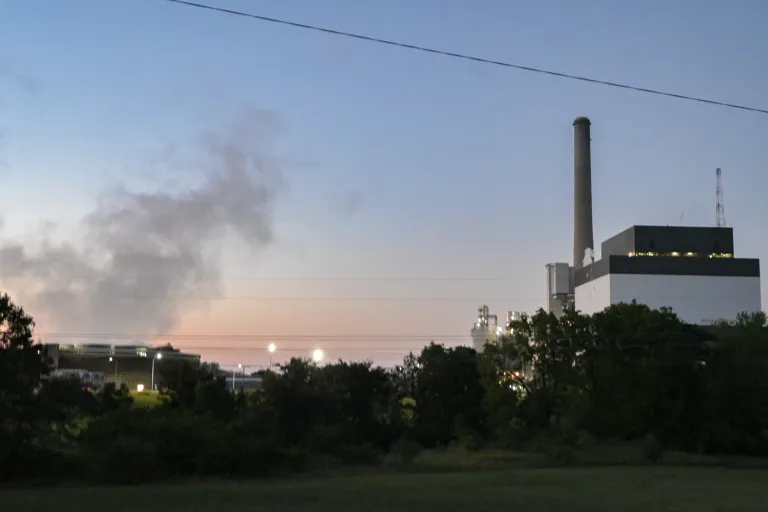
Photo: Ottumwa Generating Station by Emma Colman
Reminder: Have your well water tested for nitrates
The only way you know if the well is contaminated with high levels of nitrates is to have it tested. When you do that, also ask that the water be tested for coliform bacteria, total dissolved solids, and pH levels. Contact your county public health department to determine where to take your water for testing. Play it safe and have your well water tested every year for nitrates.
The Farm Bill
By Debbie Neustadt, Sierra Club member from Des Moines
I would like to thank the Iowa Chapter for contributing to my expenses to lobby in Washington D.C. on the Farm Bill. Iowa has both senators, Grassley and Ernst, and two congressmen, Rep. Nunn and Rep. Feenstra, on the Senate and House Agriculture committees.
It is very rare to meet with the elected officials. Most of the time your appointment is with the staff person that handles the issue. That is true for the meetings I arranged. One difference is Senator Ernst. She has a constituent breakfast on Wednesday mornings at 8 am. Even though I met with staff the day before, I also went to her breakfast.
The list of Sierra Club asks in this lobby visit does require a basic understanding of such things as budget reconciliation, SNAP, Agriculture Resiliency Act of 2025, and farm conservation programs at USDA. We talked about them in only a very broad way without going in depth.
This is a list of the top asks.
• Budget Reconciliation has helped us defend and extend the $20 billion included in the Inflation Reduction Act (IRA) for USDA conservation programs that could benefit all farmers by adding significant amounts to the baseline funding for these critical and popular Farm Programs. This is a thank you that all Iowa members of Congress agreed on.
• Support the Agriculture Resiliency Act of 2025 to increase support for local production and processing, grazing lands, state soil health programs and Conservation Stewardship programs (CSP). There are no Republicans cosponsoring this bill. The most you can hope for is that they will take a look at the bill.
• Oppose the revised Ending Agricultural Trade Suppression (EATS) Act, now renamed as The Food Security and Farm Protection Act (S. 1326) and similar marker bills that undermine state laws and food safety standards. This legislation attempts to repeal what happened in California’s Prop 12 ballot initiative. Since Iowans wrote the legislation, we did not discuss it. Our position is included in the information we leave behind with the staff.
• Restore funding and qualification requirements for SNAP, the nation’s most important food security and nutrition program. I kept asking staff why it was cut and they all mentioned over payment. Individuals would get more money than they were allowed. By the time I talked to Rep. Nunns staff I felt comfortable asking if problems were solved would SNAP benefits be restored and her reply was no.
• The Budget Reconciliation was very generous to the nation’s largest commodity growers – approximately 0.1% of our farmers. It did this by getting rid of the cap on income. This would allow even the richest farmers to get benefits. The 2025 Farm Bill must support the rest of our farmers, our rural communities, food banks and consumers.
Because I represent the Sierra Club as a volunteer, I feel I am not supposed to be a policy expert. Also, I have done this enough to have the opinion that is counterproductive to interrupt or argue with staff. I try to discuss our asks and say a few things about why I think it is important. I always have positive interaction regarding funding for the programs that support conservation. Our Senators and Representatives know that Iowa farmers apply for programs like the Conservation Stewardship Program.
I have always enjoyed talking about public policy. I feel privileged to represent Sierra Club and letting people know that we support conservation spending in the farm bill.
Experience Peak Hawk Migration - Hitchcock Nature Center
Join us on Saturday, September 20 from 11:00 AM to 1:00 PM for a special outing at Hitchcock Nature Center, one of Iowa’s most scenic and biologically rich areas. Mid-September marks the height of hawk migration, and we’ll be hitting the trails with naturalists and HawkWatch biologists to learn all about these incredible birds. Sign up today
This guided hike includes a stop at the park’s observation tower, a look at Loess Hills plant and animal life, and a short talk with Dr. Tom Rosburg at the overlook. Bring your lunch, wear sturdy hiking gear, and get ready for an unforgettable nature experience.
Cost: $5 per person
Location: Hitchcock Nature Center, 27792 Ski Hill Loop, Honey Creek, IA 51542
If you have some time after the event, you might consider a visit to nearby DeSoto National Wildlife Refuge.
Don’t miss this chance to connect with nature, learn from experts, and witness one of the most exciting migrations of the year! Sign up today
Lunch and Learns Fridays at noon
Fridays at noon, we do a Lunch and Learn livestream. See us on Facebook at "Sierra Club Iowa Chapter". These will be recorded so you can watch them anytime. Topics will be selected based on what is happening during the week. During the legislative session, we cover issues coming before the Iowa legislature.
In case you missed our past webinars and lunch and learn sessions, you can still see them on YouTube.
Check out: "2025 Dead Zone in the Gulf of Mexico, the size of Connecticut", August 15, 2025
Keep up on the latest "Carbon Pipeline Update!", August 8, 2025
Don't miss the update on "Pattison Sand", August 1, 2025
See "The Des Moines River and Coal Ash Pollution", July 25, 2025
Volunteer for the Iowa Chapter
Almost everything we do is done by volunteers like you. If you would like to volunteer for the Iowa Chapter, please let us know by sending an E-mail to Iowa.chapter@sierraclub.org. Or sign up by using the online form. There are many opportunities for you to make a difference:
making phone calls
developing graphics for banners and flyers
working on legislative issues
working on elections
fundraising
organizing events
joining an issue committee
If you would like to join our legislative action team, sign up here. Keep on top of what is happening at the Iowa legislature. Be alerted when you should contact your legislators about pending legislation.
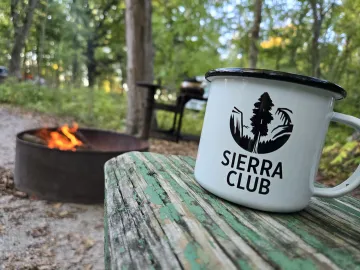
Photo: camping by Jess Mazour.
Contribute to the Iowa Chapter
Sierra Club - working every day on Iowa’s environmental problems
Sierra Club is Iowa’s oldest and largest grassroots environmental organization. Not only that, we are the best bet in the state for achieving bold solutions to Iowa’s environmental problems.
We work in the courts, before Iowa’s public agencies, and in the halls of the legislature. The Iowa Chapter's effort to protect the environment takes financial support. The Chapter receives very little financial support from the national Sierra Club. Can we count on you for a donation to ensure even more victories? Your contribution will be put to work here in Iowa on issues that affect every day Iowans – water quality, clean air, protection of Iowa's soil, parks and natural areas, and a strong democracy. The Iowa Chapter is relentless in fighting back bad legislation that affects every one of us.
Your non-deductible contributions make it possible for us to fight bad legislation and to promote good legislation. We appreciate your past and on-going support of these efforts. You can make a non-deductible donation with a credit card. A non-deductible donation supports the Chapter's effective, citizen-based advocacy and lobbying programs. If you prefer, a non-deductible check can be written to the Sierra Club Iowa Chapter and mailed to:
Treasurer
Sierra Club, Iowa Chapter
PO Box 1058
Marion, IA 52302
You can also make a tax-deductible donation with a credit card. Tax-deductible activities are limited to public interest education, research and legal actions. A deductible check can be written to the Sierra Club Foundation with “Iowa Chapter” written in the memo line.
Thank you for your support.
Donate your used vehicle
As the Sierra Club Foundation's Iowa Chapter continues to raise charitable funds to support its work in Iowa, won’t you consider participating in our vehicle donation program? Our partners over at CARS have made the process of donating your unused or unneeded car, truck, motorcycle, boat or RV easy, efficient and secure. They’ll take care of everything from picking up your vehicle to sending you a tax receipt for your generous gift. To learn more about The Sierra Club Foundation's Iowa Chapter vehicle donation program, please call 844-674-3772. Or visit our webpage to get started today!
Sierra Club Foundation promotes climate solutions, conservation, and movement building through a powerful combination of strategic philanthropy and grassroots advocacy. The Foundation is the fiscal sponsor of Sierra Club’s charitable environmental programs.
For more information
Planned giving . . . naming the Sierra Club Iowa Chapter in your will
Ensure your environmental legacy by naming the Iowa Chapter in your will or trust. These gifts cost you nothing now. You can hold onto your assets for as long as you need them.

Thank you for supporting our work!
| When | Earliest: Latest: |
| What |
|
| Word or Phrase | Word or phrase to search for: |
| Leader | All or part of leader name to search for: |
No Matching Activities Found
Loading
| Date | Activity (click title for full description) | Sponsor | Category | Type | Difficulty | Links |
|---|
Loading ...
 Outing
 Team/Committee meeting
  Volunteer Event
  Activist event
  Multiple events (map only)