This month, one of the members of the Iowa Utilities Commission resigned. That means that the next governor will be appointing two members to the three-member Commission. Elections have consequences. The two new members will have a huge impact on the decisions made by the Commission. Will they be pro-consumer and protective of the environment or will they benefit the utilities at the expense of the public? You can use the birddogging techniques to encourage the next governor to select Utilities Commission Members that protect the public interest. See Birddog Candidates
In the interim, Governor Reynolds can appoint a person to fill the open seat.
Take care,
Pam Mackey Taylor, Chapter Director and Newsletter Editor
What you can do to help the environment
Join us for a guided hike at Stephens State Forest on Oct. 17, 1:00 PM, Lucas, Iowa
Tune into our Lunch and Learn on Fridays at noon
Missed the live-stream lunch and learn? No problem, find them on our YouTube
Contribute to the Iowa Chapter of the Sierra Club so that we can continue our work on protecting Iowa's environment
In this issue of the Iowa Sierran
Protecting Iowa's Environment
Birddogging: Engaging Candidates on Data Center Issues
Sierra Club Successful in Pattison Sand Water Withdrawal Permit
Outdoor Experiences - see upcoming outdoor activity at Stephens State Forest October 17
Lunch and Learns Fridays at noon
Plus
Contribute to the Iowa Chapter
Volunteer for the Iowa Chapter
To see the archive of previous Iowa Chapter newsletters
Gray Fox
By Briana Kouma, Conservation Program Coordinator, Iowa Chapter of the Sierra Club
For the past 25 years, the gray fox population in Iowa and throughout the Midwest has been in a steep decline. Despite this, there has been very little scientific research conducted on the species in this region until recently. Biologist Vince Evelsizer with the Iowa Department of Natural Resources has been leading efforts to better understand these elusive creatures.
Gray foxes are small, typically weighing only 10 to 12 pounds. While classified as carnivores, they are seasonally omnivorous, feeding on fruits, vegetables, and bird seed. They are primarily nocturnal or crepuscular, meaning they are active at dawn and dusk, and they possess the unique ability to climb trees to hunt or escape danger. This specialized behavior makes them truly fascinating and distinct from other Midwest canids.
Research has identified several potential drivers for their population decline. First, diseases such as canine distemper and parvovirus present a significant health risk to the species. Additionally, the foxes face intense competition and predation from larger animals, including coyotes, domestic dogs, and bobcats. Habitat loss is another major factor, as the foxes struggle to find secure, available denning sites in an ever changing landscape. Finally, the high density of roads in the Midwest creates a persistent risk of vehicular collisions, which contributes to mortality.
To address these knowledge gaps, the Iowa DNR has implemented a pilot research project featuring several key components. GPS/Vhf collaring is used to track individual foxes to gain insights into their survival rates, cause-specific mortality, and general habitat use. A highlight of this research is the story of GF2, a "superstar mom" who successfully raised five pups on her own after losing her mate, providing researchers with invaluable insights into the species' resilience. Additionally, teams are deploying camera traps throughout the Driftless region to monitor fox presence, which helps identify where these animals are living. Finally, the project involves genetic collaboration with partners like Iowa State University and Luther College to analyze genetic gene flow and identify potential barriers to movement for gray foxes across state lines.
Because the gray fox thrives in "edge" habitats, the transition zones where forests meet open land, protecting these spaces serves as an "umbrella" for conservation. Efforts to preserve this forest mosaic not only help the gray fox but also provide critical support for other species like the ruffed grouse and golden-winged warblers.
Citizens can play a vital role in these conservation efforts. If you encounter a gray fox, you are encouraged to contact Vince Evelsizer (vince.evelsizer@dnr.iowa.gov) or Dave Hoffman (dave.hoffman@dnr.iowa.gov). Additionally, landowners can work with professional foresters to develop plans that maintain a healthy mosaic of forest ages on their property. Lastly, those interested in supporting this research can make donations through the Iowa Wildlife Federation to help fund tracking tools like GPS collars.
If you missed our Grey Fox Lunch and Learn no worries, check it out here: https://youtu.be/Rc5l_tQ91YM?si=zjfkiIM3yncEizcB
Nuclear Energy Task Force Underplays Risks
In January, Governor Reynolds issued an executive order creating a Nuclear Energy Task Force to study the expansion of nuclear power in Iowa. From the very beginning, it was obvious that the task force would enthusiastically support nuclear power. So, it was no surprise when the task force released a rosy report that glosses over concerns about expansion of nuclear energy in Iowa.
This is much more than hitting the jackpot of economic development projects that benefit a few Iowans. If we are not careful, the state could be digging a hole that will be hard to get out of – nuclear waste spread across the state, taxpayer subsidies with limited benefits for everyday Iowans, putting the most expensive power on the grid and forcing ratepayer bills to climb to unaffordable heights, and backtracking on renewable energy. We can do much better than investing in the nuclear industry.
Nuclear power is expensive. It is not renewable energy. Nuclear power releases all kinds of radioactive emissions, including tritium, which are harmful to human health.
The uranium fuel is mined from the earth. One method involves digging rocks from the ground, which leaves behind tailings piles that are radioactive. The other method involves pumping liquid chemicals into the ground which absorb uranium; followed by pumping the liquid to the surface where the uranium can be extracted. One can only hope that all of the liquid is brought back to the surface and is not allowed to contaminate ground water and soil.
Mined uranium is processed into fuel pellets and placed in fuel rods that are then loaded into a nuclear reactor. After several years of generating power, the fuel is considered spent, but will remain highly radioactive and dangerous for thousands of years.
Currently spent fuel is being stored in concrete casks outdoors on-site at the nuclear power plants. There is no dump site for spent fuel. The storage area at the Duane Arnold nuclear power plant near Palo, Iowa, is already the size of a football field and will be growing if the plant is restarted.
Further, the federal Nuclear Regulatory Commission has certified the casks for 20 years. We all know that concrete deteriorates over time. At some point, the spent fuel will have to be repackaged. This process will put local communities at risk of exposure to radioactive materials.
Given the large power usage by data centers and advanced manufacturing, some of the companies are expressing interest in building micro reactors or small modular reactors within a data center or manufacturing campus. That means spent fuel will be stored on-site. Should any of those companies go bankrupt or move out of the community, radioactive waste and even the power plant will remain and must be guarded for generations. These are more than simple brownfield sites.
Any accident at a power plant can render acres of land uninhabitable and unfarmable for generations. Local communities will need to undertake regular planning for the potential accident, from informing people on how to act to evacuating people from the area to sealing off the area perhaps for generations.
It is obvious that the task force envisions companies getting very rich from investments in nuclear energy while the taxpayer is on the hook for incentives, subsidies, and tax breaks. The report expects the state to provide incentives to the companies engaged in the nuclear industry and to engage in workforce development initiatives that would ensure that workers are trained. Additionally, the task force encourages the state to engage with the federal government in expanding incentives for nuclear projects. In order to expand nuclear energy and the supply chain in Iowa, the report recommends that a single-point of contact be hired by the state to facilitate nuclear energy development activities.
Among the task force recommendations is a process for local communities to raise their hands and offer to be hosts for nuclear power plants. Little is mentioned about the responsibilities and risks.
Instead of supporting nuclear power, the state should continue its leadership in renewable energy - wind energy, solar energy, and battery storage.
Although the task force report supports a robust nuclear energy presence in Iowa, it is time to step on the brakes and ask serious questions about the risks, costs of nuclear power, dealing with nuclear waste in communities, and health impacts related to living near nuclear power plants and nuclear waste.
Join Us Outdoors
Saturday, October 17th, Stephens State Forest (48546 137th Trail, Lucas, Iowa) - Lace up your hiking boots and join us on Saturday, October 17th at 1:00 for a guided hike through Stephens State Forest! Led by an officer working for the Department of Natural Resources, this hike is a great opportunity to experience the forest's scenic beauty while learning about its ecology and wildlife. Sign up for this event
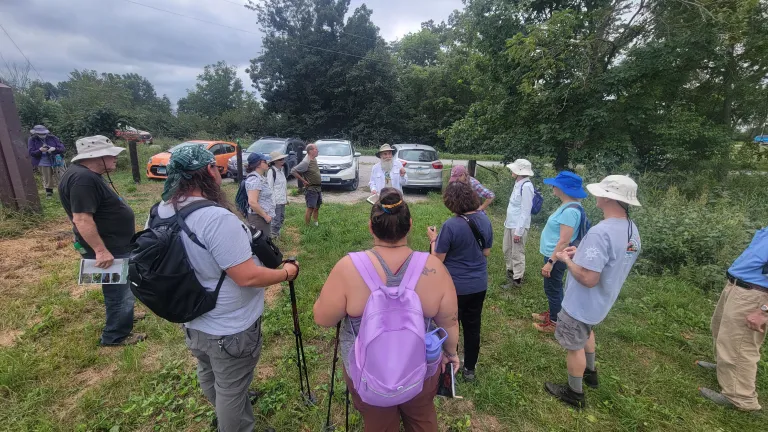
Photo of Ciha Fen hike, led by Dr. Tom Rosburg. Photo contributed by Sheri Albrecht.
Birddogging: Engaging Candidates on Data Center Issues
One of the hot-button issues this election cycle revolves around data centers, the electricity and water resources they require, and the impacts on local communities. Elected officials and candidates hear from countless people every day. When constituents consistently show up, ask questions, and make their concerns known, it sends a powerful message: these issues matter to voters! One effective way to engage candidates is through birddogging, attending public events where candidates are speaking and asking thoughtful, direct questions about the issues that matter to our communities.
We have some tools to help you.
View our webinar on birdogging: Birddogging Webinar Recording and Webinar Slides
See our list of questions you can ask candidates about the data center issues
Report Back - Share a birddogging interaction you had
The goal is simple: make sure candidates know that data centers, our water, our energy, and our communities matter to voters.
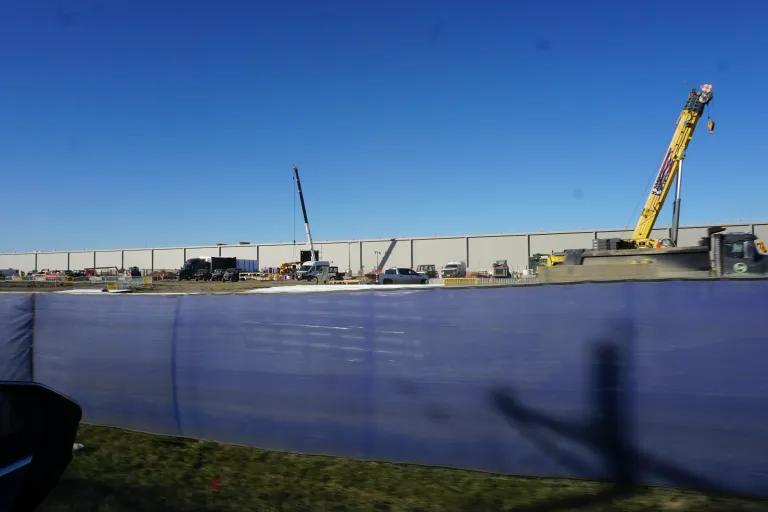
A data center under construction in Cedar Rapids, Iowa
Sierra Club Successful in Pattison Sand Water Withdrawal Permit
The Department of Natural Resources (DNR) recently issued a new permit for Pattison Sand to withdraw water from the Jordan Aquifer. The DNR put the clamps on the Pattison Sand water withdrawal permit request - making significant cuts in the water Pattison will be allowed to withdraw (as opposed to what they asked for, 2.27 billion gallons annually as opposed to 3.7 billion gallons), a 5 year permit instead of 10, a required meter to measure how much is withdrawn, a required monitoring well to measure the level of water in the aquifer with a monthly report. Sierra Club pushed hard on this and it was a big win. Even so, we will continue to monitor the withdrawal to ensure that Pattison complies with their permit and that neighboring wells are not impacted.
In September, 2024, Pattison applied for a permit to withdraw 3.7 billion gallons of water per year from several sources, including the Jordan Aquifer, to be used for Pattison’s mining operation. But the application did not explain why almost four times the amount of their current withdrawal limit was necessary for the mining operation. This was especially puzzling when Pattison’s water withdrawal records showed that Pattison had not even been using as much water as allowed by its present permit.
As a result of public outcry, the DNR paused the permit process until the Iowa Geological Survey could perform a year-long comprehensive evaluation of Pattison’s request and its impacts on nearby private wells, public wells, water levels, and regional aquifers. Based on the study, the DNR issued a permit with a limit of 2.27 billion gallons per year with a withdrawal only from the Jordan Aquifer.

Photo: Pattison Sand by Larry Stone
IPL Gas Plant in Linn County
Interstate Power and Light Company (a subsidiary of Alliant Energy) (IPL) proposes to build a gas-fired power plant in Linn County, called the Morgan Valley Energy Center. This is one of at least three gas-fired power plants that IPL is developing. And Central Iowa Power Cooperative, a rural electric cooperative transmission and generation company, is developing a gas-fired power plant in Scott County. All of these projects must obtain a permit from the Iowa Utilities Commission.
This new reliance on fossil fuels is a retreat from Iowa’s leadership in renewable energy. Natural gas is not renewable and is a source of numerous air pollutants: NOX, CO, SOX, VOC, PM, PM10, PM2.5, CO2e, and lead. IPL claims these gas plants are necessary to provide power to address increased demand for electricity. But IPL has not shown why renewable energy (wind and solar) supported by battery storage cannot satisfy this alleged demand. Nor has IPL said where this alleged increased demand is coming from, although we are sure it is related to the influx of data centers.
In order to issue a permit to a new generating plant, the Utilities Commission must determine that the facility will provide needed power to Iowa consumers, be consistent with Iowa’s environmental policies, be cost-effective, will avoid the cost and availability of fuel, and be consistent with environmental policies considering available technology and available alternatives.
We are confident that a gas-fired plant, like the Morgan Valley Energy Center, cannot meet these criteria. But we are not confident that the current members of the Utilities Commission will properly apply these criteria. The Iowa Legislature has clearly, in several statutes, said that the intent of the legislature is to encourage renewable energy. That alone should be the death knell for a gas-fired power plant. But the Utilities Commission conveniently ignores this legislative intent when permitting gas-fired plants, but emphasizes that intent when permitting a solar project.
The evidentiary hearing before the Iowa Utilities Commission on the Morgan Valley Energy Center will begin on December 7, 2026, in Cedar Rapids.
Lunch and Learns Fridays at noon
Fridays at noon, we do a Lunch and Learn livestream. See us on Facebook at "Sierra Club Iowa Chapter". These are recorded so you can watch them anytime. Topics will be selected based on what is happening during the week. During the legislative session, we cover issues coming before the Iowa legislature.
In case you missed our past webinars and lunch and learn sessions, you can still see them on our YouTube.
Nuclear Energy Task Force Underplays Risks, September 18, 2026
Big IUC News + Summit Trying To Force Process, September 11, 2026
Unpacking Environmental Impact Statements, September 4, 2026
Birddogging: Engaging Candidates on Data Center Issues, September 3, 2026
Grey Fox in Iowa, August 28, 2026
Upcoming Events!, August 21, 2026
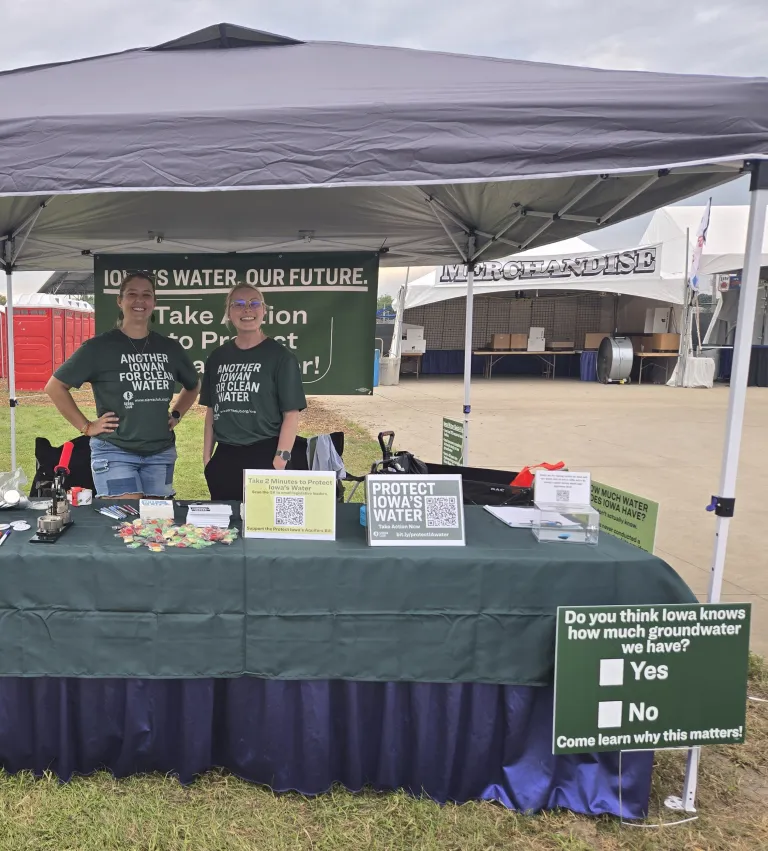
Photo: Jess Mazour and Briana Kouma staff the Sierra Club booth at the Iowa State Fair. Folks stopped by the booth during the AJR concert. AJR is an American pop band. Three brothers who founded the band - Adam, Jack, and Ryan Met - are singers and songwriters. Billboard magazine ranked AJR as one of the 100 top-selling touring artists of 2024. According to Wikipedia, "AJR describes their musical style is a mixture of many different genres such as dubstep, doo-wop, hip-hop and theatrical musical like Broadway".
Volunteer for the Iowa Chapter
Almost everything we do is done by volunteers like you. If you would like to volunteer for the Iowa Chapter, please let us know by sending an E-mail to Iowa.chapter@sierraclub.org. Or sign up by using the online form. There are many opportunities for you to make a difference:
making phone calls
developing graphics for banners and flyers
working on legislative issues
working on elections
fundraising
organizing events
joining an issue committee
If you would like to join our legislative action team, sign up here. Keep on top of what is happening at the Iowa legislature. Be alerted when you should contact your legislators about pending legislation.
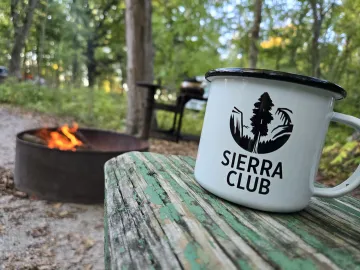
Photo: camping by Jess Mazour.
Contribute to the Iowa Chapter
Sierra Club - working every day on Iowa’s environmental problems
Sierra Club is Iowa’s oldest and largest grassroots environmental organization. Not only that, we are the best bet in the state for achieving bold solutions to Iowa’s environmental problems.
We work in the courts, before Iowa’s public agencies, and in the halls of the legislature. The Iowa Chapter's effort to protect the environment takes financial support. The Chapter receives very little financial support from the national Sierra Club. Can we count on you for a donation to ensure even more victories? Your contribution will be put to work here in Iowa on issues that affect every day Iowans – water quality, clean air, protection of Iowa's soil, parks and natural areas, and a strong democracy. The Iowa Chapter is relentless in fighting back bad legislation that affects every one of us.
Your non-deductible contributions make it possible for us to fight bad legislation and to promote good legislation. We appreciate your past and on-going support of these efforts. You can make a non-deductible donation with a credit card. A non-deductible donation supports the Chapter's effective, citizen-based advocacy and lobbying programs. If you prefer, a non-deductible check can be written to the Sierra Club Iowa Chapter and mailed to:
Treasurer
Sierra Club, Iowa Chapter
PO Box 1058
Marion, IA 52302
You can also make a tax-deductible donation with a credit card. Tax-deductible activities are limited to public interest education, research and legal actions. A deductible check can be written to the Sierra Club Foundation with “Iowa Chapter” written in the memo line.
Thank you for your support.
Donate your used vehicle
As the Sierra Club Foundation's Iowa Chapter continues to raise charitable funds to support its work in Iowa, won’t you consider participating in our vehicle donation program? Our partners over at CARS have made the process of donating your unused or unneeded car, truck, motorcycle, boat or RV easy, efficient and secure. They’ll take care of everything from picking up your vehicle to sending you a tax receipt for your generous gift. To learn more about The Sierra Club Foundation's Iowa Chapter vehicle donation program, please call 844-674-3772. Or visit our webpage to get started today!
Sierra Club Foundation promotes climate solutions, conservation, and movement building through a powerful combination of strategic philanthropy and grassroots advocacy. The Foundation is the fiscal sponsor of Sierra Club’s charitable environmental programs.
For more information
Planned giving . . . naming the Sierra Club Iowa Chapter in your will
Ensure your environmental legacy by naming the Iowa Chapter in your will or trust. These gifts cost you nothing now. You can hold onto your assets for as long as you need them. Thank you for supporting our work!

Resources for Planning for the Future
The Iowa Chapter has three resources to assist you in planning for the future - one pagers about giving via Donor Advised Funds, IRA Qualified Charitable Distributions, and planned gifts.
The flyer Donor Advised Funds (aka DAF) covers basics of Donor Advised Funds and how an individual can designate support specifically to the Iowa Chapter.
The flyer Giving through an IRA covers how to make a Qualified Charitable Distribution (aka QCD) and how it can be directed to the Iowa Chapter.
The flyer Plan Today Protect Tomorrow covers the basics of planned giving, including bequest language to make a gift to the Iowa Chapter.
If you need assistance, contact Julia Curtis at 800-932-4270, giftplanning@sierraclub.org .
| When | Earliest: Latest: |
| What |
|
| Word or Phrase | Word or phrase to search for: |
| Leader | All or part of leader name to search for: |
No Matching Activities Found
Loading
| Date | Activity (click title for full description) | Sponsor | Category | Type | Difficulty | Links |
|---|
Loading ...
 Outing
 Team/Committee
meeting
Team/Committee
meeting
 Volunteer Event
 Activist event
 Multiple events
(map only)
Multiple events
(map only)