
October 2026
In this issue:
- Annual Celebration 2026- Register Today!
- Your Vote Matters More Than Ever
- Introducing: Fireside Chats- Coming to You!
- How Well is Maine Doing on its Climate Budget?
- Sustainable Business Highlight: Piper Shores
- Community Conversation: Talking Ticks with Dr. Beatrice Szantyr
- Protest: Respect it, Defend it, Use it
- Green Tip of the Month
- The Month Ahead
- Volunteer With Sierra Club Maine

Annual Celebration 2026- Register Today!
By Corrine Adamowicz
Sunday, October 11, 2026 12:00 PM - 3:00 PM
Wolfe’s Neck Smith Center, 184 Burnett Rd, Freeport, ME 04032
Delicious Food, Live Music, and Fun for All Ages!
The Sierra Club Maine Chapter has had a busy year defending public lands, working to hold industrial polluters accountable, advocating for clean transportation, and forging new connections and partnerships among our Maine community. We are so proud of the work we've accomplished, and above all, incredibly grateful for the members, volunteers, and supporters that have brought these efforts to life (that's you!)
To say thank you and bring our chapter together to celebrate this year of action, our dedicated events team has organized an exciting line up of attractions including live music from homegrown Maine band GoldenOak, performing as a trio for this special event, catered lunch from Wild Oats Bakery & Cafe, craft corner, outdoor games and trails, complimentary beer from Maine Beer Company, a silent auction and a pre-event wagon ride! Arrive at 11:15am to join the educational wagon ride before making your way to the registration table at 12:00pm to enjoy lunch, networking, and an address from Chapter Director Jane Brekke.
Click here to see the Silent Auction line-up!
Do you own an electric vehicle?
This is an invitation for Sierra Club EV owners to park their vehicles in the specially marked area for EVs during their attendance of the annual celebration. This is part of National Drive Electric Month, which Sierra Club sponsors. Whether you want to talk about your EV with other attendees or not, please plan to park in the marked EV area as a show of solidarity among EV owners and a show of Sierra Club support for EV adoption. EVs do lower carbon footprints while making economic sense to individuals.
A HUGE THANK YOU to our amazing sponsors and in-kind donors, listed below!
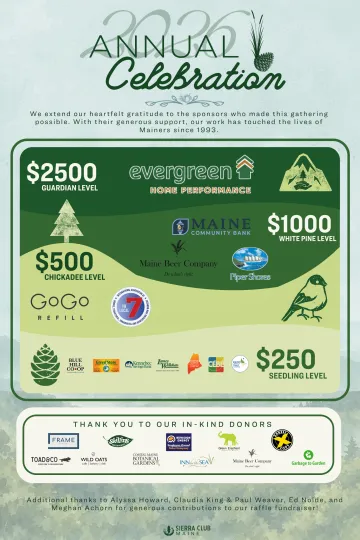
Special thanks to our Events Team members Alyssa Howard, Julie Jacob, Anya Keshishian, Lauren Strohmeier, and Amy Witt

Your Vote Matters More Than Ever
By Matt Cannon

Introducing: Fireside Chats- Coming to You!
By Ashley Nye
Maine is often described as "just one big small town" and although that may be true socially, the truth is that we're a huge place! It hasn't slipped our notice that most events we hold tend to be concentrated along the bustling coastline, leaving many of our rural members and supporters underrepresented at the table. This fall, we are hosting two casual meetings in Orono and Millinocket to begin to close that gap. We've also partnered with the Orono Land Trust and the Katahdin Collaborative to bring these meetings to life!
Join us for a potluck-style gathering where we will discuss current chapter work, community challenges, and get to know each other! Fireside chats are a new program to expand Sierra Club presence throughout the state in areas where members don't often have the opportunity to gather together. Socialize with other members and supporters in the area who are just as passionate about the environment as you! Sierra Club staff will be present to talk about our ongoing work, and learn more about the challenges our members and supporters are facing locally. Here's the details:
Millinocket Fireside Chat: Register
- October 14th
- Birch's Campground
- Meet at 4:30pm to join our Trail Mixer hike, or 5:30pm for food and socializing
Orono Fireside Chat: Register
- October 15th
- Caribou Bog Outdoor Center
- Meet at 4:30pm to join our hike, or 5:30pm for food and socializing
Please plan to bring a shareable dish to add to our potluck! Plates, napkins, cups, and utensils will be provided.

How Well is Maine Doing on its Climate Budget?
By David von Seggern
There is no room left for debate on the connection between greenhouse gas GHG emissions and the warming climate. This year 2026 is expected to finish as the warmest year on record for our planet by UN climatologists. While the level of closely-watched CO2 (carbon dioxide) continues to climb, CH4 (methane) emissions, which carry a much higher global warming potential than CO2, also continue to climb. This almost certainly entails further record years of heat ahead.
While Maine contributes only a very small fraction of the global GHG emissions, we should be mindful that we all have the obligation to reduce GHG emissions through local and state policy and regulation. Maine does have an array of such laws and regulations and is recognized as a climate leader among states. For example, the last legislature passed the second law in the nation to allow “balcony solar”, a means for individual homeowners and renters to reduce their electricity bills while also reducing the GHG emissions of Maine. There are other policy decisions in Maine going back a generation to help reduce GHG emissions in our state.
How are we doing though? Has the mix of policy, regulations, and opportunities been sufficient for Maine to make significant cuts in its GHG emissions? In order to answer this, I turned to Climate Trace, a non-profit organization built by climate researchers, concerned scientists, data specialists, and web designers. Climate Trace combines satellite observations, ground sensing, and complex modeling to estimate the amount of GHG emissions from millions of point and areal sources around the entire globe. Climate Trace is a detailed database of human-caused (anthropocentric) GHG emissions from all significant sources.
The Climate Trace website offers aggregated GHG emissions data for countries, states, counties, and municipal regions. Here one can retrieve GHG emission estimates for the US, Maine, Cumberland County, and the Portland urban area as well as the entire globe. Data only back to 2021 is granulized down to urban areas, and I draw on only those five years of data (2021-2025). Estimates for 2026 are ongoing, with monthly estimates available with only two months delay. One of the features of Climate Trace is its immediacy compared with most other GHG accounting systems.
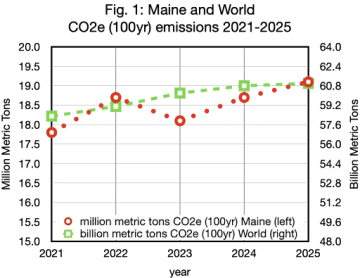
Figure 1 shows the comparison of Maine’s total GHG emissions from Climate Trace for the years 2021 to 2025 compared to the world’s GHG emissions for the same time period. Note that the scale is on the left for Maine and on the right for the world. Note also that scales are set such that slopes match when relative increases match. The data indicate that Maine is doing about as well as the entire world in controlling the rise in GHG emissions; however, in both cases, the upward trend is of great concern.
Within Maine, the urban area of greater Portland has been delineated by Climate Trace as an aggregated area. It makes sense to focus on this area because roughly 1/5 of Maine’s population live in it. It is also important to note that the cities of Portland and South Portland have jointly started an aggressive GHG-reduction program as outlined in the One Climate Future document issued in 2020.
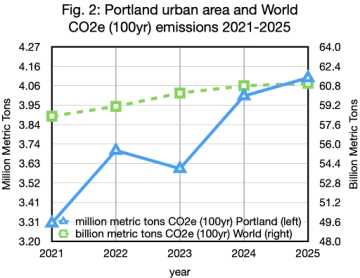
Figure 2 shows the comparison of Portland area’s total GHG emissions from Climate Trace for the years 2021 to 2025 compared to the world GHG emissions for the same time period. Note that the scale is on the left for the Portland area and on the right for the world and that, like Figure 1, the scales are set such that trends can be compared. It is not possible for Climate Trace to simply put a boundary around Portland and South Portland because GHG emission plumes don’t respect municipal boundaries. An urban-area boundary is much more reasonable in which to report GHG emissions although there will still be uncertainties associated with the larger boundary. The upward trend of Portland’s GHG emissions significantly exceeds that of the entire world and amounts to a 24% rise in four years over the 2021 amount. This is especially disturbing given that Portland and South Portland have issued an aggressive GHG reduction plan.
The population increase of Cumberland County is reported by the US Census Bureau to be 4.7% in the years 2020-2025; and so this fact alone fails to explain the 24% rise in GHG emissions shown in Figure 2. Climate Trace offers a more granular assessment of emissions by “sector”, and it is clear that transportation (road), power generation, and buildings (heating, cooling, and hot water) are by far the major contributors to GHG emissions within the urban area.
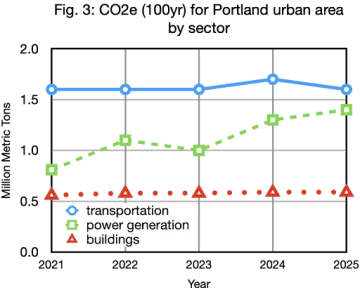
Figure 3 displays the increases in these contributing sectors over the 2021-2025 period. With GHG emissions from transportation and buildings nearly constant, we see that the overall increase in Portland urban area GHG emissions are almost solely due to increases within the power generation sector. Examining the Climate Trace data which is further granulated to specific emitters, we find that the Westbrook Energy Center Power Plant (Calpine) is causing nearly all of the increase because its graph looks nearly identical to that for power generation in Figure 3. The Calpine plant burns natural gas for electricity generation. It is not, however, within the Portland and South Portland area covered by their One Climate Future plan.
The growth of GHG emissions in Maine over the past five years, and the nearly constant GHG emissions in the Portland urban area (excluding the Calpine plant), should concern us all. Given the urgency of climate change, the time for compromise on policy is long past. Maine, as all other states, must strive to enforce its current policies strictly and to put in place new policies that will effectively abate our GHG emissions. As individuals, we must also examine our own carbon footprint and strive to reduce it.

Sustainable Business Highlight: How Piper Shores Provides a Sustainable Community for Residents
By Lauren Strohmeier
Featuring: Jen Rowland, Sustainability & Landscape Coordinator & Jean Smith, Resident
In this interview, Jen Rowland and Jean Smith reveal how Piper Shores demonstrates its commitment to caring for people and the planet. Through thoughtful stewardship of its campus, efficient use of resources, and a commitment to environmentally responsible practices, Piper Shores works to create a healthier, more sustainable community for residents, staff, and future generations. Its approach reflects a deep respect for the natural environment, recognizing that sustainability is not simply about reducing environmental impact—it is about building a vibrant community that can thrive for years to come. By embracing conservation, responsible resource management, and opportunities to connect people with nature, Piper Shores turns its values into meaningful action and serves as an inspiring example of how a business can make a positive difference in both the lives of those it serves and the world around it.
- How does sustainability influence your company’s mission and decision-making?
Piper Shores is a lifecare retirement community. Even though our focus is taking care of our residents, sustainability is a growing component of how we think about our operations and how they impact the well-being of the community.
Sustainability is an important part of how we provide care for our residents. For example, we have a sustainability plan that has various components (energy efficiency, waste, etc.) that guide our organization’s daily operations. Ultimately, our commitment to sustainability supports our residents and our community’s well-being. That’s how sustainability influences our mission.
The mission is very defined in terms of its responsibility to its residents. A part of our mission is also to be responsible community members. Our resident population is, by and large, very committed to being responsible citizens of the planet. Our residents influence our move toward sustainable practices.
Regarding our decision-making, we’re always striving to make fiscally responsible decisions. Oftentimes, we need to weigh the short-term cost against the long-term benefit, particularly when it comes to sustainability initiatives. We recognize that an initiative may be expensive upfront, but in the long term, will pay dividends in terms of reducing our energy consumption or waste stream. Sustainability influences our decision-making by helping us consider longer-term goals.
- What long-term sustainability vision guides your company?
Piper Shores has a sustainability plan, which features its long-term sustainability vision. The plan addresses the organization’s goals of carbon neutrality. We have ambitious goals.
Specifically, our goals are to reduce our greenhouse gas emissions, reduce water usage, minimize waste, shift landscape practices towards greater stewardship, and strengthen resident engagement. These goals should advance us toward our overarching goals, which are to be carbon neutral by 2040 and fossil fuel free by 2045.
- Are you investing in renewable energy or other sustainable technologies?
We collaborate with Competitive Energy Services to source clean energy for our campuses. Because the markets operate separately, we don’t receive the renewable energy credits (RECs) that are associated with those purchases. Currently, eighty-five percent of our energy is clean energy in terms of our bulk purchasing.
- What actions are you taking to reduce your company’s carbon footprint?
Piper Shores’ sustainability plan has many objectives in multiple areas. Energy efficiency will have the greatest impact in terms of reducing our carbon footprint. We’re reducing our carbon footprint by making our boilers run more efficiently so that we’re using less propane and electricity to operate them. That’s a significant project.
We also have an ambitious waste management program that’s driven by our residents. It includes recycling plastics and other items, fabrics, and more. Because Piper Shores has 450 residents, there is a lot of waste. That’s why we’re trying to find solutions to keep things out of the waste stream.
There’s also an opportunity to reduce our water consumption. One small effort we’ve made so far includes replacing faucet aerators so that the water flow is reduced. We also are considering ways to optimize our irrigation system. For example, we think about how we run water and when.
Piper Shores also has ambitions to reduce its transportation emissions by using electric vehicles. We also consider how we can reduce emissions across the board. For example, we are striving to optimize our landscaping practices. I believe the return on investment for that initiative will show in a few years.
Those are some of the areas in which we’re reducing our company’s carbon footprint.
- Are your products designed for durability or recyclability?
That’s an interesting question for our business. Our product includes our services to the community. So, the product is hard to define in terms of sustainability because it includes our services.
We educate the community, so residents and staff understand our sustainability objectives. The community is well-educated with a real commitment to sustainability.
Our sustainability goals include building a resilient and sustainable community. With the climate changing, there’s lots of work for us to be doing in the sustainability realm to move us toward being a more resilient community in the face of those changes.
- How do you track and report progress toward sustainability goals?
That is a tough question for us because one of our greatest challenges is that Piper Shores is such a complex organization with two different locations. We have many departments in which we’re trying to implement sustainable business practices. Because our organization consists of many departments, it has been a challenge to track all our progress.
With that said, we have historically collaborated with University of New Hampshire’s Sustainability Institute and Competitive Energy Services to track our carbon footprint. That collaboration provides some baseline information. However, that information does not necessarily provide us with deep insight into the results of shifting our daily practices.
Our goal is to develop a system for collecting day-to-day information that enables us to evaluate the impact we’re making and communicate that impact to residents. Specifically, we would like to gain deeper insights into energy usage and transportation emissions and report on the findings to residents.
- What new technologies or practices are you exploring to improve sustainability?
We have a goal to roll out composting for staff across our operations. Currently, there’s composting available for residents. However, there’s very limited availability for staff in breakrooms. Thus, we’re striving to expand composting across our operations.
Piper Shores is also striving to make a dedicated move to energy efficient appliances, resident units, and commercial kitchens. We’re really trying to make the most of existing technologies.
- How does your company support environmental advocacy or conservation efforts?
Our residents participate in a national organization, called Senior Stewards Acting for the Environment (SSAFE), that empowers seniors to lead climate action in their communities, and advance clean energy, sustainability, and environmental stewardship. It’s very active and promotes advocacy.
Additionally, we have a board member who is a sustainability advocacy expert.
There’s also a lot of community involvement in multiple local and national organizations. Ninety percent of this involvement is driven by residents. Residents are very active as sustainability advocates. They’re also well educated in terms of what’s happening nationally and in the state.
Piper Shores also has relationships with a couple of environmental organizations that are close to us geographically. Sometimes, representatives at these organizations will conduct presentations here. We have ongoing partnerships with those groups.
There’s an opportunity for us to deepen some of our connections with other conservation organizations in Maine. Gratefully, I bring many professional contacts with me. For example, I’ve been able to reach out to my contacts at Maine Farmland Trust, Maine Audubon, and First Light. I’ve been able to tap these groups for resources and/or consultation.
As our sustainability program grows, there’s an opportunity to engage with more conservation organizations. We did initiate a relationship with Scarborough High School. Some of our residents volunteered to meet with their Eco Club, which is the environmental club of the high school. There also was an initiative in which our residents volunteered in their garden, which was very well received. We’ve talked about doing more projects with the high school.
- How does your company engage with and give back to your local community?
Piper Shores is a microcosm community in itself that consists of 400+ people. We give back to our community and beyond through our sustainability efforts.
Piper Shores also has formed many relationships with various environmental organizations, such as the Sierra Club, Scarborough Land Trust, Wild Seed Project, and many others.
- What is Piper Shores doing differently than other businesses?
Piper Shores is inherently different from other businesses because our business involves taking care of people. That’s our product. By and large, our resident population is very committed to being good environmental citizens.
Piper Shores promotes the importance of caring about the planet and people. For example, we talk about how our actions affect the lives of our children and grandchildren. We educate residents about how our sustainability efforts are impacting future generations. We’re committed to addressing the environmental issues of our time, both at the local and national levels.
One of the aspects that’s unique about Piper Shores is that, if you look at retirement communities across the country and what they’re doing in the sustainability realm, there’s quite a few that are shifting towards more sustainable practices. With that said, Piper Shores is doing more significant work in sustainability. That’s what differentiates us.

Community Conversation: Talking Ticks with Dr. Beatrice Szantyr
By Corrine Adamowicz
Join the Woodie Wheaton Land Trust and the Sierra Club Maine Chapter to learn important information about Lyme disease, a tick-borne illness prevalent in our region. Hear from local experts and get your questions answered.
Fall is here and so is hunting season. Did you know ticks are still active in the fall? Do you know how to avoid tick bites? Can you recognize the rash of Lyme disease? Did you know there are steps you can take to protect you, your family and your favorite pets from Lyme disease and some of the other troublesome infections that travel in the same ticks? Woodie Wheaton Land Trust and the Sierra Club Maine Chapter welcome you to join us for a ZOOM presentation by Dr. Bea Szantyr on Thursday, October 29 at 6:00pm. Learn the essentials of prevention and early recognition of Lyme disease, and some of the consequences of missing the early opportunities. An ounce of prevention really is worth a pound of cure!
Dr. Beatrice Szantyr, is an Internist and Pediatrician living in Lincoln, Maine. She received her undergraduate degree from Fordham University, her doctorate in medicine from the University of Connecticut School of Medicine, and completed her internship and residency in Internal Medicine, Pediatrics and Adolescent Medicine at St. Louis University Hospitals and Cardinal Glennon Memorial Hospital for Children. Dr. Szantyr came to Maine in 1987 in service of a National Health Service Corps3-year commitment. She enjoyed a rich and varied clinical practice that spanned all ages and severity of medical conditions.
Dr. Szantyr has lectured on Lyme disease and related tick-borne disorders throughout Maine and nationally to both professional and community groups for more than two decades. She is an active member of Maine CDC’s Vector Borne Disease Work Group as well as the International Lyme and Associated Diseases Society. Dr.Szantyr recently served on the 2022 Federal Tick-Borne Disease Working Group Access to Care and Education Subcommittee.
Please click HERE to preregister for this event.

Protest: Respect It, Defend It, Use It
By Corrine Adamowicz
Our right to protest is under attack. Our democracy is at stake.
Nonviolent protest is one of the most powerful tools ordinary people have ever wielded. And because it works, it is under attack.
We need it now more than ever.
Annie Leonard (creator of The Story of Stuff, Former director of Greenpeace US, and more) and Andre Carothers (involved with Greenpeace, Rainforest Action Network and more) have written a book that is a tribute to and defense of peaceful protest. Annie and Andre are speaking in Freeport, Maine on September 23rd and Portland Maine one September 24th tribute to and defense of peaceful protest.
Green Tip of the Month
By Francesca Liberatore
October is here, and every year the shorter days and colder temperatures take me by surprise: what do you mean the summer is over?
It’s also when I start thinking about how I’m going to keep myself and my family warm over the next few months. Clothing swaps and second-hand clothes are my go-to. They are affordable while also not contributing to fast fashion and waste.
This Substack offers a list of thrift stores by town. It’s not an exhaustive list – definitely google your local area for more. If you live in Southern Maine, find more thrifting options here.
Want to donate or sell your old clothes? This is a list of stores where you can do that. It is also worth checking whether your local thrift store accepts donations.
If you prefer to buy or sell online, I recommend Vinted or Thredup. I just bought my teenager a winter coat for $10!
Clothes swaps are also a great way to stock up for the season. Having some guidelines around what people should bring, making sure you have a range of sizes, and talking about what to do with leftover clothing are things to bear in mind if you’re organizing one. That said, you can also find locally organized clothes swaps; they usually happen in the start of Fall and Spring!
If you are looking to learn more about fast fashion and its impact, and what we can do about it, I highly recommend Consumed, by Aja Barber. This book radically changed the way shop for clothes!
Do you have a green tip that you would like to have included in a future newsletter? Please share it with us here
The Month Ahead
Here are some of the meetings and events we have coming up. Hope to see you soon!
Events Team Meetings - All events are listed on the main page of our Chapter website; please scroll down to see the Events Calendar. Help us organize events to educate and engage Mainers across the state.
- 10/8 at 12pm
- 10/22at 12pm
- 10/11 at 12pm: Annual Celebration!
10/14 at 12pm: Volunteer Orientation
Learn how you can help protect Maine’s environment
VOLUNTEER OPPORTUNITIES
Interested in helping to protect Maine's environment? Join us at our next Volunteer Orientation! No matter your background, we have a role for you--no experience necessary.
SUBMISSIONS
Submit a photo, article, or event for us to include in our next newsletter!

Call Your Elected Officials to Support LD 1646!
Sierra Club Report on Myth of Renewable Natural Gas
Monetizing Carbon Offsets for Small Woodlands
Sierra Club Maine Submits Feedback to Natural/Working Lands Working Group
Sierra Club Files FOIA Request
Sierra Club Maine Endorses Rep. Jared Golden in District 2