The Michigan House Agriculture Committee heard opposition testimony for HB 4257 and 4265 earlier this week. These bills threaten the quality and safety of our drinking water, soil, and the very air we breathe by deregulating toxic liquid waste from anaerobic digesters and slaughterhouses.
Sierra Club Political & Legislative Director Christy McGillivray, along with coalition partners from Michigan Environmental Council and Clean Water Action, provided testimony detailing the dangers of these bills and urging the committee to vote against their adoption.
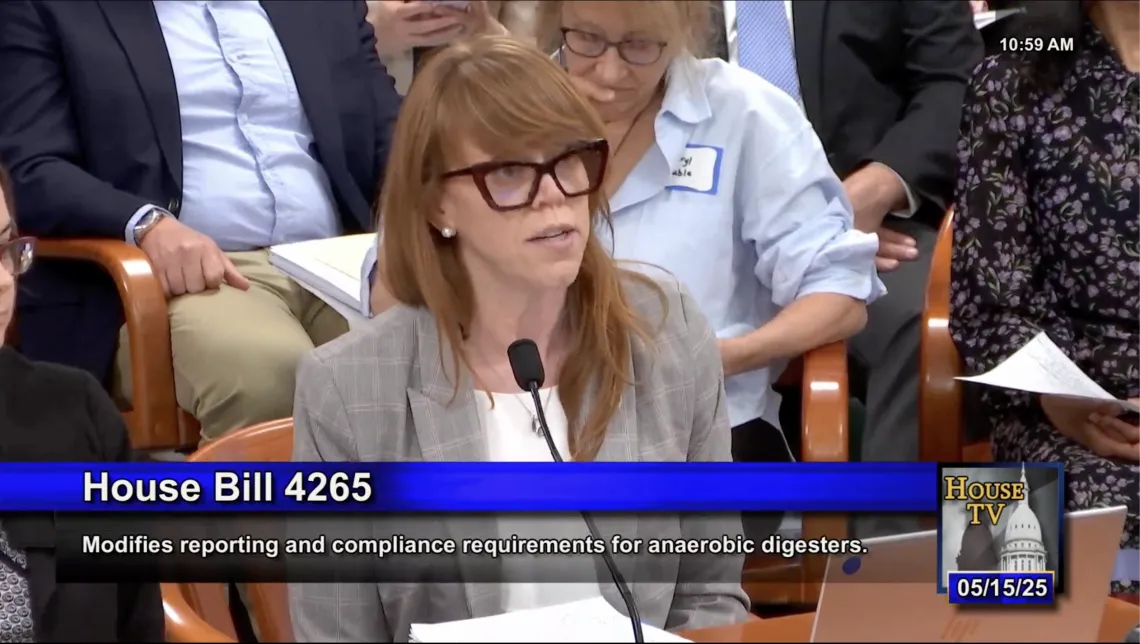
Watch full testimony here or read the transcript of Christy McGillivray’s remarks below:
Thanks for the opportunity to testify. We know it's at the chair's discretion, and we really appreciate it on behalf of the Sierra Club's thousands of members and supporters here in Michigan.
I am here to share our serious concerns with House bills 4257 and 4265. According to comprehensive legal memos drafted by the Environmental Law and Policy Center, if passed, these bills would put Michigan in violation of our own existing state laws, federal laws, and a recent Michigan Supreme Court decision that affirmed the authority and prerogative of the state of Michigan to regulate and protect the waters of our state.
Anaerobic digestion is shorthand for the decomposition of organic matter in an oxygen-free environment at a small or large scale. The method and context for how this decomposition happens determines if the digester is increasing greenhouse gas emissions or capturing them. You’ve heard industry claims that they are a green industry, however, capturing methane can only be considered green if its production is otherwise inevitable.
In the case of RNG production using anaerobic digestion on an industrial scale – which is what we're talking about here – decades of data now prove that the dairy industry is increasing herd sizes to increase methane production, not to produce more food. Financially backed by DTE, Consumers [Energy], and Chevron in particular, here in Michigan – BP and Shell in other states – dairy farmers are now financially incentivized to expand their herds to produce methane gas for the profits of fossil fuel companies.
An industry cannot claim it is [green] because it is burning methane produced by agricultural operations instead of methane produced by fracking. Methane gas is methane gas, and burning methane drives climate change.
Furthermore, groundbreaking 2023 research from engineers at Princeton University measured fugitive emissions from wastewater treatment plants equipped with digesters as well as wastewater treatment plants that did not have digesters. And their data shows that some of the largest fugitive methane plumes were from wastewater treatment plants with digesters. This is because methane pipelines and digesters leak, and if we ramp up the amount of methane produced in them, it means we ramp up the amount of methane that leaks out.
I also want to address the claims that Michigan should do less to protect water quality because other states are also doing a bad job. Anything happening in other states that is increasing water pollution into the Great Lakes is a reason for us to decrease it here.
We must not aspire to match bad practices in other states that are polluting our Great Lakes.
Finally, the context in which this is happening is highly relevant. A significant factor in the increasing severity and duration of acutely toxic harmful algal blooms is harmful runoff from agriculture. Given the sweeping and devastating cuts to the federal monitoring conducted by NOAA at the University of Michigan, the state of Michigan must be doing everything that we can to minimize the sources of pollution – not dramatically increase our state sources of pollution that will drive the severity and duration of, again, acutely toxic, harmful algal blooms.
This is a recipe for creating a rapidly escalating public health and tourism disaster for the state of Michigan. The false claims of climate mitigation, the illegality of this bill language, the inappropriate comparisons to bad water quality protection practices in other states, the escalating pressures on our fragile Great Lakes system, combined with the dereliction of duty of our federal water quality quality monitoring all indicate that we should decrease the amount of water pollution flowing into our Great Lakes, not create a pathway for increasing it. Which is what these bills do.
We encourage you to vote no.