As I write this, the United States Army is going to detonate 10,000 pounds of lead azide at the Iowa Army Ammunition Plant in Middletown, Iowa, on Wednesday, November 25. They expect a plume with lead dust to travel 100 miles from the detonation site, following the prevailing winds at the time of the detonation.
The more I read about this, the more appalled I am.
The Army stockpiled this material for over 20 years - 20 years when they could have safely neutralized the chemicals.
There has been a limited amount of information provided to the public about what is happening.
There appear to be numerous flaws in the permit issued by the Environmental Protection Agency, which allowed the detonation.
The Army is intentionally ignoring a stay from the Eighth Circuit Court of Appeals.
Lead is a powerful neurotoxin. Over the years, we have removed lead from gasoline, we have removed lead from paint, we have removed lead from children's toys, and we are removing lead from drinking water lines. Why would we intentionally blast a plume of lead into our atmosphere?
I sincerely hope that once the dust settles, a thorough review of the materials that are being stockpiled at the munitions plant is undertaken, with safe destruction of the materials no longer needed.
This issue has been fast-moving and we will continue to stay on top of it. Read our article Army to detonate 10,000 pounds of lead azide in Middletown, IA, on Nov. 25
Take care,
Pam Mackey Taylor, Chapter Director and Newsletter Editor
What you can do to help the environment
Save the data of our 2027 annual meeting - August 7
Tune into our Lunch and Learns on Fridays at noon
Missed the live-stream lunch and learn? No problem, find them on our YouTube
Contribute to the Iowa Chapter so that we can continue our work on protecting Iowa's environment
In this issue of the Iowa Sierran
Protecting Iowa's Environment
Plus
Lunch and Learns Fridays at noon
Contribute to the Iowa Chapter
Volunteer for the Iowa Chapter
Calendar of events
To see the archive of previous Iowa Chapter newsletters
Army to detonate 10,000 pounds of lead azide in Middletown, IA, Nov. 25
As I write this, the United States Army is going to detonate 10,000 pounds of lead azide at the Iowa Army Ammunition Plant in Middletown, Iowa, on Wednesday, November 25. They expect a plume with lead dust to travel 100 miles from the detonation site, following the prevailing winds at the time of the detonation.
In March, 2026, after the Iowa Army Ammunition Plant found 68 barrels of lead azide that was deteriorating, they began planning how to safely dispose of the material. The material had been stored for over 20 years at the facility near Middletown, Iowa, in Des Moines County. Because the lead azide was starting to crystallize, military officials are concerned that any movement would cause the chemical to explode spontaneously.
Originally, the munitions plant decided to conduct two controlled explosions on Friday, November 20. The community was given less than a week’s notice of when the detonations were to occur. The Army rescheduled the detonations for Monday, November 23, indicating weather predictions would made the November 20 detonations unfeasible.
On November 19, Sierra Club and the Iowa Environmental Council, represented by Earthjustice, appealed to The Eighth Circuit Court of Appeals to halt the plans until a formal review is done to determine if detonation is the best way to destroy the lead azide.
On November 20, the court agreed to stay the detonations which means the munitions plant should not proceed with the detonations until a formal court decision is made.
As of November 21, the court had not made a formal decision, the court’s decision to stay remains, and the Army has been told not to proceed. After the court ordered the stay, the US Department of Justice requested the Eighth Circuit to allow the Army to proceed with the detonations.
Late in the evening on November 21, the Department of Justice and the Army filed a document with the Eighth Circuit saying that they are going to move forward with the detonation. At this point, the Army has indicated that they will not comply with the Eight Circuit's stay. So, the Army intends to proceed with the detonation on Wednesday, November 25. For further information, check the Army’s webpage at https://www.army.mil/asc#org-iowa-army-ammunition-plant
Under the Army’s plan, the lead azide will be surrounded by concrete magazines, covered with earth, and surrounded by Hesco barriers of sand. The soil above the magazines would be saturated with water and water misters would be operating during the explosions. The explosions were expected to result in lead particles in the air and an air plume with lead-containing particles. The plume would disperse and deposit lead on the ground, on structures, and in waterbodies. Lead is a powerful neurotoxin and can cause serious long-term health injuries.
Further, people living close to the detonation site are asked to evacuate the area for four hours while the detonations are happening. The explosions are expected to break windows in the nearby area. The plume is expected to remain in the area for about an hour. Then the plume is expected to disperse as far as 100 miles.
It is very obvious that the Army has mismanaged this stockpile of lead azide. It is unfortunate that more protective measures could not have been undertaken, measures that would not have required detonating 10,000 pounds of lead azide. Furthermore, the Army has mishandled providing information to the public, not only Iowans, but also our neighbors in other states.
References
“Public and Media Advisory Regarding the Detonation of Lead Azide at Iowa Army Ammunition Plant in Middletown, Iowa”, US Army, November 18, 2026, https://d34w7g4gy10iej.cloudfront.net/pubs/pdf_78366.pdf
“Questions & Answers - Lead Azide Management and Disposal at Iowa Army Ammunition Plant (IAAAP)”, US Army https://d34w7g4gy10iej.cloudfront.net/pubs/pdf_77827.pdf
Kyle Werner, Maya Marchel Hoff, “Toxicologist: Plan to detonate lead azide in Iowa a ‘dumpster fire’”, Des Moines Register, Nov. 19, 2026
“Illinois Officials Monitoring Planned Detonation at Middletown, Iowa Army Ammunition Plant”, November 18, 2026, Illinois Officials Monitoring Planned Detonation at Middletown, Iowa Army Ammunition Plant
United States Court of Appeals for the Eighth Circuit Case No. 26-3374, Iowa Environmental Council and Sierra Club, Petitioners, v. United States Environmental Protection Agency, et al, Respondents
Sophie Hurwitz and Rachel Santarsiero, “The Army Is Detonating a Toxic “Lead Bomb” in Iowa. It Forgot to Warn People”, Mother Jones, November 19, 2026, https://www.motherjones.com/politics/2026/11/army-military-iowa-lead-azide-toxic-detonation-dust-health/?utm_source=mj-newsletters&utm_medium=email&utm_campaign=daily-newsletter-11-20-2026
3,550 Unsigned Easements on Summit’s Route
For months, Summit has been begging the Iowa Utilities Commission (IUC) to fast track the second phase of their carbon pipeline project. Earlier this month, the IUC issued an order asking for comments on proposed plans to proceed with Phase 2 of Summit’s carbon pipeline project.
In the filing, IUC disclosed that 3,550 parcels on the entire route are refusing to sign easements with Summit and face the threat of eminent domain. After years of “negotiating” with landowners, only 35% of the route has signed easements with Summit - showing widespread opposition and a project that should not move forward.
The IUC order also proposed that the remaining Phase 2 dockets remain separate but will go through the process concurrently with a joint in-person hearing and that Summit will arrange logistics and security for the hearing. The IUC is seeking input before December 2, 2026, on how long the hearing may last, where it should be, and other concerns. Sierra Club Iowa Chapter will be filing a response asking the IUC to halt any action on Phase 2 until the original Phase 1 permit has completed the appeal process through the Polk County District Court and the Iowa Supreme Court.
A map of the Summit Carbon Solutions proposed route through Iowa:
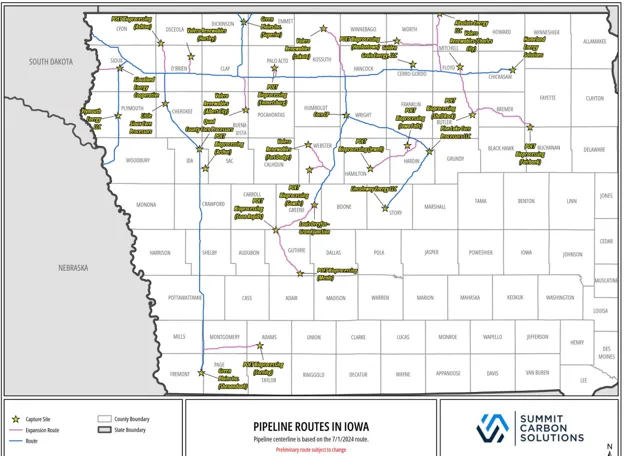
A chart of the dockets at the Utilities Commission and their status follows:

Shocking levels of pesticides moving off farm fields into the environment
Researchers at the University of Iowa have been looking at pesticides in Iowa's streams, in tree leaves, and in household dust, as part of the Iowa INSIGHT project (Iowa Integrated Network for Science, Information, and Geospatial Health Tracking). Earlier this month, they announced that
98% of stream samples contained the insecticide clothianidin
91% of the stream samples contained the herbicide atrazine
82% of the stream samples contained the insecticide imidacloprid
96% of the tree leaf samples contained atrazine
98% of the tree leaf samples contained the fungicide azoxystrobin
79% of the household dust samples contained the insecticide imidacloprid
80% of the household dust samples contained azoxystrobin
The researchers collected 193 water samples from rivers and streams in northeast Iowa between 2024 and 2026, tree leaves from multiple parks and schools in Iowa City between May and August in 2026, and household dust from 28 homes across Iowa.
The pesticides enter streams and rivers when rains wash them off farm fields. Pesticides can become air borne and can travel large distances.
Atrazine, a herbicide applied to corn, is a known endocrine disruptor. Public drinking water systems test for atrazine and ensure that levels in finished water meet safe levels. However private wells are not required to be tested and can carry unhealthy levels of atrazine.
The researchers said their key takeaways are
Pesticides were frequently detected in Iowa surface waters, urban environments, and homes
Several pesticides were found across multiple environmental media, indicating multiple opportunities for exposure
Some pesticide concentrations in surface water exceeded levels considered protective of aquatic life
Pesticide drift and deposition can transport agricultural chemicals into schools, parks, and residential areas
continued monitoring is needed to better understand long-term impacts on ecosystems and human health
Clearly people across the state are being exposed to these pesticides, with unknown effects on their health.
Resources
Press Release, "New UI Study Finds Pesticides in Iowa's Water, Air, and Homes", University of Iowa, IIHR-Hydroscience and Engineering, November 11, 2026
"Monitoring Pesticides in Iowa", Research Insights, University of Iowa, Iowa INSIGHT, November, 2026
Rachel Cramer, "", University of Iowa study finds pesticides in water, leaves and indoor dust", Iowa Public Radio, November 16, 2026
Sierra Club Report Shows Data Centers’ Potential to Erase 15 Years of Climate Progress
November 17, 2026 - A new report, released today by the Sierra Club, reveals how data center projects are on track to reverse 15 years of climate emissions reductions over the next three years and increase local air pollution for nearby communities. The report, Artificial Intelligence, Real Pollution, provides a framework for Iowa to reduce toxic emissions for communities and the financial impacts on families and small businesses. Voters rejected Big Tech and corporate greed driving the affordability crisis, and the Sierra Club’s guardrails offer solutions.
By 2030, the U.S. could emit 2.3 billion tons of carbon dioxide (CO2) emissions from the electric sector alone, an increase driven by data centers that rely on fossil fuels. This higher level of climate pollution would rival emissions from the U.S. electric sector in 2011, potentially undoing years of progress.
“Iowans need clean air and water, not gas plants to power hyperscale data centers” said Emma Colman, Senior Campaign Organizer, Sierra Club Iowa. “Earlier this month, Iowan voters spoke loud and clear: we're sick of being bulldozed by Big Tech and we're sick of dirty energy polluting our water, air and land. We need transparency, we need accountability, and we need renewable energy for people, not billionaires. We need change now.”
Driving increased emissions are nearly 250 gigawatts of new gas-burning power plants that are planned or under construction to power data centers nationwide. That is enough to power nearly 75 percent of all U.S. households. Iowa utilities are following suit. MidAmerican Energy plans to keep operating five coal-burning power plants across the state and build 1,217 megawatts of new gas by 2035 while Interstate Power and Light (IPL), an Alliant subsidiary, plans on building 3,014 megawatts of gas. IPL is currently proposing two big gas burning power plants in front of the Iowa Utilities Commission, largely to provide electricity to new AI data centers. Both utilities earned an “F” in Sierra Club’s 2026 Dirty Truth Report as a result of continued investment in dirty, expensive fossil fuel power plants.
In addition, the Sierra Club’s new report shows that gas plants built on-site at the largest data centers will be significant contributors to increased pollution. The twelve largest data centers with on-site gas plants could emit nearly 180 million tons of CO2, equivalent to the entire electric sectors of Florida and Pennsylvania. The gas plants are also expected to be large sources of health-harming pollutants, including fine particulates, oxides of nitrogen, and hazardous chemicals. As a state with the second highest cancer incidence rate in the nation, Iowans are looking to their state decision makers to protect the public from increased air pollution and to make corporate polluters clean up their messes.
Solutions are available, but they will require lawmakers to make good on their election campaigns. Iowa does not yet have basic state protections, such as mandated public reporting on water and electricity use, ensuring that data centers pay their fair share of electric costs, and required utility resource planning.
These guardrails must increase transparency and accountability to ensure data centers do not threaten our health, our environment, and our climate. One impactful solution is to triple solar and double wind on the electric grid to meet U.S. electricity demand. Even with moderate data center growth, these investments would reduce CO2 emissions 25 percent below 2025 levels and reduce average electricity costs by more than $5 billion annually compared to business as usual.
Lunch and Learns Fridays at noon
Fridays at noon, we do a Lunch and Learn livestream. See us on Facebook at "Sierra Club Iowa Chapter". These are recorded so you can watch them anytime. Topics will be selected based on what is happening during the week. During the legislative session, we cover issues coming before the Iowa legislature.
In case you missed our past webinars and lunch and learn sessions, you can still see them on our YouTube.
Lead Azide Detonation Emergency Stay Granted, November 20, 2026
What are NDAs?, November 13, 2026
Summit needs eminent domain on 3,550 parcels!, November 6, 2026
Morgan Valley Gas Plant Fight, October 30, 2026
Rewilding Iowa - Habitat Corridors, presentation by Dr. David Hoferer to the Northwest Iowa Group of the Sierra Club
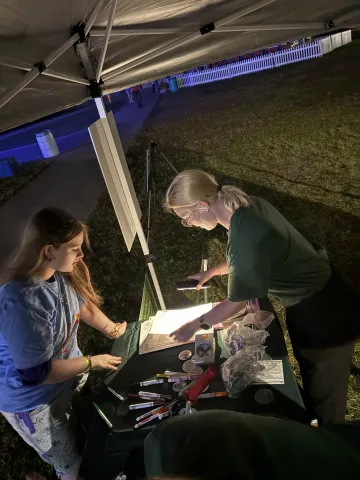
Photo: Briana Kouma staffed the Sierra Club booth at the AJR concert at the Iowa State Fair.
Volunteer for the Iowa Chapter
Almost everything we do is done by volunteers like you. If you would like to volunteer for the Iowa Chapter, please let us know by sending an E-mail to Iowa.chapter@sierraclub.org. Or sign up by using the online form. There are many opportunities for you to make a difference:
making phone calls
developing graphics for banners and flyers
working on legislative issues
working on elections
fundraising
organizing events
joining an issue committee
If you would like to join our legislative action team, sign up here. Keep on top of what is happening at the Iowa legislature. Be alerted when you should contact your legislators about pending legislation.

Photo: camping by Jess Mazour.
Contribute to the Iowa Chapter
Sierra Club - working every day on Iowa’s environmental problems
Sierra Club is Iowa’s oldest and largest grassroots environmental organization. Not only that, we are the best bet in the state for achieving bold solutions to Iowa’s environmental problems.
We work in the courts, before Iowa’s public agencies, and in the halls of the legislature. The Iowa Chapter's effort to protect the environment takes financial support. The Chapter receives very little financial support from the national Sierra Club. Can we count on you for a donation to ensure even more victories? Your contribution will be put to work here in Iowa on issues that affect every day Iowans – water quality, clean air, protection of Iowa's soil, parks and natural areas, and a strong democracy. The Iowa Chapter is relentless in fighting back bad legislation that affects every one of us.
Your non-deductible contributions make it possible for us to fight bad legislation and to promote good legislation. We appreciate your past and on-going support of these efforts. You can make a non-deductible donation with a credit card. A non-deductible donation supports the Chapter's effective, citizen-based advocacy and lobbying programs. If you prefer, a non-deductible check can be written to the Sierra Club Iowa Chapter and mailed to:
Treasurer
Sierra Club, Iowa Chapter
PO Box 1058
Marion, IA 52302
You can also make a tax-deductible donation with a credit card. Tax-deductible activities are limited to public interest education, research and legal actions. A deductible check can be written to the Sierra Club Foundation with “Iowa Chapter” written in the memo line.
Thank you for your support.
Donate your used vehicle
As the Sierra Club Foundation's Iowa Chapter continues to raise charitable funds to support its work in Iowa, won’t you consider participating in our vehicle donation program? Our partners over at CARS have made the process of donating your unused or unneeded car, truck, motorcycle, boat or RV easy, efficient and secure. They’ll take care of everything from picking up your vehicle to sending you a tax receipt for your generous gift. To learn more about The Sierra Club Foundation's Iowa Chapter vehicle donation program, please call 844-674-3772. Or visit our webpage to get started today!
Sierra Club Foundation promotes climate solutions, conservation, and movement building through a powerful combination of strategic philanthropy and grassroots advocacy. The Foundation is the fiscal sponsor of Sierra Club’s charitable environmental programs.
For more information
Planned giving . . . naming the Sierra Club Iowa Chapter in your will
Ensure your environmental legacy by naming the Iowa Chapter in your will or trust. These gifts cost you nothing now. You can hold onto your assets for as long as you need them. Thank you for supporting our work!

Resources for Planning for the Future
The Iowa Chapter has three resources to assist you in planning for the future - one pagers about giving via Donor Advised Funds, IRA Qualified Charitable Distributions, and planned gifts.
The flyer Donor Advised Funds (aka DAF) covers basics of Donor Advised Funds and how an individual can designate support specifically to the Iowa Chapter.
The flyer Giving through an IRA covers how to make a Qualified Charitable Distribution (aka QCD) and how it can be directed to the Iowa Chapter.
The flyer Plan Today Protect Tomorrow covers the basics of planned giving, including bequest language to make a gift to the Iowa Chapter.
If you need assistance, contact Julia Curtis at 800-932-4270, giftplanning@sierraclub.org .
| When | Earliest: Latest: |
| What |
|
| Word or Phrase | Word or phrase to search for: |
| Leader | All or part of leader name to search for: |
No Matching Activities Found
Loading
| Date | Activity (click title for full description) | Sponsor | Category | Type | Difficulty | Links |
|---|
Loading ...
 Outing
 Team/Committee
meeting
 Volunteer Event
 Activist event
 Multiple events
(map only)