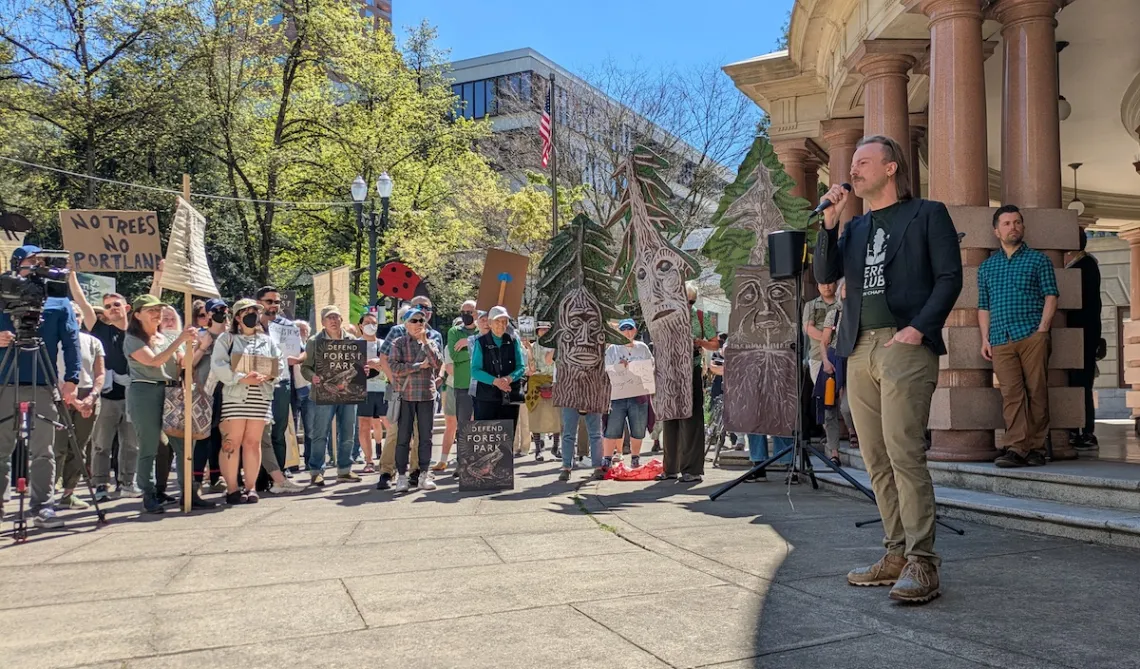
More than 300 people rallied outside City Hall in defense of Forest Park on April 17. Oregon Chapter Director Damon Motz-Storey addresses the crowd.
On May 7, Portland City Council unanimously approved the City Attorney’s findings, overturning a Hearings Officer’s approval previously granted to Portland General Electric (PGE) to cut 4.7 acres of trees, fill two wetlands, and irreparably impact streams and wildlife in Forest Park. This is a powerful victory for the preservation of 150+ year old trees and a complex forest in the park, and the people and wildlife who enjoy Forest Park and call it home.
“Forest Park Conservancy applauds Portland City Council for their correct decision to deny PGE's application to remove trees from Forest Park,” said Executive Director Scott Fogarty. “We hope this sends a message that our unique treasure must remain intact for all future generations to enjoy and benefit from.”
On March 7, 2025 a City of Portland Hearing’s Officer approved PGE’s request to expand its infrastructure and cut down nearly 400 trees (many more than 150 years old) in Forest Park to build new power lines in the park for PGE’s proposed Harborton Project Phase 3. In defense of the park and its users, the Forest Park Conservancy and Forest Park Neighborhood Association appealed the decision to Portland City Council. At the end of a 5-hour hearing on April 17, council voted unanimously to tentatively uphold the appeals and deny PGE’s proposal. This morning, that unanimous decision was affirmed.
“Councilors did their homework for the April 17 hearing – they asked questions that PGE couldn’t answer,” said Carol Chesarek, Forest Park Neighborhood Association Land Use Chair. “PGE had no evidence to support their claim that this project would reduce fossil fuel use. The park cleans our air, filters stormwater, and absorbs carbon – it is critical city infrastructure. We are thankful that Council upheld the park’s management plan, ensuring that five acres of mature forest won’t be replaced by power lines.”
While PGE made broad claims about the Harborton Project’s necessity, the city’s own staff report found the application failed to meet the required approval criteria in the Forest Park Natural Resources Management Plan (FPNRMP). Specifically, the Portland Bureau of Development Services voiced skepticism that the project could be brought into alignment with Conservation Goal #1 of the FPNRMP, which is focused on preserving the ecology of the area to “grow an ancient forest for the benefit and enjoyment of future generations,” and cited the project’s significant impacts including cutting of nearly 400 trees, disturbing soil and ground covers, impacting riparian zones, and broadly altering ecosystem functions. Further, components of PGE’s proposed mitigation plan were not even planned within the impacted area, failing to meet another requirement of the FPNRMP.
Portland residents need safe, reliable, and renewable electric power transmission, yet PGE failed to demonstrate how the Harborton Project Phase 3 would have met those needs. According to PGE's schedule for load growth change, residential demand is projected to increase by only 3.5% between 2016-2025, while heavy industrial demand has a projected increase of almost 150%. Based on current trends, it is clear that the utility is focused on expanding transmission and energy generation infrastructure in response to the rapidly increasing demand of large industrial facilities, such as the growing number of data centers sited in Hillsboro.
As Portland works to strengthen energy reliability and support electrification and decarbonization, inclusive community engagement will be essential to ensure that these investments are made without sacrificing key community values.
“PGE wrongly perceived the Harborton route to be their path of least resistance to achieve their expansion goals," said Micah Meskel, Urban Conservation Director of Bird Alliance of Oregon.“ Instead they were met with a passionate advocacy base, backed by a strong land use policy in the Forest Park Natural Resource Management plan that prioritizes public good over corporate interests. We applaud all City Councilors for aligning their votes unanimously with park advocates and upholding the management plan's central goal of growing an ancient forest for all of us to benefit from.”
Today’s affirmation is a victory for the park’s ecosystem, community interest, and staff expertise. Since January, Portlanders have submitted more than 3,000 comments and testimonies in opposition to the Harborton proposal, while more than 300 rallied outside City Hall just before Council’s appeal review on April 17th. In addition, five city, county and state agencies formally opposed the application alongside more than one dozen community based organizations. And Portland’s new City Council spent more than five hours on the appeal hearing, asking insightful questions of PGE and demanding substantive answers.
“The City of Portland and PGE have an opportunity to establish a clear precedent for how we build a more just and sustainable future, by prioritizing deep community participation in any future proposal to increase transmission capacity and renewable energy generation,” said Damon Motz-Storey, director of the Sierra Club Oregon Chapter. “We recognize the need for and support upgrades and maintenance to the electrical grid, including transmission line development required for reliable electricity and to support the transition from fossil fuels to clean energy. In this case, PGE failed to demonstrate the need to sacrifice a valuable, publicly-owned forest ecosystem in order to meet Portland’s electricity needs. PGE can make grid improvements without harming Forest Park.”