by Andrew Christie and Gianna Patchen
California’s oak woodlands protect each and every one of us. They directly improve air quality, retain stormwater, recharge groundwater, prevent erosion, and sequester carbon – more than 675 million metric tons, per a 2008 inventory of the state’s oak woodlands.
They are keystone species that provide essential habitat for wildlife, creating one of the most biodiverse ecosystems across the state. Ten years ago, biologists estimated that California had already lost more than 30 percent of the approximately 12 million acres of oak woodlands that covered the state in 1850. Of the oak woodlands that remained, only about 4 percent are protected. But the state law passed to protect them two decades ago is failing to do so because its loopholes have allowed extensive destruction across California.
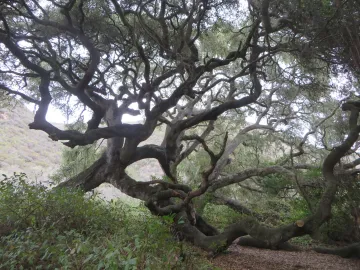
San Luis Obispo County has been a significant contributor to that loss. Justin Vineyards clear cut 15,000 oaks on 100 acres of its Paso Robles property in 2011, a year after Lynda and Stewart Resnick bought the land. Then in 2016, Justin cut hundreds more oaks across their 375-acre property.
The same year, the Napa County Board of Supervisors approved a proposed vineyard expansion that would have clearcut 300 acres of oak forest. A five-year legal battle ensued, and the Sierra Club, Center for Biological Diversity and the Napa environmental community managed to downsize the project from 28,000 trees cut on 300 acres to 14,000 trees on 160 acres.
For decades local communities pressured SLO County supervisors to create a county-wide oak protection ordinance, but time and time again the idea was stuck in task forces and subcommittees that produced toothless tweaks to the status quo.
In 2017, the public outrage over Justin’s oak tree massacre triggered SLO County to finally adopt a long overdue Oak Woodland Ordinance to protect local oaks. However, the end result was lackluster oak protection. The ordinance’s outlined protections are scant, and it simply increases the level of permitting for projects with high levels of destruction, including clearcutting of oak woodlands, and exempts all residential development proposals from any of the oak protections.
And this year, the SLO County Planning Commission and Board of Supervisors decided to permit the destruction of yet another oak woodland: this time at the Dana Reserve housing development in Nipomo. Some 3,000 coastal oaks, their understory and habitat, will be destroyed to make way for the massive Dana Reserve development. When the County approved this development, they easily sidestepped the County General Plan and multiple county ordinances, including the Land Use Ordinance and the feeble Oak Woodland Ordinance.
Activists and the community fought to protect this Nipomo oak woodland by proposing alternative development plans, showing up en masse to meetings, and when all else failed, suing the developers. The lawsuit ended in a legal settlement with the developer that will reduce the 1,400-unit development’s size by about 230 units, spare 195 oak trees and five acres of open space, and save a portion of one of the rarest plant species on earth: The Nipomo Mesa Manzanita (Arctostaphylos nipumu).
The Dana Reserve development earned this critique from Stephanie Pincetl, Founding Director of the California Center for Sustainable Communities at UCLA: "The proposal is yet another example of 20th century approaches to land use that have caused the current climate crisis. It will generate absolute vehicle miles traveled, destroy carbon sequestering oak habitat that is not substitutable or mitigatable (habitat is unique to place, it’s not a generic concept, interchangeable anywhere), perpetuate segregation and exposure of lower income populations to higher sources of emissions, will generate serious runoff, and more."
It all could have been avoided.
The original failure lies with the state of California, specifically the Oak Woodlands Conservation Act that was passed by the legislature in 2004.
The Oak Woodlands Conservation Act was supposed to be the state’s acknowledgement that oaks are essential. However, the Dana Reserve is the latest evidence that the Oak Woodlands Conservation Act is not working. It is simply the original, larger version of the local ordinances in cities and counties across the state, including their loopholes. All of the above oak woodland elimination projects and many others took place after the Act was signed into law.
It is imperative that we strengthen California’s Oak Woodlands Conservation Act. The reason is as obvious now as the initial reason for its passage: Local governments will never prioritize the protection of oak woodlands. If the state does not fix the loopholes in California’s oak protection law, the iconic oaks of the Central Coast may one day exist only on postcards and in chamber of commerce brochures.
The California Oak Foundation has concluded that “California is estimated to be at risk of losing 750,000 acres of oak forest and woodland by the year 2040.” But, instead of accepting that fate and the consequences that would come with it, “California, despite its large and growing population, has the capacity to significantly enhance its oaks.”
That seems to us like the preferable path. It’s a path that will require some genuine conservation from California’s Oak Woodlands Conservation Act.