Opinion
by Jill Stegman
The newly rebranded Central Coast Zoo in Atascadero—formerly the Charles Paddock Zoo—likes to remind us that it is AZA-accredited, a “gold standard” in the industry. But accreditation should not be confused with adequacy. While accreditation signals that the facility meets basic animal care standards, it does not mean that the zoo is truly suited for every species. When it comes to housing tigers, one of the largest and most wide-ranging carnivores on the planet, adequacy is not enough. True animal welfare and conservation demand more than minimal credentials.
The Sierra Club and other wildlife organizations have addressed this issue. In its Wildlife and Native Plants Policy, the Sierra Club states—"Zoos, aquaria and botanical gardens should recognize their foremost responsibility is the welfare of the species and should not be collections for public entertainment or private profit.” True animal welfare and conservation demand more than minimal credentials.
In essence, the Sierra Club’s broader ethos demands that we treat wildlife, not just as objects on display, but as sentient beings deserving of environments that reflect their natural behaviors and ecological roles.
The zoo’s entire campus is barely five acres, and its tiger enclosure is only a fraction of that space. It’s published at around a half-acre, but with all the foliage, it looks smaller than my backyard. While precise dimensions have never been made public, the scale speaks for itself: the whole zoo is smaller than a single tiger habitat at the San Diego Zoo Safari Park, where six tigers reside at “Tiger Trail,” which sprawls over five acres alone.
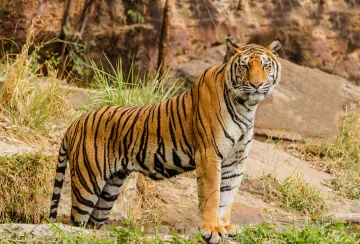
Visitors who spent time watching Menderu often saw him pacing the same path over and over again. Such stereotypic behavior is a red flag in captive cats. It signals stress, a lack of stimulation, and, above all, a lack of space. Tigers are solitary hunters that roam territories of 20 to 60 square miles in the wild. Cramming them into a postage-stamp habitat, however well landscaped, cannot replicate what they need.
Humane enclosures must be not just safe but spacious, complex, and enriching: multiple yards, water features for swimming, vertical climbing structures, dense vegetation, and above all, room to roam. Many modern zoos have embraced this. The Bronx Zoo’s Tiger Mountain spans three acres. San Diego Safari Park's Tiger Trail gives its tigers multiple acres of interconnected habitat. The Central Coast Zoo offers only a small corner of its five-acre grounds. Even Moorpark College’s teaching zoo in Ventura County, with far fewer resources, boasts an 8000-square-foot tiger exhibit with a pool and multiple yards.
Now the zoo is fundraising to expand the tiger enclosure. That is welcome, but expansion alone will not erase the reality that the facility is constrained by its tiny footprint. Unless the zoo can dedicate a truly expansive area on the scale of half a hectare (about 1.25 acres) or more, for a new tiger, it should reconsider whether bringing another big cat here is ethical at all.
This problem is not just local—it is global. Today, there are an estimated 5,000 tigers in captivity in the United States alone, more than the roughly 4,500 left in the wild worldwide. When captivity outpaces conservation, and when animals are confined in spaces that compromise their welfare, we must ask whether we are helping these species or simply exploiting them for display.
I lived in Atascadero for over thirty years and remember taking my children to the zoo. But we always felt sorry for the large animals trapped in small enclosures. Before Menderu arrived, there were actually two tigers in the same enclosure until, tragically, one killed its mate. My now-grown children and I applauded when the zoo reduced its large animals to house smaller animals like the red pandas and exotic birds. My granddaughter loves the spider monkey “orphans” who recently arrived.
A modest addition will not transform a small-town facility into one that can match the welfare standards of large, modern tiger exhibits. Without multiple acres of space and complex natural features, the next tiger will likely face the same stress behaviors that haunted Menderu’s final years.
If Atascadero wants to continue serving the community and teaching children about wildlife, it should do so with species suited to smaller enclosures. Red pandas, birds of prey, or reptiles can thrive in compact, carefully designed habitats. Tigers cannot. To acquire another would be to repeat the mistakes of the past—placing a wide-ranging predator into too small a corner, and calling it conservation.