 The Magazine of The Sierra Club
Rehoming Seattle’s Purple Martins
Washington State balances critical coastal remediation projects with conserving a beloved, vulnerable bird
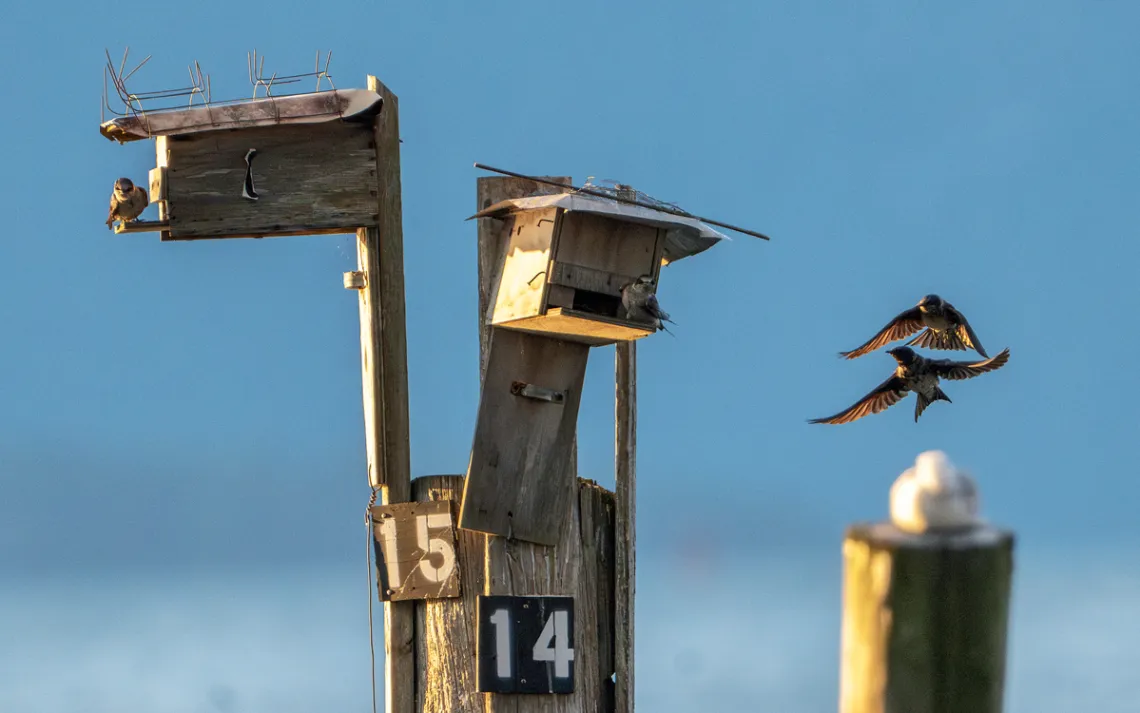
Western purple martins swoop toward nest boxes that volunteers maintain around Puget Sound. | Photo by Nancy K. Crowell
It was an overcast morning in April 2024, and Seattle’s purple martins were due to arrive. Kimberle Stark, clad in rain gear, rubber boots, and gloves, stood in the frigid waters of Washington’s Puget Sound, submerging the hollowed-out gourds these swallows call home. Clumps of last year’s nesting material, broken eggshells, and a few chicks that hadn’t made it splashed out. Then vigorous scrubbing commenced. “We find some funny things in these,” Stark said, working quickly to beat the rising tide. “Shiny things, like crows collect. And sometimes they use plants with huge thorns—weird choice.”
Stark is a marine biologist by trade who, as a citizen scientist in her spare time, has helped lead Seattle-area purple martin conservation efforts for 21 years. Purple martin populations have dwindled across North America as settlers and modern development have in various ways threatened their natural habitat: For the western purple martin subspecies in the Pacific Northwest, that means dead trees (snags) close to water. Today the birds are almost entirely dependent on human-provided housing, such as the gourds and nest boxes Stark and a team of dedicated volunteers maintain.
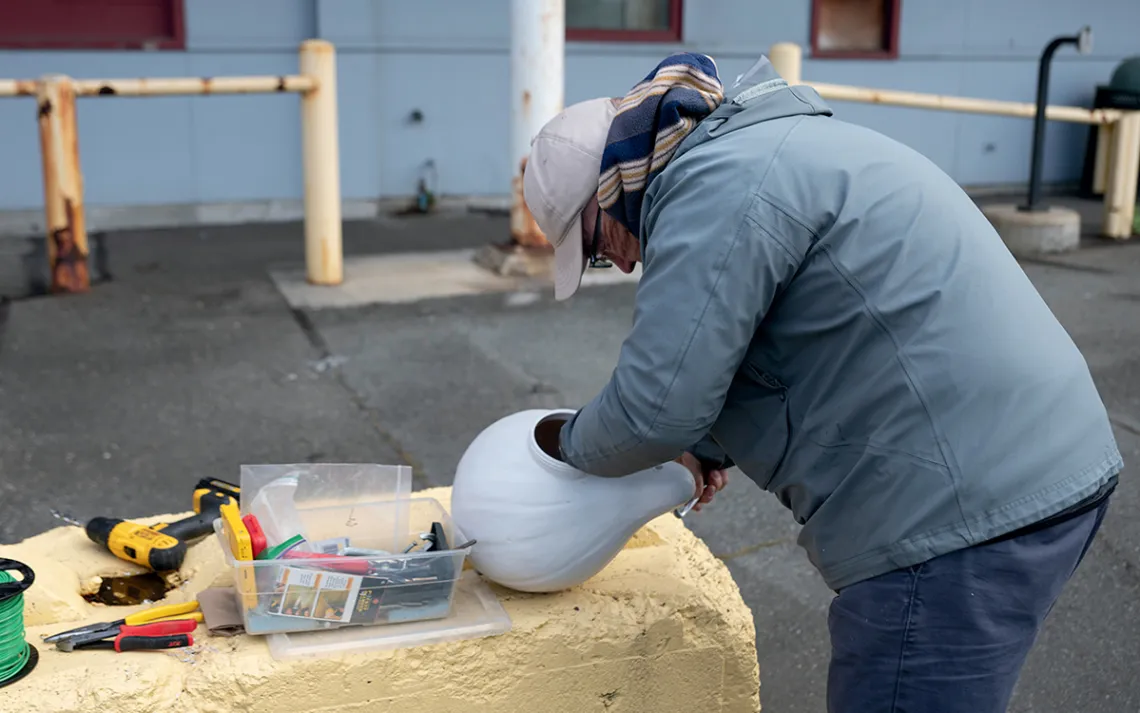
Volunteer Carl Bevins prepares a new nesting gourd. | Photo by Nancy K. Crowell
“Our purple martins are really picky,” Stark said. “They really like to nest above the water.” The gourds she was here to clean hung on tall pilings in the sound: a great location for the birds but a precarious one for the human helpers, who had to perch atop tall ladders on soft mud to reach them. A few curious onlookers wandered nearby. The volunteers were happy to chat with potential recruits to the cause.
Suddenly, a shout: “Martin!” Everyone paused what they were doing and looked up to see a single bird darting overhead, the first martin spotted at the site that year. It was likely a scout, a male bird sent early to check on the nesting options. He seemed like a manager overseeing the volunteers’ progress. Yes, his home was still there—at least for now. With a final approving swoop, he winged off.
Nest gourds hang on pilings that are left over from old docks in ports throughout western Washington, from small coastal towns to cities such as Seattle and Bellingham. More dot the shores where individual homeowners have hung small clusters. But no one knows exactly how many nesting sites there are or how many purple martins come to Washington each year.
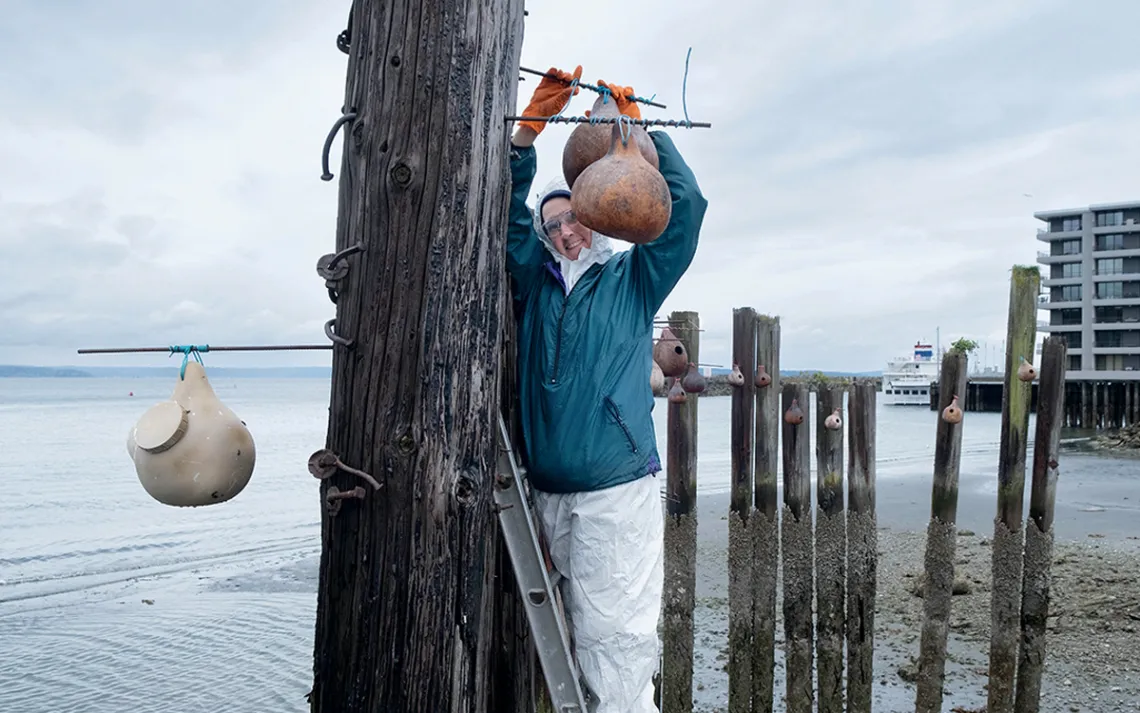
A volunteer removes the previous year’s gourds from pilings near Shilshole Bay Marina in Seattle. | Photo by Rebecca Dzombak
The pilings that so often provide ideal nesting spots are also old and coated in creosote, a tarlike wood-preserving substance that leaches contaminants into the water. Since the early 2000s, the state has been steadily removing them in shoreline remediation projects. And with them go the nesting gourds. “I understand the need to remove the pilings,” Stark said. But when purple martins lose nesting sites, “it just sucks.”
Habitat loss puts nesting sites “at a premium,” said Jean Power, another scientist and local leader of purple martin conservation who helped organize the spring cleaning. The volunteers’ goal for the birds is one Seattleites have for themselves: “Get as much housing up as we can,” Power said. The birds’ reliance on artificial habitat is one of the main reasons they are listed as a “species of greatest conservation need” in Washington.
When pilings are removed or simply fall in disrepair, the state and landowners don’t usually replace them. That leaves the volunteers scrambling to establish new nesting sites on the water, in spots where there are ample insects for foraging and designed so other types of swallows or even starlings don’t move in (the swinging nests are harder for other birds to enter). The purple martins also seem to prefer sites without too much noise or light. With so much shoreline controlled by the city and private owners, getting a replacement site set up can be a tall order.
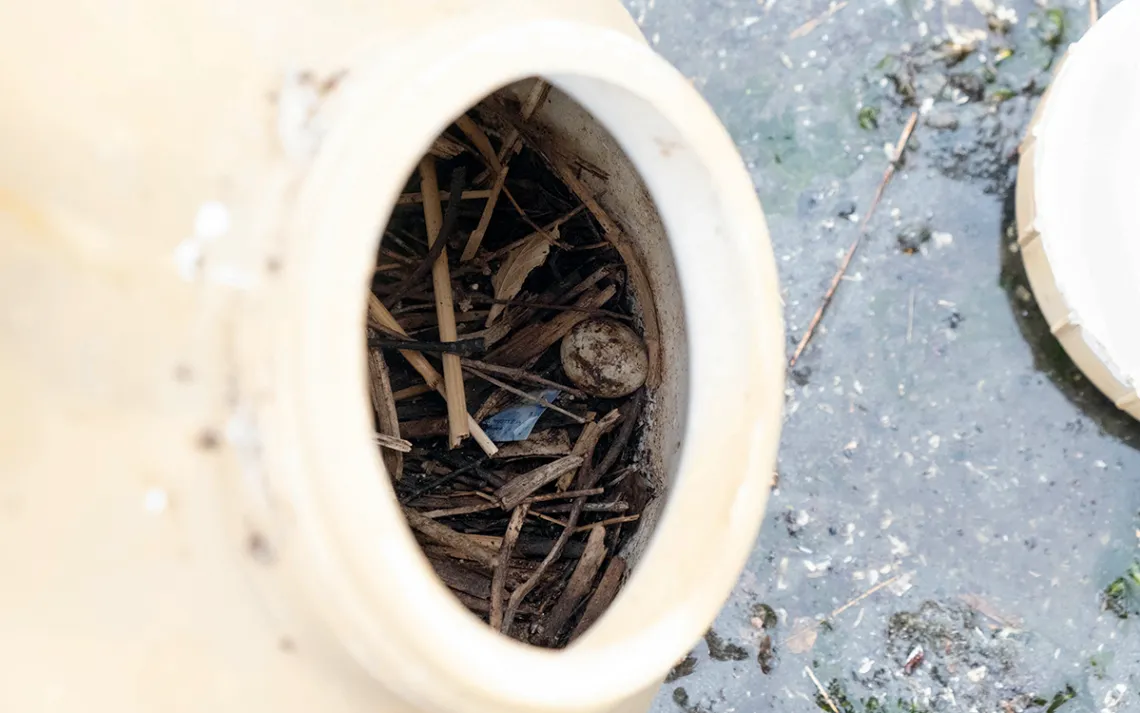
A gourd that volunteers haven’t cleaned out contains old nesting material and an egg that never hatched. | Photo by Rebecca Dzombak
In August 2024, a Port of Seattle coastline remediation project began that involved removing pilings where purple martins had nested for about a decade—and had recently been thriving. Dozens of martins would need new homes.
“We knew that those pilings would come down sooner or later, whether from falling down or removal,” Power said. “It just happened sooner than expected. And that was super disappointing.”
Rehoming purple martins isn’t always as simple as putting up new gourds. The birds have very high site fidelity, which means that once they find a spot they like, they stick to it—and they don’t like change. So even if volunteers can install replacement nests in a good spot, there’s no guarantee purple martins will move in.
Power and Stark have allies at the Port of Seattle and the Washington Department of Fish and Wildlife who have supported volunteers’ efforts to set up and maintain nesting sites. Christopher Anderson, who describes himself as “the most urban” wildlife biologist at the department, facilitated getting a dozen replacement gourds installed on pilings from an abandoned fishing pier on Seattle’s waterfront last spring. That pier is slated for replacement, so the fix was temporary, but Anderson and the volunteers are advocating for gourds to be installed on the new pier.
They’ve also found a collaborator in Jenn Stebbings, a habitat biologist for the Port of Seattle. She has been enthusiastic about purple martin conservation since joining the Port in 2022. “The people dedicated to their recovery are so passionate,” Stebbings said. “It’s easy to absorb some of that.” She suggested Lake Jacobs, a human-made pond in a relatively tucked-away spot nearby, as an alternative to putting gourds on the port’s replacement pier. There, the birds wouldn’t be disturbed and could snack on aquatic insects.
The day after the April nest cleaning, Stebbings and Power hung a dozen gourds on new racks above the water at Lake Jacobs. During the summer, purple martins seemed interested in the new site—flying around, scoping things out, perching on the gourds, and venturing inside. But the volunteers won’t know if any birds actually used the gourds until this year’s spring cleaning, which is the main way they monitor local purple martin populations. Community science programs for the birds are limited, Anderson said, so much of what is known about recent populations comes from volunteer-organized counts.
In 2025, the volunteers are formalizing a working group for Puget Sound purple martins to improve coordination, monitoring, and resources for those interested in the birds’ conservation.
“There are more and more people who want to do something,” Stark said. “I’m more optimistic than ever.”

Photo by Nancy K. Crowell
The Nest Best Thing
Setting Up House
Keeping landscapes as natural as possible gives purple martins—and other species—good habitat. Leave dead trees standing if they’re safe, and minimize pesticide use to keep local insect populations robust.
Catering to the Locals
Learn about the martins in your area. Local birding and conservation groups can help you discover whether the birds like to be directly over or simply near the water, whether they prefer gourds or nest boxes, and whether they favor living in small or large groups.
Housekeeping and Reporting
Spring cleaning is key. Make sure gourds and nest boxes are ready for spring arrivals. Report martin sightings and nest use to eBird and the Purple Martin Conservation Association.