This Land Is Your Land
A mother and daughter pedal across Wyoming as public lands hang in the balance
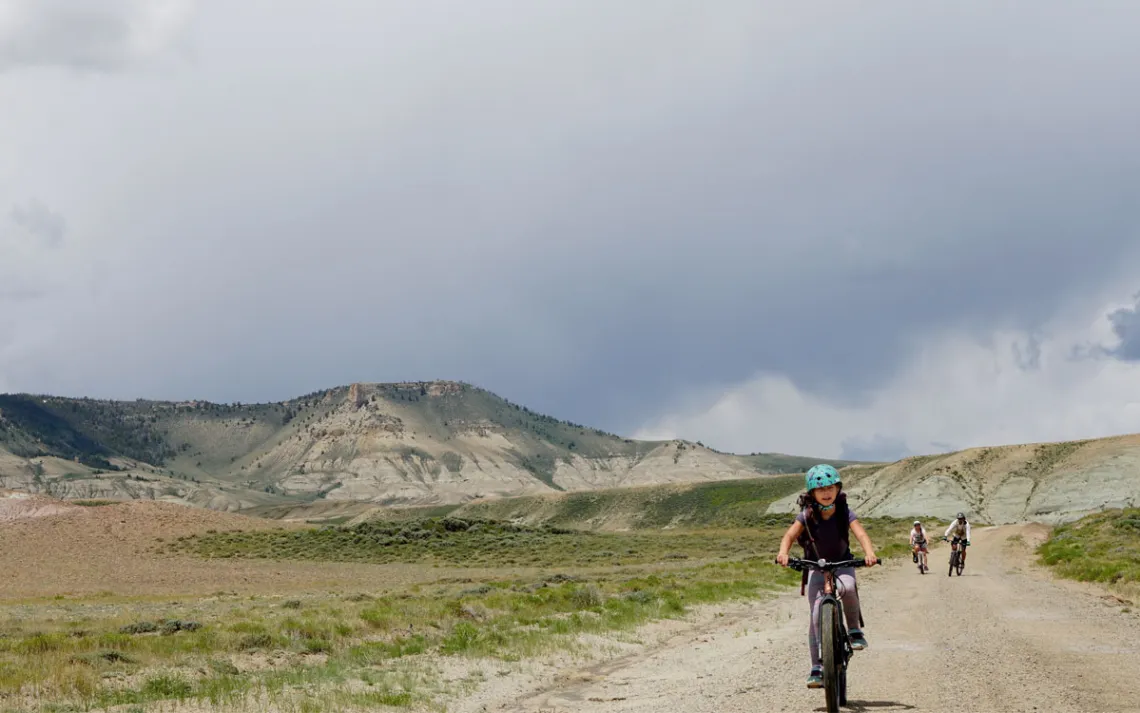
Miriam Peterson bikes on a county road through BLM land, with the Oregon Buttes behind her.
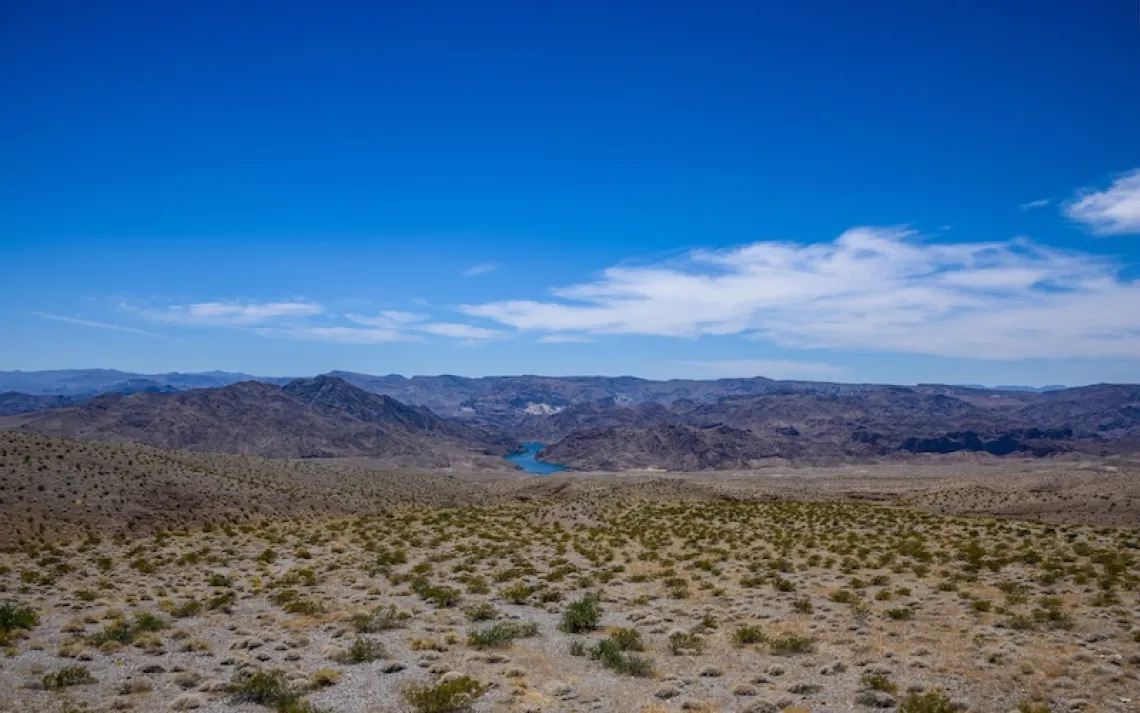
Soft morning light bathed the yawning sagebrush desert as Miriam flew by me on her mountain bike, her squeals piercing the quiet. Mud from her tires pelted the ground around me like gravelly raindrops. I smiled, said a quick prayer that she’d use her brakes, then let out a deep sigh—the kind the open vistas of Wyoming’s Red Desert always seem to elicit. Only the ribbon of road we were careening down broke the undulating sage-colored sea. No houses sat in the distance. No power lines crossed above. No shopping centers, oil wells, or fences stood between us and the horizon.
I finally caught up with my intrepid eight-year-old at the bottom of the first hill. From there, we settled into a comfortable riding pace, side by side, mother and daughter.
Miriam glanced back at where we had started, at the flat-topped, dusty-green and tan twin peaks that rose 8,600 feet out of the plains and were draped with a dark-gray blanket of clouds.
As she’s done since she first learned to talk, Miriam peppered me with questions: “Why are those called the Oregon Buttes? What makes them buttes? How far are we riding today? Do you think it’s going to rain again?”
I answered, as I always have, the best I could: “They’re called the Oregon Buttes because pioneers on the Oregon Trail could see them from miles and miles away and used them as a landmark. Their shape is what makes them buttes—volcanic ash and rock stuck around as the surrounding area has slowly eroded away from wind and rain.” We would be riding many, many more miles that day, possibly accompanied by that same wind and rain.
She kept pedaling, placated by my quick explanation of this prominent feature in the half-million-plus-acre Red Desert. Wet, red clay covered the underside of her new gold-colored bike, the one with big-girl 24-inch wheels.
“It’s wild there aren’t any fences,” she offered, looking out across the road and into the sagebrush. “I like that.”
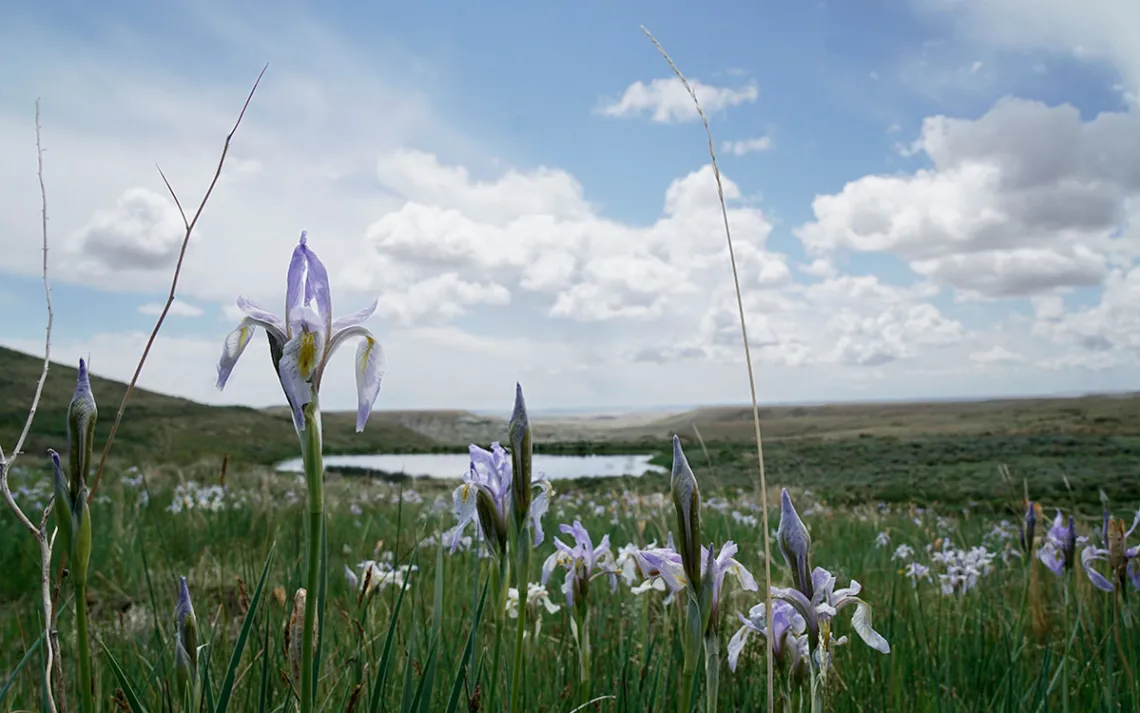
Wild irises grow near a stock pond.
“Me too, kiddo,” I replied. “And I like that everything we see belongs to all of us.” Miriam understood this sentiment. She’s a Wyoming kid and the product of two Wyoming kids. She has spent more than a year of her life sleeping in a tent under the stars on lands owned by all Americans—managed by the Bureau of Land Management (BLM) and the US Forest Service. Miriam had been eager to ride her bike for days through a muddy desert, as long as she could wear a pink ruffled skirt and matching pink tank top.
I thought about telling her how this land might not always be ours, about how efforts to carve it up keep increasing with Trump administration executive orders and sneaky congressional amendments. I felt a familiar catch in my throat as I wondered what this land will look like when Miriam is my age, if she’ll be able to bring her kids here, or if fences screaming “No Trespassing” will block her way.
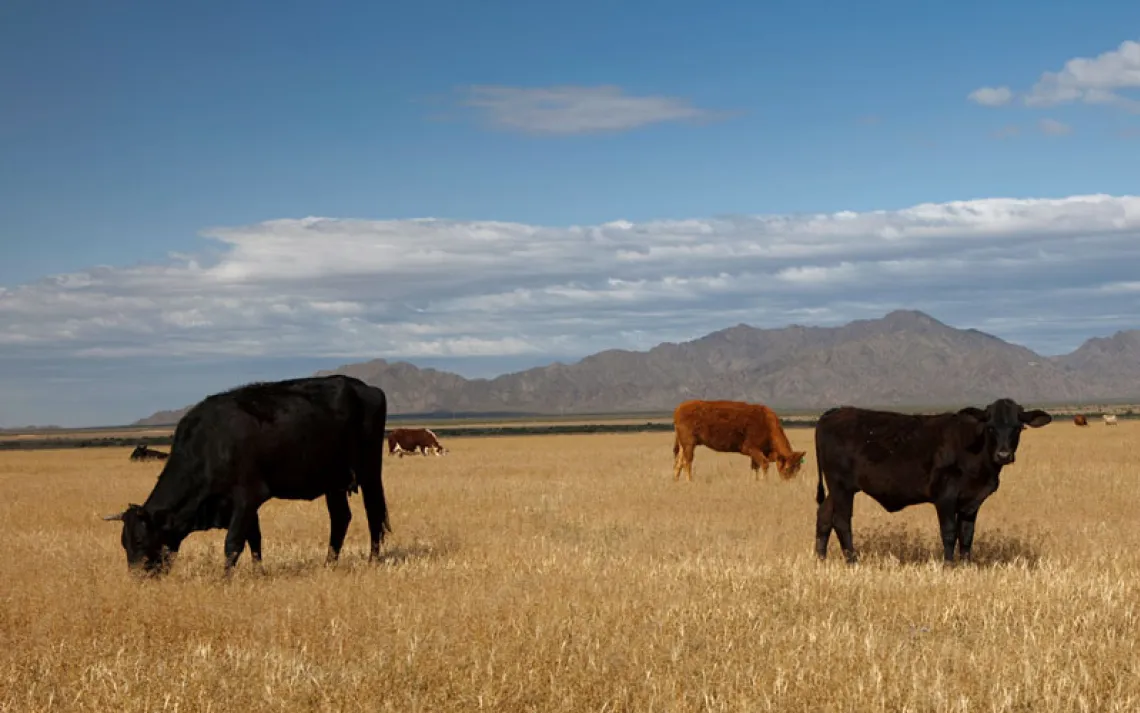
I biked this same 70-mile section of the Red Desert seven years ago, riding past grazing cattle and sand dunes that sing in the wind. Miriam was not quite one year old then. Her dad, Josh, buckled her in her car seat each morning and drove with our water, food, and camping gear while two friends and I set out to explore this open terrain that includes nine wilderness study areas, ruts and markers from three pioneer trails, and herds of elk, mule deer, and pronghorn. I imagined how it would change with fences, pumpjacks, and more roads. But talk of selling off public lands was a bit more fringe then. I didn’t get a lump in my throat when I thought about their future.
It’s different now.
So I brought Miriam back, this time as a rising fourth grader. Her dad rode with us, along with his sister and her five-year-old son. Miriam’s grandparents drove with the supplies. We were three generations of Wyomingites sailing the sagebrush sea.
As the dark clouds building over the Oregon Buttes threatened to spill out over us, I decided it wasn’t the time to talk to an eight-year-old about political storms. We had two more days to go. Plus, Miriam asked if I wanted to race to catch up to her dad.
Wyoming’s Red Desert, like much of the rest of the millions of acres of BLM land in the West, became public a bit by accident.
The Eastern Shoshone and Ute Tribes once called the area home, carving pictures of game and bow-wielding warriors into cliff faces. Almost a dozen other tribes lived here at one time or another.
By the mid-1800s, the US government had divided the West into 640-acre squares, a key step in fulfilling the Eurocentric vision of Manifest Destiny. The government broke treaties with the tribes, stole much of their land, and then gave vast swaths to the railroads while offering the rest to any white man old enough and capable enough to make a living on its soil. Plenty were old enough. Most didn’t make it, unable to navigate an arid landscape vastly different from the fertile fields of the Midwest and the East.
The failed homesteads and unclaimed deeds went into US coffers, said David Willms, the associate vice president of the National Wildlife Federation’s public lands program and a University of Wyoming adjunct professor.
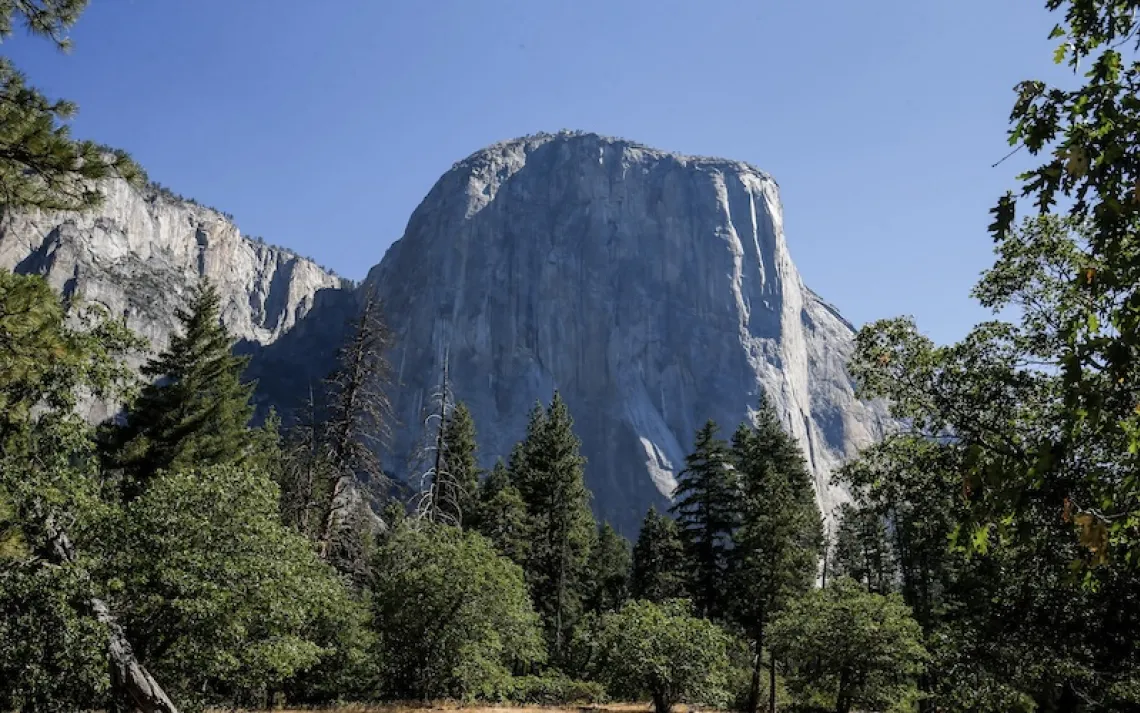
“The original idea was never to own them forever,” he said. “But we started seeing that idea chip away in the 1870s or so when Yellowstone was created, and then Yosemite. Folks started seeing that these lands have value.”
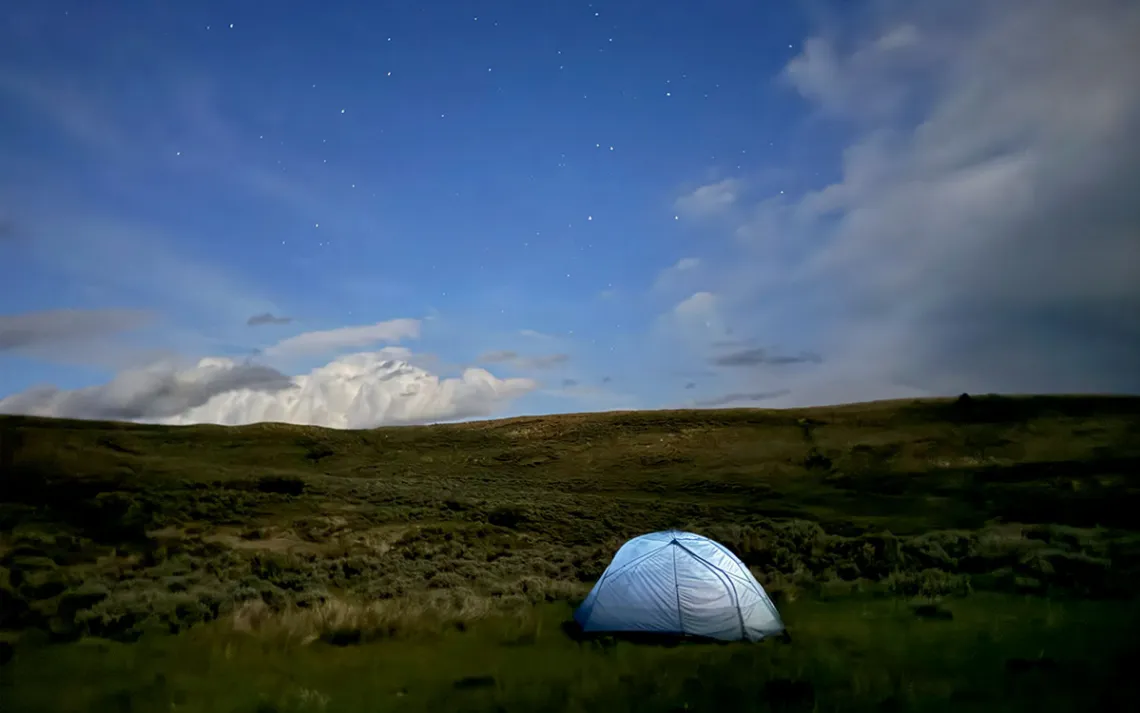
Camping in Wyoming’s Red Desert.
In 1976, Congress passed the Federal Land Policy and Management Act, tasking the BLM with managing 245 million acres of public land and finally ending the nation-wide land giveaway.
In the decades that followed, BLM lands like the Red Desert gained a following. People flocked to them, looking for elk and golden eagles, burrowing owls and white-faced ibis. They gazed at bright-red Indian paintbrush and golden balsamroot and sought relief from the heat in hidden aspen stands. They camped and rode dune buggies, hunted elk and antelope, looked for petrified wood, and took nighttime photos of our galaxy.
The federal government’s unintentional accumulation of public lands likely played into the current efforts to divest them, said Jess Johnson, government affairs director for the Wyoming Wildlife Federation, who hunts, hikes, and camps in the desert.
“They’re seen as the lands that nobody knew what to do with,” she said.
Doug Burgum, the former real-estate tycoon turned interior secretary, has an idea for what to do with these lands. He sees them as the country’s “balance sheet,” a line item, a place where unregulated, or barely regulated, housing development and drilling for oil and gas could help offset our nation’s growing debt.
Others in Washington, DC, want to sell the land outright. In mid-June, Utah Senator Mike Lee added an amendment to President Trump’s One Big Beautiful Bill to force the sale of up to 3.2 million acres of public land. Hunters, anglers, hikers, bikers, rockhounds, birdwatchers, and countless others vehemently opposed the amendment, after which Lee reduced the number to 1.2 million acres.
That version, too, met its demise as a multitude of outdoor recreationists and public land advocates—from off-roaders and hikers to hunters and even podcaster Joe Rogan—voiced their protest, writing emails, making phone calls, and even showing up at statehouses across the West.
BLM lands—like the orange, green, pink, and blue striped cliffs we faced as we rode our bikes into a 30-mile-per-hour headwind on day two—are “underutilized,” Lee wrote on Instagram in late June. In a radio interview a few days earlier, he claimed that a lot of public lands have “zero recreational value” and “zero conservation value.”
Yet as we drew closer to those rainbow-colored bands, all Miriam could say was, “Oh, wow.”
While congressional efforts to sell public lands like these may have died in June, Land Tawney, the co-chair of American Hunters & Anglers and the former president and CEO of Backcountry Hunters & Anglers, reminded me that the fight is far from over. President Trump’s 2026 budget proposal called for a reduction in the size of national monuments and cuts of hundreds of millions of dollars from agencies like the BLM and the US Geological Survey, which studies and helps manage these lands. At the same time, Trump proposed expanding energy development on public lands and drastically shortening environmental review processes.
“Mike Lee is not going anywhere,” Tawney said. “He says he’s talking to the administration, and the administration wants to figure out how to actually get this done . . . and they’re systematically trying to destroy our public lands so they can privatize them.”
Those lands they’re intent on selling and developing in Wyoming teem with wildlife, including dancing, chicken-size greater sage grouse and the largest desert elk herd in the world. Wild horses roam the landscape along with mule deer and Great Basin spadefoot toads.
Horned lizards live here too. At a stop along our bike route, I spotted one and cradled it in my hand.
“It is soft!” Miriam said as she gently touched the lizard’s belly before I placed it back under a sagebrush. “I can cross it off my bucket list now.”
She’d wanted to feel a horned lizard since her first-grade teacher described their velvety undersides. I considered for a moment if Interior Secretary Burgum thinks about that kind of wonder when he pencils out our country’s balance sheet.
That night, our three generations sat around a campfire nestled in an aspen oasis on the side of Steamboat Mountain. Purple wild irises sprouted from wet soil behind us. Bright-red trumpet flowers flourished in pockets of fading sunlight.
We watched the waxing moon rise from the horizon and listened to the mountain bluebird’s silky warble as it rested on a nearby limber pine stump. My father-in-law talked about his first time on this cliff face almost 45 years ago, listening to the same fresh spring gurgle as he scanned the hillsides for milk-chocolate-colored elk with fluffy white rumps through his binoculars.
By the last leg of our journey, sand and grit coated our bikes and bodies as four-wheelers raced each other in the distance. Oil pads dotted the horizon, near the world’s longest documented mule deer migration route. The area has always been multiple-use—portions have been drilled, portions protected. And while the Biden administration signed off on a controversial but conservation-heavy management plan for the desert last year, officials were already discussing ways to undermine it within months of Trump reentering the White House, said Johnson.
As the Trump administration continues to shorten environmental reviews under laws like the National Environmental Policy Act, exclude climate change and social justice concerns, and gut land-management agencies, it’s easy to see how—even without Lee’s land-sale amendments—this region may look very different to Miriam in 10 or 20 years.
But we kept pedaling, struggling to stay upright on sandy two-track to reach Boar’s Tusk, the core of an ancient volcano and the formal end of the trip. The Arapaho call it Neniiheii, which means “the parents,” said Big Wind Carpenter, a tribal member who grew up on the nearby Wind River Reservation. I saw the resemblance to an actual boar’s tusks, but I like the name Neniiheii more; it conjures the image of two parents cloaked together, looking out over the desert.
I wrapped Miriam in a sweaty hug and told her how proud I was that she had ridden all those miles through mud and sand, over a body-shaking washboard and away from building thunderstorms.
Hours later, we sat in the shade of our truck, snacking on carrot sticks and cucumbers. It was in the 90s, far too hot for anything substantial.
Miriam and my nephew didn’t seem to mind the heat. They raced each other across the Killpecker Sand Dunes, one of the largest living sand dunes in North America. Miriam turned one cartwheel after another, then they both lay down on the dunes and waved their arms and legs up and down, making twin sand angels. It had all been one big adventure for these two, a 70-mile journey from one natural playground to another.
I hadn’t told her yet that this could all change. Because maybe it wouldn’t. Maybe we’d keep speaking up, calling our lawmakers, advocating for the land, for wildlife, for our way of life, for our children, and for their futures.
Maybe I would wait until our trip was over to tell her.
She had one more sand angel to make.
Explore
Take a Sierra Club trip to Wyoming. For details, see sc.org/outings.