The Magazine of The Sierra Club
The Mission to Make EV Charging Accessible to Everyone
Donald Trump tried to scrap the NEVI program. Then Sierra Club attorney Joe Halso stepped in.
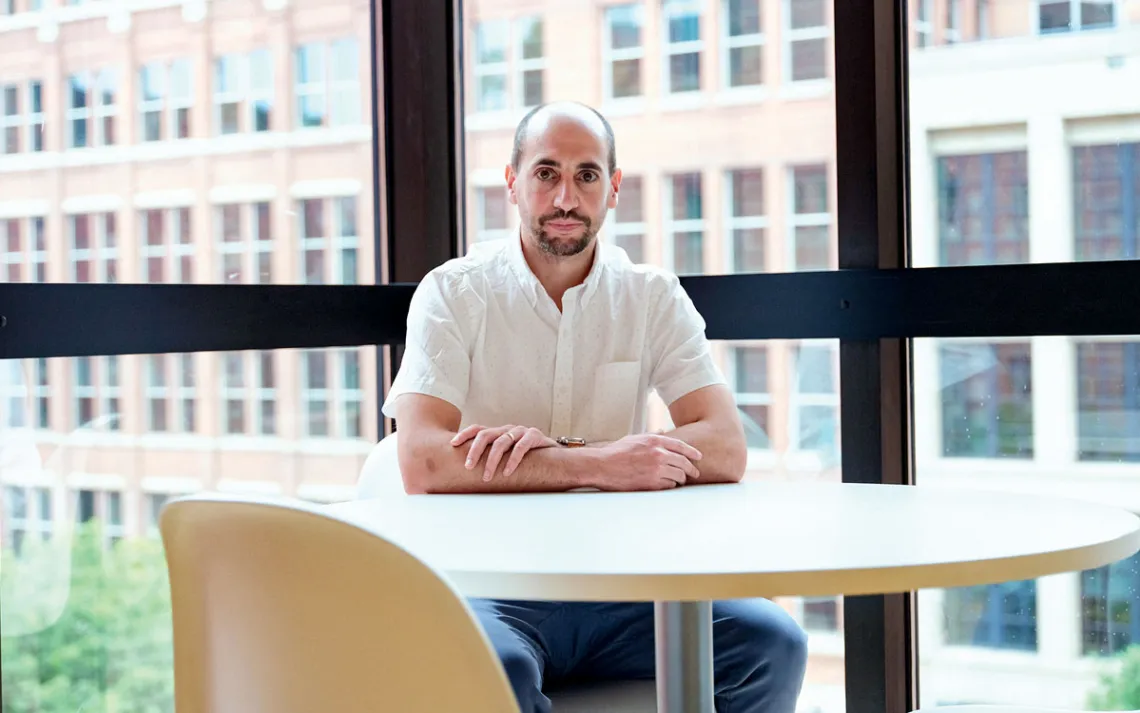
Photo by Rebecca Stumpf
Joe Halso has spent the past decade thinking about one of the biggest obstacles to mass electric-vehicle adoption: range anxiety. After all, no one wants to be left stranded. As a lead attorney for the Sierra Club’s Clean Transportation for All campaign, his primary goal has been to narrow the accessibility gap so anyone can go electric. A robust charging network is a major part of the solution.
For Detroit-born Halso, the issue is personal. Working in the automotive industry runs in the family. His great-grandfather made gears and axles for Chevrolet. His paternal grandparents met while working at a Detroit tire plant. And both of his parents worked for an auto-supply company. Growing up, Halso spent summers at a local YMCA camp, where he developed a love of the outdoors. In college, at the University of Michigan, he led outdoor-adventure trips and studied Ralph Waldo Emerson and John Muir. A course on environmental law—and its inspiring teacher—led him to law school, with the goal of one day working at an organization like the Sierra Club.
In 2015, after a professor told him about a legal fellowship at the Sierra Club, Halso leaped at the opportunity. He was hired as a full-time attorney with the Environmental Law Program the next year. He has spent most of his tenure in this role appearing before public utility commissions, making the case for where EV charging infrastructure should be built and how it should be funded. Starting in 2022, Halso helped shape a first-of-its-kind initiative called the National Electric Vehicle Infrastructure (NEVI) Formula Program by commenting on the draft proposal, after it was passed as part of the Infrastructure Investment and Jobs Act.
The NEVI program was set to spend $5 billion to help states build a nationwide highway EV charging network. But President Donald Trump, on the first day of his second term, tried to scrap NEVI and other clean energy and EV charging programs. By then, however, every state had a federally approved plan to build its share of the NEVI network, and many had already begun moving projects forward. That didn’t stop the Federal Highway Administration from notifying states in February 2025 that the program would be indefinitely suspended.
“My first thought was that this is not a mere ‘suspension,’” Halso said. “They’ve canceled states’ plans, cut off funds, and there’s no guarantee that they will turn the tap back on.”
Halso and his team embarked on a mission to unfreeze NEVI—building legal arguments, filing dozens of record requests to uncover Trump administration communications, and connecting with state attorneys general and nongovernmental organizations. The Infrastructure Investment and Jobs Act did not authorize the federal government to pause the NEVI program. And it laid out only two pathways for funding to be revoked: if a state failed to develop EV charging plans or it failed to act on them. Neither had occurred.
In court, plaintiffs must have standing. It’s the foundation of every lawsuit, said Josh Berman, a Sierra Club attorney who worked with Halso on the NEVI case. To have standing, plaintiffs need to be directly harmed by the offending action, and they must benefit from the requested remedy.
While Halso and Berman tackled the Sierra Club’s standing, 16 states and the District of Columbia—led by Washington, California, and Colorado—filed suit in May 2025, challenging the freeze of their NEVI funding. Then four more states joined the lawsuit. A few weeks later, Halso led a coalition of national, state, regional, and community organizations into the case to represent people nationwide, including in states that had not sued.
To make their case, Halso and the legal team helped gather three dozen Sierra Club members from around the country to describe how gaps in the charging network had impacted their lives—from being stranded, to skipping trips to visit loved ones, to purchasing EVs with the expectation that NEVI stations would be built. Together, the Sierra Club and its allies used those stories to show that the harms of the NEVI freeze extended from coast to coast.
They were able to show the value of the NEVI program, said Caitlin Soden, one of the lead attorneys for Washington state, who argued the case alongside Halso in late January. “They were able to find people in every single state that are part of their membership who could attest to the harm they were experiencing,” she said.
Less than two weeks after Halso and Soden argued their case in federal court in Seattle, the state and NGO plaintiffs won a sweeping victory. Judge Tana Lin’s order restored billions of dollars for EV charging and barred the Trump administration from interfering with NEVI going forward. And, just as the Sierra Club and its partners had sought, the ruling applied nationwide.
“The theory that Joe had worked up initially ended up being the theory that we were able to actually litigate in the case,” Berman said. “At the oral argument, he was so thoroughly prepared; he’d worked through every question that he could get asked and how exactly he wanted to answer it.”
Following the legal victory, states have restarted the NEVI buildout, with hundreds of NEVI funded charging stations now online across the United States. “If you ever charge up in Ohio or Utah or Maine, think of Joe, Josh Berman, and the many others working to protect NEVI,” said Sierra Club managing attorney Josh Stebbins.
Still, there is a long way to go. The Trump administration’s attacks on funding for EV charging keep coming. Most recently, the Federal Highway Administration proposed nearly impossible-to-meet restrictions on the materials that could be used to build charging stations, a move that would again effectively halt NEVI if finalized.
“Defeating the NEVI freeze was extremely gratifying,” Halso said. “But we’ve got a lot more work to do.”
Judge Lin’s ruling makes clear what remains at stake. A road, she wrote, “does not exist simply to take up space as a ribbon of blacktop,” but is “used to bring people from one place to another.” When access to essential infrastructure is denied, she explained, there are real harms for real people.