Beach Communities Hit by Major Storms Search for Ways to Reclaim Lost Sand
Gulf Coast counties are exploring sustainable solutions to restore impacted beaches
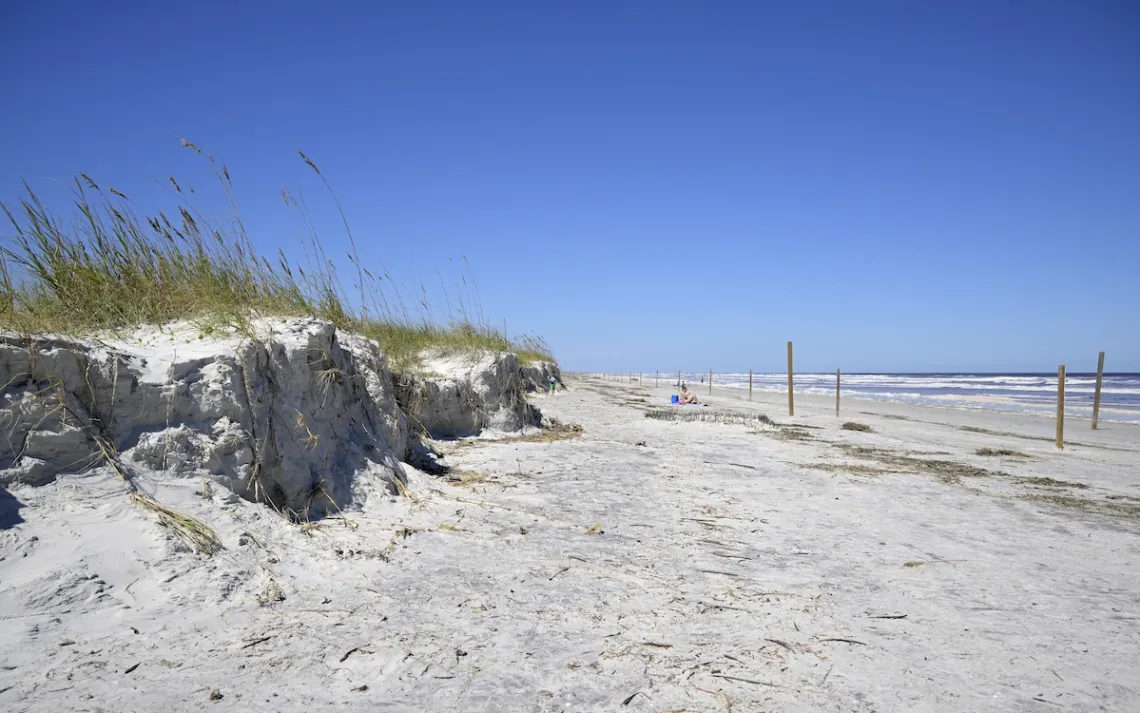
Beach erosion, including damage to sand dunes, in the aftermath of Hurricane Ian at New Smyrna Beach, Florida. | Photo by Phelan M. Ebenhack via AP
Last year, Hurricanes Debby, Helene, and Milton walloped Florida’s central Gulf of Mexico coastline. With Helene, in particular, many communities endured storm surges of four to eight feet, which carried and deposited boatloads of sand beyond the beaches. In some places, sand accumulation reached four feet and presented a materials management nightmare. Many compared it to northern cities dealing with a heavy snowfall—that would never melt.
“Looking to history, there wasn't any precedent for what to do with four feet of sand coming in across the entire towns along the southwest coast of Florida,” says Charlie Hunsicker, Manatee County’s director of natural resources, which includes Bradenton, Anna Maria Island, and the northern part of Longboat Key and their beaches. The southwest coast hadn’t seen a storm surge approach from that direction since the 1920s, he says. Returning the sand directly would mean that “broken up shingle, insulation, window pane glass, frames, wood, debris, and oils and greases from the parking lots [would be] placed on our beautiful beach.”
No one wanted that. The Florida Department of Environmental Protection also has strict sand rules about the grain’s size, color, and consistency when it’s used to rebuild impacted beaches during hurricane recovery. Several communities, like Manatee County, sought inventive means to repurpose all the storm sand they could salvage. A few even managed to redirect the nonreusable “trash” sand to sustainable uses that ultimately benefited beleaguered local residents.
Sand is heavy and noncompressible, which could translate into communities paying high tipping fees—the landfill fees based on the material’s volume and weight. Tipping fees for Manatee County’s sand, Hunsicker estimated, might reach $4.5 million.
Working for Manatee County’s Natural Resources Department since 1991, Hunsicker aimed to think about the storm-deposited sand resourcefully and innovatively while also saving the community—whose economy relies heavily on tourism and appealing beaches—some money. Manatee County has a history of following sustainable practices, which includes their “Love It Like a Local” program for visitors. The Bradenton Area Tourism Bureau is Florida’s first destination to partner with Leave No Trace, and since 2017, the Manatee County government had been designated as a Florida Green Local Government platinum-level for environmental stewardship by the Florida Green Building Coalition.
“This community tried to address an opportunity and take advantage of it,” says Hunsicker.
Any sand remaining on the beach was tractor-raked and sifted multiple times with tines reaching two inches down to remove debris. For the cleaner sand they collected that might be upcycled back to beaches, Hunsicker “borrowed from heavy rock construction practices" to sift and clean it where it was hauled into a publicly owned space. Their tactics included a multipronged filtering system using three-quarter-inch-opposing diamond screens that moved like a flour sifter. The size of the screen also helped the process take only a month to thereby ensure beach reopening for the coming tourist season. Replenishing the beach with new sand from a sand mine could have cost between $2.5 million and $3 million, Hunsicker estimates.
For sand collected from residents’ homes, parking lots, and commercial sites that was deemed “incompatible” with the beach, Hunsicker devised another solution that viewed sand as a valuable raw material. During the clean-up efforts, the county transported the equivalent of 700 heavy truck loads to a county site for temporary storage. This sand will be repurposed as fill to help rebuild a local road that needs to be elevated above the flood plain. “Sand like this can [also] be used in the shoulders and under sidewalks and swales,” Hunsicker adds. That avoids landfill costs and reuses the material sustainably.
In all, Manatee County estimates they’ll save residents $8 million by reusing the accumulated sand. They also worked quickly to restore one of the dune barrier systems both as a future storm buffer and to help block commercial and residential lighting (from the nesting sea turtle’s perspective), helping to ensure that the sea turtles will nest successfully this season. Since the early 2000s, when Manatee County began beach renourishment projects, sea turtle nests have risen from 96 nests in 1991 to 685 in 2024, even despite the hurricane impacts, says Hunsicker.
North of Manatee County, the community of Pass-a-Grille faced similar sand challenges. After 2023’s Hurricane Idalia, the community had completed emergency 10-foot dune creation trying to prevent future damages. Such dunes are “like a speed bump for the hurricane” that slow it down, thus “lessening the energy that impacts the properties,” explains John Bishop the coastal management coordinator for Pinellas County, which overseas Pass-a-Grille. Unfortunately, the dunes’ vegetation was planted only in May of 2024, so “the sea oats barely had a chance to even get the roots down” before being “obliterated” by Helene’s surge, he says.
Pass-a-Grille was also nearly two-thirds of the way through a beach renourishment project when Helene hit. Luckily, they were able to pivot that contractor to clear their streets and help to clean the storm-deposited sand with a “giant sieving machine” that filtered to three-quarters inch, as Manatee County did. However, as Bishop explains, even filtered, the sand from the streets wasn’t from a “permitted borrow area,” so their contract didn’t allow using that sand to replenish the Pass-a-Grille beach. They were, however, allowed to use it to rebuild the destroyed dunes, and this summer they plan to plant those with sea oats and sea grapes, whose roots will help hold these new dunes in place.
On Pass-a-Grille, the area hardest hit was from First to Ninth Avenues, where the dunes and vegetation were newest. One takeaway is that “established, vegetated dunes work,” says Camden Mills, the public services director at City of St. Pete Beach. Before that vegetation takes root is a “vulnerable time frame,” he notes, going into this year’s hurricane season. And the Passe-a-Grille beach remains unreplenished, due to the storms and easement issues, says Bishop.
While some question the long-term efficacy and sustainability of beach renourishment programs, that is still standard practice. Defenders of that strategy cite experts, such as James R. Houston, director emeritas of the US Army Engineer and Research Development Center. “For every dollar spent annually on beach renourishment, beach tourists spend $3,300, adding $1,500 to the US GDP and generate $228 in taxes,” Houston presented at the 2025 National Conference on Beach Preservation Technology, citing both the US Travel Organization and the Federal Reserve.
Wide, replenished beaches fare best in storms as evidenced by Siesta Key in 2024. That beach was “one of the least impacted [west coast Florida] beaches because it’s wide and has at least 500 feet of sand before you get to the dunes,” says Scott Moranda, division manager of beaches and water access for Sarasota County Parks. Other areas, like Manasota Key and Blind Pass Beach with narrower beaches, were more heavily impacted.
The state of Florida is currently requiring coastal governments to make vulnerability assessments of their beaches and infrastructure that take into account sea level rise, increasing rainfall, and higher tidal surges, although they might need to use other language that the current federal administration approves of. Communities are trying to go “above and beyond returning things to what they were before the storm,” says Moranda. Mitigation recommendations may include beach nourishment, hardening structure, raising facilities, or installing a sea wall. “A lot of that will come down to how much money the county can put toward it and how much will be received from FEMA,” he says.
Manatee County has had to patch a few gaps in the post-storm dunes system and looks forward to a 2026 plan with Army Corps federal and state partners to renourish both the width and depth of sand along a five to six miles stretch, says Hunsicker. A wide beach is an “energy barrier, energy buffer, energy expender,” he explains. “Our beaches are sacrificial sand public investments to take the energy of the storm, along with the dunes and the vegetation.”
With increasing storm intensity and frequency widely predicted, all these coastal communities will need ongoing financial assistance to keep beach sand and dunes in place. “As long as we have a federal response to help you recover from catastrophic events—whether it's wildfires or tornadoes or tropical storms, hurricanes—if we're there as a government to help you repair, then we should be there as a government to help you prevent,” says Hunsicker. “Which is what beaches do.”