 The Magazine of The Sierra Club
The People Who Grow America’s Potted Plants Need More Climate Protections
Farmworkers in Florida are working with retailers to create lasting safety protocols for working in the heat
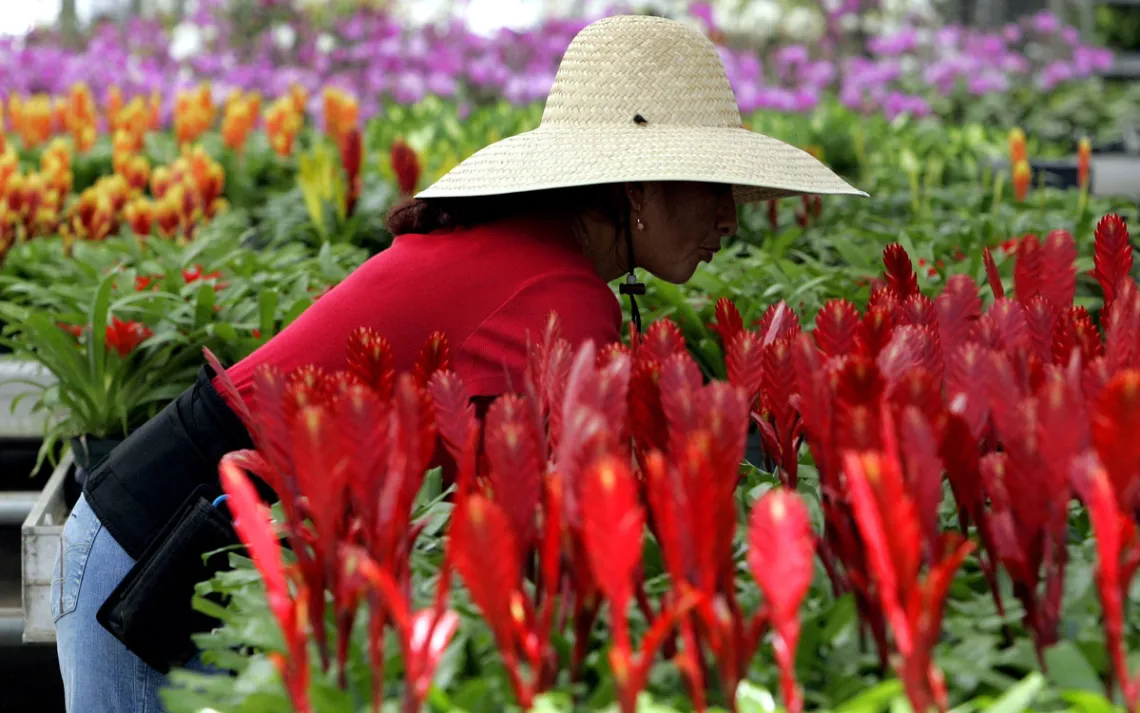
Sara Mendez prepares bromeliads for shipment to retail stores. | Photo courtesy of AP Photo/Lynne Sladky
During his first three years in the United States, Alejandro worked odd jobs, looking for work on street corners. He finally found work at a plant nursery on a small farm, where his companions showed him how to plant seedlings in containers with soil and fertilizer. Now, Alejandro works for a bigger nursery, where his experiences are different—he plants seedlings, prunes, takes out trash, and handles dirt piles.
“We go to work well-prepared because, especially during this hot season, the extreme heat is brutal,” said Alejandro (last name withheld upon request). Many nurseries don’t provide protective equipment, so workers have to buy gloves, boots, and shirts suitable to protect them from the heat and steam of summer. Workers may ask their employers to put up shades or tents to help, but the heat is there, regardless of their response. Alejandro claims that employers are “never going to say ‘look, go get some water,’ or ‘hey, take a break,’ or ‘go in the shade.’” The challenge, he added, is that if workers don’t take care of themselves, no one else will.
“When I go to work, I get home completely exhausted, with a headache and burning eyes,” Alejandro said. “It’s not easy; it’s hard.”
In the summer, people across the nation head to big-box stores, such as Home Depot and Lowe’s, to buy houseplants. But behind the innocuous plants stocked on store shelves is a hidden workforce. The $50 billion US houseplant industry employs hundreds of nursery workers in Central and South Florida alone. Nursery workers lack basic labor protections and face extreme heat, low wages, and pesticide exposure, according to a new report by WeCount!, a worker’s center and community organization.
Alejandro is a leader in the Planting Justice campaign, an organizing effort by nursery workers who advocate for labor protections. While nurseries vary in size, they sell plants to big brands. As part of the Planting Justice program, workers developed a comprehensive code of conduct for nurseries and are looking to sign direct legal agreements with retailers at the top of the supply chain, such as Whole Foods, Home Depot, and Lowe’s. The program would require that retailers buy only from plant nurseries that are treating their workers in accordance with the code of conduct.
Less than 1 percent of farmworkers are unionized nationwide, and nursery workers are excluded from key labor and employment law protections, including the National Labor Relations Act. Organizers for nursery workers say binding agreements with big brands are a way to ensure enforceable standards for fair pay, safe working conditions, and protection from harassment and retaliation in their workplaces.
According to WeCount!’s report, Florida produces nearly 70 percent of the nation’s indoor houseplants, with Miami-Dade County as the epicenter of the US plant industry. Farmworkers tried to secure a statewide heat standard in Florida, modeled after California's. But the legislation largely lacked enforcement mechanisms and, as it has in other legislative sessions, died in committee due to industry lobbying, organizers claim.
Consequently, nursery workers reorganized and campaigned in 2023 for a Miami-Dade heat standard so workers could have 10-minute breaks in the shade every two hours. The standard included protocols around heat acclimatization and mechanisms for penalizing employers who violated labor protections.
Organizers say that industry groups, including Costa Farms—one of the largest growers of houseplants in the world—lobbied against the local ordinance. The CEO of Costa Farms, along with another construction executive, said in an op-ed that the ordinance was discriminatory toward agricultural and construction industries. According to the Miami-Herald, Costa Farms led the charge to defeat the heat law, a move that the company acknowledges got it branded as “the bad guys.” Costa Farms declined to comment on lobbying against the local ordinance in Miami-Dade.
In 2024, Florida Governor Ron DeSantis signed into law House Bill 433, banning local safety rules for outdoor workers. The law prohibits local governments from regulating heat exposure. Organizers are now advocating for growers and retailers to join the Planting Justice program to ensure that nursery workers have access to fair wages and protection from extreme heat.
“Costa Farms markets itself as a responsible company with some of the best labor standards in the industry,” said Oscar Londoño, an organizer with WeCount! “Our response to that marketing is that if it's true that Costa Farms is a responsible company, why not work with the Planting Justice program to prove and guarantee their entire supply chain is free from labor abuses?”
Costa Farms declined to provide comment. In a previous statement to CBS News Miami, Costa Farms said it prioritizes worker safety, maintains an "industry-leading safety record," and operates an on-site medical clinic with a full-time nurse. Costa Farms said that its heat-protection policies align with proposed federal OSHA guidelines.
Meanwhile, South Florida continues to break heat records, with the hottest temperatures reaching up to 96°F in Homestead, where Costa Farms is headquartered. Climate change analyses show that by midcentury, South Florida is projected to experience 50 to 100 days per year when the heat index will be or exceed 105°, a five-fold increase from the past.
For workers like Letty Pineda—who came to Florida at the age of 24 from El Salvador—the effects of working in extreme heat are lasting. Pineda now works for a laundromat but used to work at a flower farm where they grew ornamental plants and roses in plastic-lined greenhouses.
“Being in those high temperatures in the plastic-lined houses is unbearable, the humidity and everything. . . . It gives you anxiety, headaches, nausea, [and] heatstroke,” said Pineda. She is a member of the Farmworker Association of Florida and added that she likes working in agriculture and being in contact with the land, but exposure to extreme heat, chemicals, and pesticides while working in greenhouses has had lasting effects on her health.
“Being in the heat gives me a kind of panic, a panic to be in the heat in hot places,” she said. “It has hurt my nervous system a lot. . . . I get a surge of anxiety because my body has memories of those previous symptoms.”