Putting Down Roots
A dairy operation helps three New Yorkers break into the tough business of farming
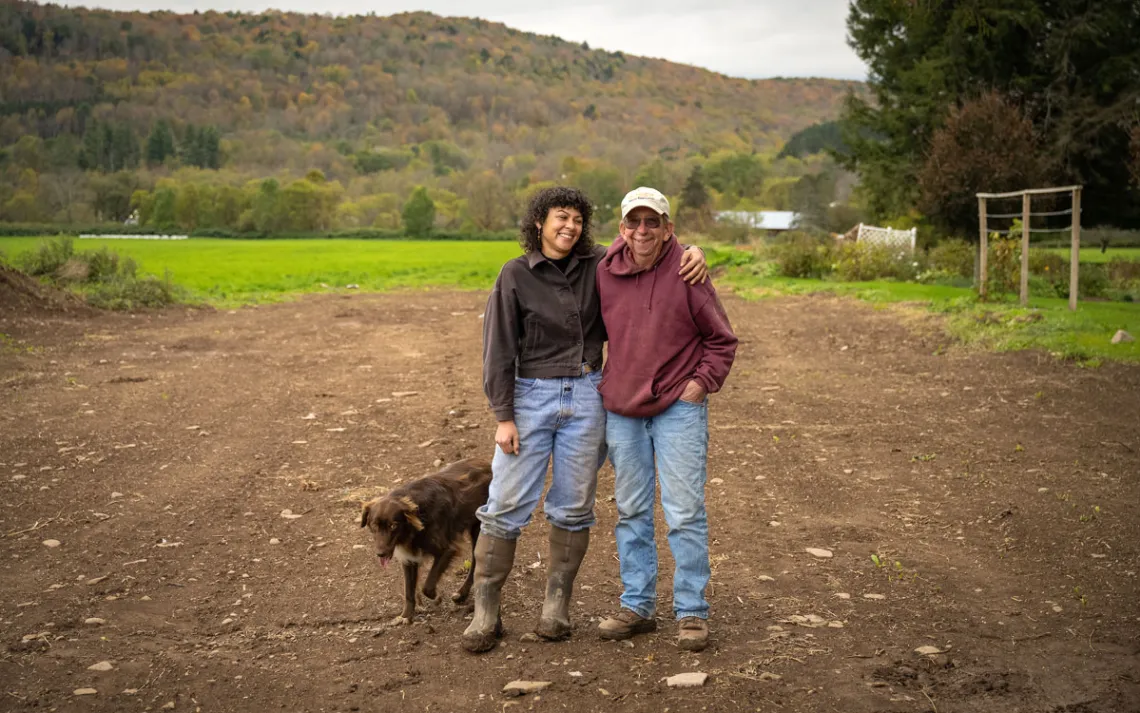
Sea Matías (new-generation farmer) and Tommy Hutson (transitioning farmer) stand together on the commons. | Photo courtesy of Jamieson Johnson
Sea Matías grew up in the Bronx and was raised by a nature-loving grandmother who made her own compost and sang to her plants. Matías didn’t know it as a child, but their grandmother’s influence would propel them toward an unlikely path. “We would spend a lot of time cooking meals together and caretaking her insane tropical plant stock in a Bronx apartment, like even an avocado tree,” they said. “It started my whole idea about plants and life.”
Matías turned that childhood affinity for gardening into a passion for food sovereignty. In 2020, Matías met Jessica Tobón and Kitty Williams while working at the New York Botanical Garden. At the time, Tobón and Williams grew vegetables in their community garden plot and distributed their produce to people in need. Together, the trio dreamed of leaving the city to grow more food than was possible in their urban gardens. But there was one looming question: How would they afford land?
“I didn't have an inheritance or savings, no land locked down,” said Matías.
According to the National Young Farmers Coalition, finding affordable land is the top challenge young farmers face, and centuries of discrimination and dispossession have made this barrier even higher for farmers of color, such as Matías, Tobón, and Williams. In addition, 2,000 acres of farmland are lost to nonagricultural uses, including development, in the US each year. When land gets built over, there are negative implications not just for future farmers but for food security and for the environment.
Farming involves a lot of upfront costs, such as land acquisition and infrastructure, and the profit margins are notoriously slim. Matías, Tobón, and Williams, who eventually dubbed themselves the Iridescent Earth Collective, are just three of countless growers across the country whose business idea seemed doomed before it started. But for them, there was ample support. Two nonprofits, the Catskills Agrarian Alliance and American Farmland Trust, helped by introducing the collective to a retiring farmer.
Tommy Hutson is a fourth-generation dairy farmer in Delancey, New York, who lives 150 miles north of the Bronx. Just as the creators of the Iridescent Earth Collective were looking for land, Hutson was concerned about the fate of his. He wanted to keep it in agriculture but had no one to take over the business. His business is part of a staggering statistic: 40 percent of the nation’s farmland is owned by people over 65. Up to 370 million acres of farmland could be sold in the next 20 years, and much of that to development. Hutson decided to participate in an experiment.
In the spring of 2023, after receiving encouragement from the Catskills Agrarian Alliance, Hutson sold his 287-acre plot to American Farmland Trust—an agricultural conservation organization with the resources to initiate the purchase of his land. The farmland trust is now the temporary guardian of the land, but a fledgling organization called West Branch Commons was created to raise the funds to buy it permanently. The goal is to make it available to new farmers for the long haul. Already, West Branch Commons is halfway to its $1 million fundraising goal.
The team behind West Branch Commons will administer affordable, long-term leases, which will provide farmers with the security needed to build out their businesses without prohibitive upfront costs. Meanwhile, the farmers will own the businesses and any infrastructure they build on the land. “We have farmers who need land,” Rhiannon Wright, the program coordinator for West Branch Commons, said. “We have land that needs to be transitioned.”
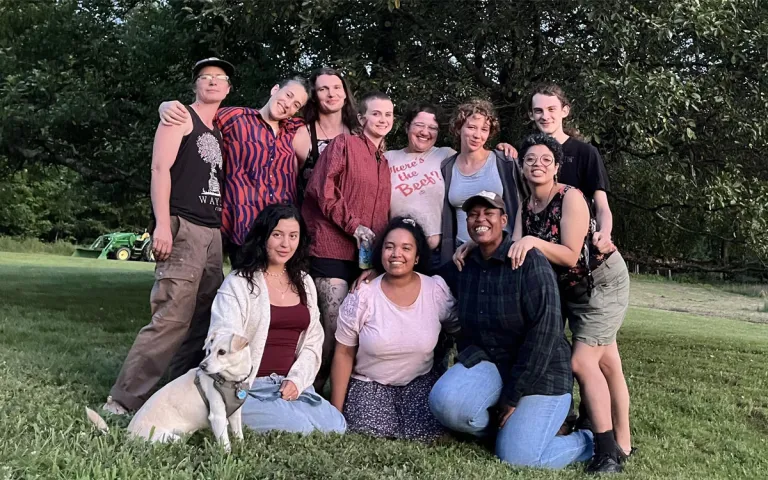
Wright said the land will accommodate four to eight farm operations, and she hopes to especially support marginalized farmers who have historically been excluded from land ownership or agricultural opportunities. It is already the home base of a handful of operations, including Iridescent Earth Collective, which arrived in the fall of 2023 after a brief stint renting a piece of land in Sloansville, New York. Since then, the collective has expanded to include builders, butchers, herbalists, and more—11 in total.
The Catskills Agrarian Alliance organizing committee. | Photo courtesy of Walter Hergt
Matías has even started a new farm operation called Serra Vida. Now, Matias, Tobón, and Williams all have temporary leases for their ventures on the land, and they will enter into long-term leases with West Branch Commons when the land transfer from the American Farmland Trust is complete, likely in late 2026. Tobón said that being part of this project has provided connections that Iridescent Earth Collective desperately needed.
“There's definitely different barriers to access [land].... We're from the Bronx but with an interest in urban farming that [turned] into this desire to be out in the country,” Tobón said. “There was a challenge of not knowing enough people.”
She and Matías said they have received mentorship from Hutson himself, who still farms a small portion of the land. They’ve also received guidance from nearby farmers in the tight-knit agricultural community and from the Catskills Agrarian Alliance.
Preserving farmland
Jerry Cosgrove, farm legacy director and a senior adviser for American Farmland Trust, negotiated the terms for the sale of Hutson’s land. As someone who has been working in agricultural policy for decades, he’s come to the conclusion that new farmers need the wherewithal, the “chops” to start and stay farming.
“But there's really only one way, in my view, to test that out,” Cosgrove said. “They have to have access to land.”
Keeping land in agriculture is about more than just fulfilling young peoples’ dreams to get their hands in the dirt. Hutson’s land is in the watershed that provides drinking water for New York City. And Wright's vision is that growers who farm the area will use ecological methods to cultivate the land and keep it healthy. “In the long term, this is going to be an organic project,” Wright said. “All of these farms are going to be either certified organic or using organic practices.”
This means starting with organic seeds, avoiding chemical sprays, and using regenerative soil practices, such as composting and cover crops. Since Hutson’s land is on the Delaware River, these practices help ensure that the water is not inundated with either carcinogenic chemicals or nutrient runoff, commonly associated with conventional agriculture. In addition to regenerative soil practices, including no- or minimal-tillage, Matías plants native trees and shrubs to support native pollinators.
Preserving farmland also supports the ability for the region to rely, at least in part, on locally grown and sourced food. New York State has put policy and funding behind this goal. Since 2020, the state has dedicated more than $500 million to projects that aim to increase access to local food for New Yorkers and provide new markets for New York farmers. And a new state executive order 32 directs state agencies to purchase at least 30 percent of their food from New York farmers by 2030.
“[Local food] may not be all the food that we eat, but it can be a large part of our diets,” Tobón said.
While Matías’s grandmother is not around to see the fruits of Matías’s labor, they pay homage to their Puerto Rican roots by growing crops like cilantro, collard greens, pigeon peas, and more. Matías feels that working the land is carrying on a critical tradition. And just as they tended to an avocado plant in a pot, they feel responsible for taking care of the little slice of Earth where their project sits so that future generations can have food and clean water.
“I am the future ancestor of this piece of land,” Matías said. “It’s not just for me.”