Saving One of America’s Most Imperiled Birds
The Florida grasshopper sparrow is rebounding thanks to the work of these conservationists
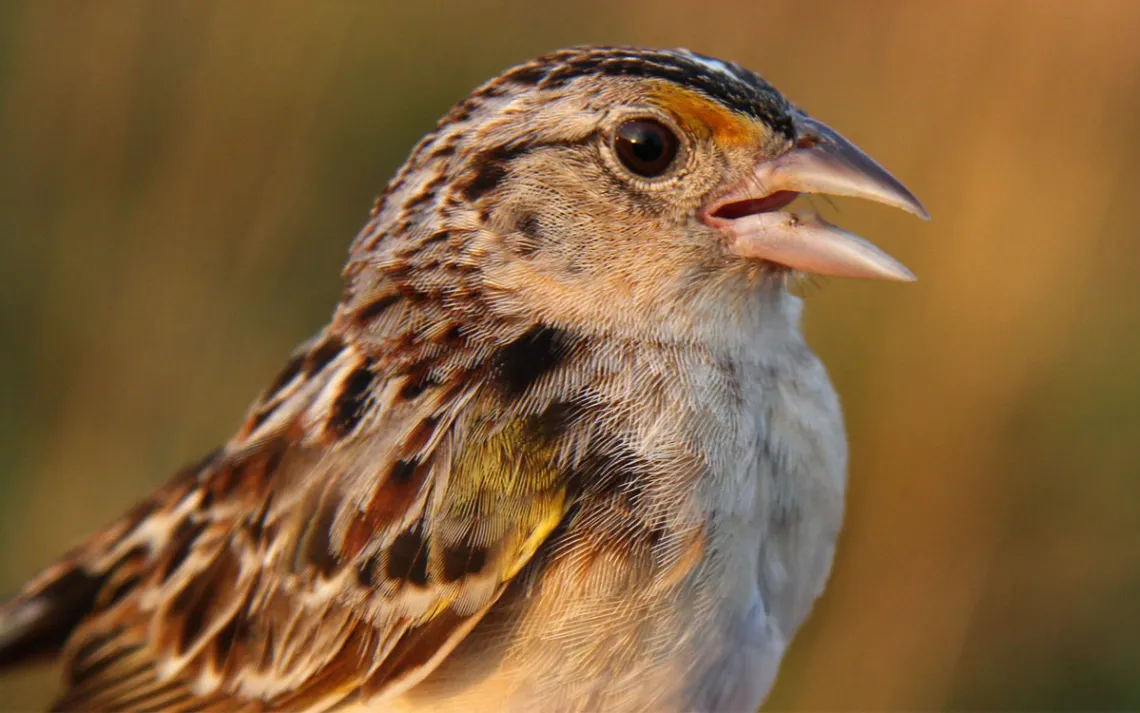
Florida grasshopper sparrow. | Photo by Florida Wildlife Commission
The buzzzz of a Florida grasshopper sparrow is one of the rarest avian sounds in America. However, the fact that its insect-like trill can be heard at all is a sign of progress and hope.
This species was on the precipice of extinction just decades ago, but a band of researchers combined resources and knowledge to save them. Among them was an unlikely cohort of scientists, who assisted with transporting fledgling sparrows born in captivity to Welaka National Fish Hatchery. When first approached with the idea to help with sparrow conservation, Tony Brady, the acting project leader for the hatchery, said he was a little surprised. “A fish hatchery working with birds?” he asked himself. “That was really a stretch.”
The hatchery has been involved with grasshopper sparrow conservation since 2019, but efforts go back to 2002, when a group of volunteers banded together to start the Florida grasshopper sparrow working group. The alliance consisted of representatives from a variety of federal, state, and nonprofit organizations. This included the US Fish and Wildlife Service, the Florida Wildlife Commission (FWC), White Oak Conservation, Avian Preservation and Education Conservancy, the Brevard Zoo, the Welaka National Fish Hatchery, and the Audubon Society. Researchers with these organizations say that captive breeding was never the original plan, but rather a last resort.
Officials with the Fish and Wildlife Service, the federal agency charged with managing threatened and endangered species, and the FWC started monitoring the birds in 1995. The sparrows are native to Florida’s dry prairies, but because of urban development and agriculture, the majority of the birds’ habitat has been eliminated. Other problems, including climate change, fire management, changes to hydrology, and low genetic diversity, also contributed to the dire situation. By 2018, only 48 known birds remained. The overall number of individuals was too low, and they weren’t reproducing quickly enough in the wild. To prevent them from becoming extinct, members of the working group needed to increase the number of hatchlings.
Conservationists put together a recovery strategy for the sparrow the same year the hatchery got involved with recovery efforts. The authors of the recovery plan wrote, “Recent research confirms that adult survival and productivity rates are too low to support a stable population.” Mary Marine, a biologist with Archbold Biological Station, an organization that assists with the monitoring and management of the Florida grasshopper sparrows in the wild, said that the decision didn’t come lightly. “We realized if we just kept watching them, they would go extinct.”
Since the birds can have four to five broods within a year, the fledglings were reaching a point where they no longer needed their parents but were still taking up valuable space at the breeding facilities. Their prolonged presence delayed breeding pairs from starting their next brood. But biologists wanted to keep an eye on the juvenile birds for a bit longer before releasing them into the wild. From there, the idea of including the hatchery was born.
The first step was to build a space for the birds. “We built the aviaries using carport frames and wire mesh,” Jorge Buening, lead biologist for the hatchery, said. “As soon as we were getting it sealed up, the birds arrived.”
They’ve also created a way to monitor the birds in a passive way. They have trail cameras focused on the feeding stations and switch out the cards daily. “We go through all of the videos every day,” Brady said. “Each bird that comes to the hatchery has a unique color combination of leg bands, and we track each bird by those leg band colors.”
When the birds are around 40 days old, the team from the FWC assess their health. They check their weight, lightly blow on their feathers to see their pectoral muscles, and closely examine their flight feathers. Sometimes, they just need a little more time at the hatchery, and the team happily obliges. When the birds are ready, the researchers release them at the Avon Park Airforce Range or Three Lakes Wildlife Management Area. State biologist Alex Marine is one of the team members who gets to share this special experience with the birds as they’re starting their new lives.
“Sometimes they’ll take a worm before they go and just look around and take it all in before they leave,” Marine said. “Hopefully we’ll see them again in a few months.”
Alex and Mary Marine both separately lead crews. They call their work applied conservation—taking what they’re learning and applying it immediately. While they are monitoring and studying the birds, they take steps to help each bird and nest on a case-by-case basis.
The male birds start singing in mid-March, and that’s the cue that they’re looking for a mate. For the Marines, that’s also their signal that it’s time to wake up at 3 a.m., douse themselves with bug spray and sunscreen, and get ready to spend their days in the hot Florida sun. Once they find a male bird, they don’t let him out of their sight until they find his female mate, and eventually, the nest.
Since flooding poses a threat to the ground-nesting birds, the crews raise the nests a few inches, if needed. They also put up fences to keep out predators, but there’s one surprising predator that can’t be kept out with a fence: fire ants from South America. A focused effort of treating fire ant mounds has increased nest success by about 40 percent at the DeLuca Preserve in Osceola County.
While there’s a long way to go, there’s enough data to show that the collaborative effort is working. Mary Marine shared that at the DeLuca Preserve, she’s seen the highest number of nests ever since the species hit its record low. “We had 20 nests this year,” she said. “Last year we had 16, and the year before that, there were three.” There aren’t any releases happening at that site, so this is evidence that the protective measures, as well as the bird-releasing program, are contributing to population growth in the wild. They’re also being found at other locations, such as Kissimmee Prairie Preserve State Park.
“The birds are doing it,” she said, of their tendency to move around on their own. “They’re responding to the efforts that we are putting forth.”
Researchers estimate there’s currently a total of 200 Florida grasshopper sparrows. "It’s a huge increase,” Adrienne Fitzwilliam, a FWC biologist, said. “We were definitely facing imminent extinction, and if the captive breeding facilities and conservationists didn't get involved, I don't think we would have Florida grasshopper sparrows now.”
Captive breeding is still necessary for now, but the end goal is to find a solution that allows the birds to thrive in the wild without it. Everyone involved agrees that saving this tiny bird is important on multiple levels. “All species are worth preserving because they do have an innate value,” Fitzwilliam added, “But by helping the Florida grasshopper sparrow, we're also helping … all of those species and wildlife that utilize grasslands.”