Executive Summary
Shifting The Focus From Moving Vehicles To Moving People
The Sierra Club Harvey Broome Group
07/20/2026
Rush hour traffic in Knox County’s I-40 corridor is a nightmare. UT’s Boyd Center for Business and Economic Research predicts continued growth in the local area of more than 1% per year (an additional 200,000 people by 2050), further exacerbating the problem. A closely related issue is the limited functionality of mass transit in the region. It is imperative that we shift our planning focus from “moving vehicles” to “moving people”. By doing so, we wouldn’t simply reduce traffic congestion today, we would move toward a transportation system that smoothly scales with increasing population, reduces our carbon footprint, improves mobility for fellow citizens with little or no access to a car, makes Knoxville more “user-friendly”, and frees up a staggering amount of downtown real estate dedicated to parking. This shift in focus can start with a relatively small amount of additional capital investment.
The majority of vehicles traveling the I-40 corridor belong to local motorists; dominated by in county commuters, but including significant commuter traffic to/from Loudon County, Oak Ridge and Maryville/Alcoa. The two major interstate highways also inject a significant amount of truck traffic, and significant engineering deficiencies (weigh station locations, insufficient acceleration lanes, etc.) don’t help. TDOT is considering ways to address the issue of congestion, and the goal of this document is to ensure that the solutions adopted include improvement of mass transit options for local commuters (including Bus Rapid Transit along I-40 and out to Oak Ridge and McGhee-Tyson airport), and allow for a graceful future upgrade of that system to light rail.
We include recommendations that could provide some immediate relief - including engineering improvements, making the use of KAT and carpools more appealing, encouraging flexible work hours (to spread out rush hour) and work-from-home, discouraging through traffic during rush hour, and improved biking network - but we expect that some additional automobile capacity will be needed. The Tennessee Transportation Modernization Act, signed into law in April 2023, allows for the construction and implementation of “choice lanes” (express lanes, charging a traffic-dependent toll). Choice lanes offer drivers the opportunity to pay for access to express lanes, providing a revenue stream for further infrastructure improvements. They would be useful for emergency vehicles and should be freely available to carpools and express buses. Given support for this concept in Nashville, we expect that added capacity will come in the form of such choice lanes. However, adding lanes to reduce congestion has been compared to loosening your belt to deal with obesity: it can work temporarily, but not in the long run. The Knoxville area is continuing to grow, and it will eventually become impossible to add enough lanes to reduce traffic to an acceptable level.
The conceptual breakthrough is the realization that new choice lanes would provide the most important piece of infrastructure needed for an initial Bus Rapid Transit (BRT) system. A plan that includes BRT, compared to simply continuing to add freeway lanes, would allow bus service to expand at relatively low cost to accommodate our growing population. Certainty that such a system is in the area’s future would kickstart transit-oriented development, that would in turn increase the demand for the system. It is possible to imagine a future in which the demand overwhelms the BRT’s capability, and an upgrade to a light-rail system is justified. We can smooth that transition, and lower its cost, by designing today’s upgrade with tomorrow in mind.
Introduction
Knoxville is a rapidly growing, mid-sized city, embedded in a larger region that prizes its rural roots. Growth over the last several decades has not been adequately planned for. The city is collocated with two major interstate highways whose combined throughput is merged for a seventeen-mile stretch on the west side of town, the so-called I-40 Corridor. Outside the city center there is relatively little in the way of walkable communities, and access to appealing public transportation is spotty at best. All this has combined to produce significant congestion woes - the average time each Knoxville commuter lost to congestion in 2024 has been estimated to be 52 hours! - and prompted the Tennessee Department of Transportation (TDOT) to embark on a process to identify and implement solutions. In this report we argue that now is the time to start thinking beyond just adding lanes. We must use this opportunity to make it more feasible for people to leave their cars at home. Decisions taken now will determine how easy it will be to transition to a multimodal transportation system that will better accommodate the area’s future growth.
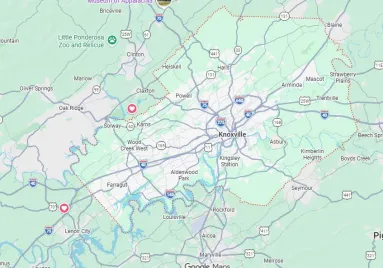
Orientation to Knoxville metropolitan area transportation
The Knoxville metropolitan area is currently home to nearly a million people. Recent growth has
been steady at a bit more than one percent per year. This is expected to continue for some
time, increasing the local population by more than two hundred thousand people in the next
twenty-five years. Figure 1 shows a map of the region. Interstate highways I-40 (east/west) and I-75 (north/south) merge for seventeen miles on the west side of Knoxville. The I-640 bypass allows through traffic to avoid downtown, but since the bypass radius is fairly small (roughly three miles), through traffic still has a significant impact on local commuters. Pellissippi Parkway is a controlled access highway (I-140 south of the intersection with I-40, highway 162 north of the intersection) connecting Oak Ridge and Maryville. Alcoa Highway (highway 129) is a controlled-access highway connecting Knoxville and Maryville. Chapman Highway (highway 441) is a non-limited access road connecting Knoxville to locations in Sevier County. Kingston Pike (highway 11) is a non-limited access frontage road paralleling I-40 west of Knoxville. Clinton Highway is a nonlimited access highway connecting Knoxville to Clinton in Anderson County. I-40/75 has four lanes in each direction between the Pellissippi Parkway and the I-640 bypass, and three lanes otherwise. I-640 has three lanes in each direction. Pellissippi Parkway, Alcoa Highway, Chapman Highway, Clinton Highway and Kingston Pike all have two lanes in each direction. Recognized engineering deficiencies - in acceleration lane length and curve radius, and suboptimal weigh station locations - exacerbate inadequate capacity.
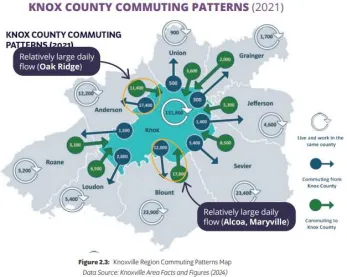
Figure 2 shows a map of Knox County commuting patterns. A little more than half of commuters live and work within Knox County. Anderson County (Oak Ridge), Blount County (Alcoa/Maryville), and Sevier County are significant nearby business and population centers, each with a large number of commuters going in both directions. Oak Ridge is booming, due to its strong ties to a rejuvenated nuclear power industry, and Alcoa is home to McGhee-Tyson, the region’s primary airport. Through traffic adds roughly 25%, by vehicle, to these commuter totals. But many of the throughgoing vehicles are tractor trailers, which have an outsized impact on congestion. KAT (Knoxville Area Transit) is the primary mass transit option in the area. KAT has 20 routes servicing over 500 bus stops. Roughly half of Knoxville residents are within a quarter mile of a bus stop. However, due to various shortcomings (limited hours, limited routes, service frequency less than twice per hour and slow transit speeds) ridership is only about 8,000 per day. As one unscientific example, Google Maps estimates travel time between East Knoxville and the West Town mall / Cedar Bluff area via mass transit to be more than two hours. Less than two percent of local commuters carpool.
Bypass Knoxville?
Currently, tractor trailers are limited to the right two lanes on local expressways. Commuters typically cross their path when they enter the freeway and get into the left lanes, and then again when they exit. This has a serious impact on traffic flow, and is unnerving for many people. Starting in the 1990’s, anticipated growth in Knox County spurred active planning for an Interstate bypass at a distance from Knoxville sufficient to separate through traffic from commuter traffic. Routes that went to the north and west of Oak Ridge National Lab were rejected early due to multi-billion dollar cost estimates. Figure 3 shows a map of the preferred “Orange Route”. Plans for this route were abandoned in 2010, when projections showed the Orange Route would divert less traffic from I-40/I-75 than previously expected, and the cost estimate ballooned to more than a billion dollars. Today, Hardin Valley is one of the fastest growing areas in Knox County and the Orange Route passes through dozens of brand new developments, greatly increasing local opposition and adding further to cost. And, for all that money, no more than 25% of the vehicles (the through traffic component) would be diverted. Throughgoing and local traffic can also be separated without a bypass, by including dedicated through-lanes (no exits) on the stretch of I-40/75 within Knox County. A recent proposal suggests a three-dimensional approach, installing such lanes on a platform elevated above the center of the existing highway. Although this would be expensive and have engineering challenges, it would avoid the need for taking more land.
Choice Lanes
In 2023, Tennessee passed the Transportation Modernization Act, specifically supporting public-private partnerships and choice lanes as a funding and delivery model. Choice lane access can be obtained by paying a toll, riding in a multi-occupancy vehicle (a carpool or a bus), or both, depending on policy decisions. Choice lanes have the benefit of bringing in private money to help cover capital costs. They also reduce the risk of congestion-related delays for emergency vehicles. Tennessee’s first choice lanes will soon be incorporated into I-24, between Nashville and Murfreesboro. Given the realities of trying to build a bypass around Knoxville, they seem likely to be the preferred solution for adding capacity here as well. However, it is important to acknowledge the reality that adding capacity by simply adding lanes is not sustainable.