By Tracy Slack
It was a dark and stormy night, and some Delaware state Representatives were angry – angry that their attempts to turn Delaware taxpayer dollars into windfall profits for huge, out-of-state data center developers weren’t going well.
First, Starwood’s “Project Washington” took one on the chin for its callous disregard for Delaware’s Coastal Zone Act, which helps protect you and me and our gorgeous shoreline from heavy industry’s nastier emissions. Second, New Castle County passed Ordinance 25-101, a set of zoning rules to ensure that massive data centers cannot be built 50 feet from your daughter’s daycare, cannot use more cooling system water than the Delaware River sees in a year, and cannot be left as a hazardous eyesore if the owners decide to skip town.
The collective mood was understandably gloomy, until someone shouted, “Hey, I’ve just thought of ANOTHER way we can funnel a mountain of Delaware taxpayer dollars into a very select few pockets! It’s called tax credits. ‘Credits’ sound nice; much cuddlier than ‘windfall profits.’ Plus, we can pretend we are helping to solve the energy crisis, even though we’re doing quite the opposite!”
A chorus of approving murmurs filled the room, and POOF! … House Bill 186, a bill that would give $450 million in transferable tax credits to 3 gas plants, was born.
We are in an energy crisis. Look no further than your home’s soaring electric and heating bills. Natural gas supply and demand drives much of that. Natural gas fuels about 80% of Delaware’s electricity generation, and it’s also one of the biggest sources of electricity generation that Delaware imports from out of state. Your electric bill and your gas bill are heavily reliant on cheap, stable supplies of exactly one thing – natural gas.
When gas supplies run low or occasionally even run out, prices go through the roof! Instead of the usual $100 per megawatt hour (MWh) wholesale cost, wholesale prices spiked up to $1,400 per MWh during Delaware’s recent winter storms. Clearly, such lopsided dependence on a single energy source spells disaster for consumers.
Delaware HB186 is a massive detour in several wrong directions. It permits three new power plants (using yet more natural gas!) to claim up to $15 million in tax credits apiece, per year, for up to 10 years. 3 x $15mm x 10 comes to a cool $450 million of OUR money, and it all goes into just 3 corporate pockets. So, what’s in this for you and me?
Can you buy cheaper electricity from these three plants and save on utility bills? Almost certainly not. HB186 lets these plants contract privately with an individual energy buyer instead of selling their electricity to the regional grid that powers our homes and businesses. Their ideal private contract customer is … you guessed it … a data center. Data centers big enough to support AI technology are the one industry buying energy at this scale – from a plant generating between 100 and 500 MWs of power, energy production that HB186 won’t fully tax for 10 years. This means below market rates subsidized by Delawareans, but electricity not accessible to Delawareans.
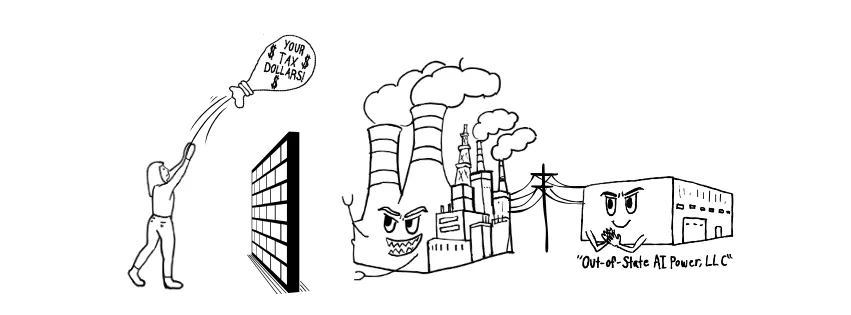
Is there any guarantee that our tax dollars at least benefit Delaware somehow? Absolutely not. The power plant developer and the data center they sell to are most likely to be out-of-state or even foreign-owned corporations. Starwood Capital Group (of Project Washington fame) is a perfect example. They’re a multinational company with offices in nine countries, but without a single drop of tax liability in Delaware.
In the very best case, if these plants DID sell their electricity to the regional grid at a lower price, how soon might you see the savings on your home’s utility bills? Six years or more, if you’re lucky. These plants take easily that long to get operational. Here’s the worst part – if natural gas becomes too expensive, the power plant’s owners could abandon the whole project … AND STILL GET TO KEEP ANY TAX CREDITS THEY’VE ALREADY EARNED. Remember, continued reliance on just natural gas is an extremely high-risk gamble. Because HB186 doesn’t claw back any tax credits in the case of project abandonment, you are shouldering some of that risk … not the power plant.
One way out of this mess is to completely replace HB186 with a bill that a) keeps your tax dollars in Delaware, b) guarantees you can share in the savings if cheaper electricity becomes available, and c) prevents the tax credits that you funded from being re-sold to an outside corporation.
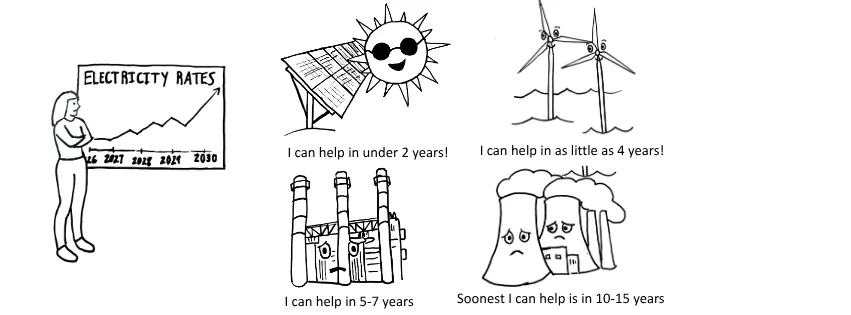
The wise long-term approach, however, is summed up in one word – diversify. Having choices in energy sources puts downward pressure on utility prices. Plus, the right choices can bring relief from rising energy costs to your pocketbook much sooner. Gas plants take 5 to 7 years to come on line; nuclear plants can take 10 to 15 years. Offshore wind, however, can deliver savings to you in only 4 years. Solar/storage options are even faster; you could see results in as little as one year.

In the meantime, while our elected Representatives struggle to do the right thing, how about this for a crazy idea? Give some credit where credit is due … NOW ... to YOU, Delaware’s taxpayers! Instead of handing your tax dollars to three out-of-state corporations, carefully funnel some of them back into the pockets of our state’s neediest consumers.
You, the Delaware taxpayers who drive our state’s economy, need reliable, sustainable help with energy costs, and you need it as fast as possible. HB186 utterly fails to deliver. It puts your tax dollars into the hands of a few corporations, and by using yet more natural gas, it further destabilizes Delaware’s energy portfolio. That can only result in higher prices for you, not lower.