Alex Mountfield, alex.mountfield@sunstonestrategies.org, (202) 599 7509
Judith Crosbie, judith.crosbie@sunriseproject.org, (929) 584 3344
Shannon Van Hoesen, shannon.vanhoesen@sierraclub.org, (202) 604-2464
GONZALES, LA — Representatives from the Good Neighbors Louisiana coalition dropped in on Hyundai’s offices in Gonzales to present the company with a list of demands regarding its proposed $5.8 billion steel mill in Donaldsonville, as well as comments filed with the Louisiana Department of Environmental Quality (LDEQ) about the company’s failure to establish safeguards on toxic dust from transportation and construction.
The delegation included representatives from the United Steelworkers (District 13), the NAACP (Louisiana State Conference), the Sierra Club Delta Chapter, and the Sunrise Community Group. During their visit, the delegation made contact with Hyundai staff to deliver paper copies and confirm receipt of the documents.
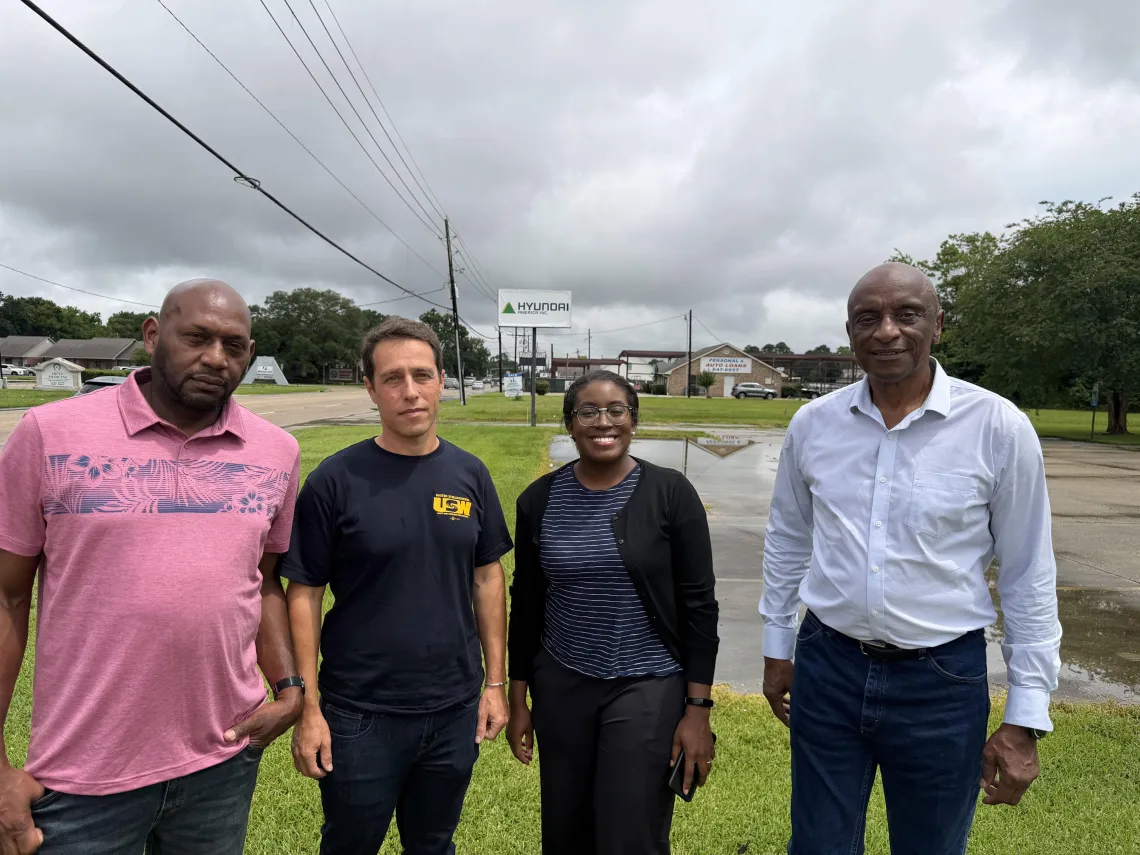
PHOTOS AVAILABLE FOR MEDIA USE
Attribution: Photos courtesy of Sierra Club Delta Chapter
“Hyundai’s own analysis acknowledges that they’re building their factory in one of the top 4% most polluted communities in the country,” said Dr. Angelle Bradford-Rosenberg, Chair of the Sierra Club Delta Chapter. “The project is getting $2.4 billion in public subsidies — one of the largest incentive packages in Louisiana history. But what are we getting in return? Unless Hyundai uses clean technologies and covers storage piles and trucks, we will get more asthma, cancer, and chronic disease.”
“Right now, Hyundai is refusing to have a face-to-face conversation with the communities living on the fenceline of its new steel mill project,” said Yolanda Martin-Singleton of the NAACP’s Louisiana State Conference. “These communities are predominantly black, and many families have lived on the land for generations. They’ve made it clear that they do not want to be displaced by the mill, but there’s no guarantee that they’ll have a real choice whether to stay or to leave.”
“We want Hyundai to avoid repeating the low-road labor practices that have been well documented elsewhere in its U.S. supply chain," said Jacob Horwitz, Organizer with the United Steelworkers. "That's why our coalition is calling on the company to negotiate a Community Benefits Agreement to ensure that the jobs the steel mill creates are safe, family-sustaining, and available to the communities living closest to the mill.”
“Hyundai still isn’t telling us the full story — there’s a lot they haven’t disclosed or put into writing,” said Glenn Price, President of the Sunrise Community Group of Donaldsonville. “If they want to be our neighbor, they need to negotiate and legally commit to some basic responsibilities to the community. That’s just common-sense decency”
Sierra Club comments filed with LDEQ and hand-delivered to Hyundai state that the company’s permit application “does not even quantify or evaluate controls for the toxic dust that blows off the trucks” as well as other sources, adding “without enclosures and covers, the wind will inevitably carry toxic dust into the lungs of Hyundai’s workers and neighbors, causing severe health impacts”. Fine particulate matter from the dust can cause asthma and lung cancer, while slag and cement dust carry toxins known to damage the nervous system, especially in children, and cause irreversible lung scarring.
Sierra Club has submitted three previous sets of comments warning of problems with Hyundai’s air permit application, which LDEQ has agreed to expedite. Sierra Club has asked LDEQ to allow a reasonable amount of time for public comments and require public hearings and informational sessions after LDEQ issues the draft permit.
Sierra Club’s previous comments on the permit application included analysis showing that if Hyundai used electricity instead of pollution-intensive methane gas for ‘steel finishing’ operations at the steel mill, the company could potentially save $2.7 million per month in operating costs while reducing greenhouse gas emissions by 39.5%, smog-forming nitrogen oxides (NOx) by 33.38%, and volatile organic compounds by 25.2%. Using green hydrogen for the iron reduction process could reduce the facility’s GHG and combustion emissions even more.
###
About the Sierra Club
The Sierra Club is America’s largest and most influential grassroots environmental organization, with millions of members and supporters. In addition to protecting every person's right to get outdoors and access the healing power of nature, the Sierra Club works to promote clean energy, safeguard the health of our communities, protect wildlife, and preserve our remaining wild places through grassroots activism, public education, lobbying, and legal action. For more information, visit www.sierraclub.org.