by Linda Parks
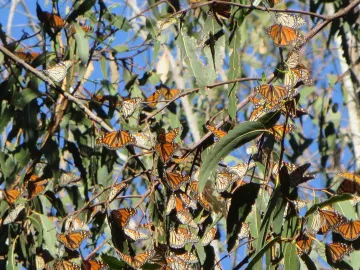
The Western Monarch Butterfly is on the brink of extinction. According to the US Fish and Wildlife Service, the population of monarchs has declined over 99% since the 1980s, when millions of these butterflies could be found between the Rocky Mountains and the California coast. Unfortunately, insecticides, loss of habitat and climate change have decimated their populations and now only 9,000 western monarch butterflies exist.
At our local Pismo Beach Monarch Grove, the drop in population mirrors the decline across the west, with fewer than 500 butterflies counted in December 2025, compared to 115,000 in 1998.
A study published by the Oxford Press for the Society of Environmental Toxicology and Chemistry analyzed a mass mortality event in January 2024 near a monarch overwintering site in Pacific Grove, Monterey County. They found on average, each monarch butterfly tested contained seven pesticides with three insecticides “consistently detected at or near each chemical’s lethal dose.”
Knowing what is decimating monarch butterfly populations provides us a path to their recovery. This includes:
Planting pesticide-free nectar-rich flowers like asters, goldenrods, and coneflowers. They provide quality habitat for monarchs and other pollinators while at the same time adding beauty to a yard with drought-tolerant landscaping. This is being done on a larger scale by the City of Atascadero in collaboration with the Central Coast Zoo and the UC Master Gardener Program. The City’s “Monarch and Pollinator Native Garden Corridor Project” will transform a triangular piece of city property at the Highway 101 southbound off-ramp at Highway 41 into a demonstration garden for monarchs.
Planting Native Milkweed is really important and something each of us can do. (For San Luis Obispo County, the Xerces Society, which works to save our iconic butterflies, warns against planting milkweed within 5 miles of the coast so as not to interfere with female monarch migration.) Monarch caterpillars only eat milkweed so planting pesticide-free native milkweed can play a vital role in their recovery. Some of our local nurseries have the native Narrowleaf Milkweed available for sale, and pesticide-free seeds can be purchased online. Getting the plants started now with the early winter rains can bring plants in February and March when monarchs mate and females begin searching for emerging milkweed to start the next generation of monarchs. Some organizations, like SOAR (Save Open Space and Agricultural Resources) in Ventura County, have even stepped up by mailing thousands of packets of pesticide-free native milkweed seed to their members.
Banning the Sale of Tropical Milkweed is also a way to protect monarchs. The Xerces Society warns against planting tropical milkweed. That is because, unlike native milkweed varieties that go dormant, tropical milkweed doesn’t and may delay or eliminate migration due to its year-round availability. This has been found to reduce overall monarch population numbers. Tropical milkweed is also more likely to harbor a parasite, Ophryocystis elektroscirrha (or O.E.) that harms monarchs. In addition, a study found that the concentration of cardenolides, a chemical in milkweed that is found in higher concentrations in tropical milkweed, increases and may become toxic in hotter weather like that associated with climate change. The selling of tropical milkweed has been banned in some California counties because of its negative impacts on monarchs.
The Sierra Club encourages you to grow pesticide-free nectar rich flowers and plant native milkweed seeds or plants. If you plant now with the early winter rains, you could become the beneficiary of a very hungry caterpillar that will turn into a beautiful monarch butterfly! Imagine if everyone reading this newsletter planted milkweed that brought forth one butterfly, we’d have thousands more butterflies fluttering by!