By Carole Mintzer
The California Environmental Quality Act (CEQA) requires public agencies to consider the environmental consequences of proposed developments and prevent significant, avoidable environmental damage. It also requires the consideration of alternatives that could reduce the project’s environmental impacts.
CEQA doesn’t stop projects from being built, but it does provide an opportunity to mitigate potential harmful effects of a proposed development. For example, in 2011, CEQA made it possible for Sierra Club, Defenders of Wildlife, and Center for Biological Diversity to craft a settlement agreement with the developers of the Topaz Solar Farm and California Valley Solar Ranch, which were sited on the Carrizo Plain, home to the largest concentration of endangered species in California. We secured the addition of more than 9,000 acres of the Carrizo to lands designated for permanent protection and preservation under their permits, resulting in a total of approximately 26,000 acres of the Carrizo receiving protection. The developers also agreed to fund efforts to eliminate rodenticides on the Carrizo Plain, remove thirty miles of livestock fencing from the area to allow for greater wildlife movement around the projects, and make significant financial contributions to help San Luis Obispo County acquire a largely undeveloped subdivision in the Carrizo to be restored for wildlife conservation.
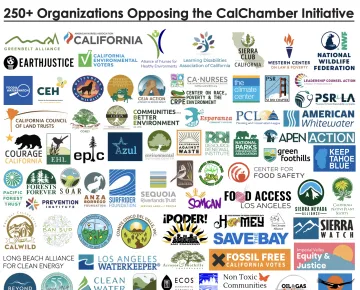
Now, along comes Proposition 45, put forward by the California Chamber of Commerce. Its title, “Modifies Environmental Review for Certain Projects,” doesn’t describe how it would essentially gut CEQA. In June 2026, over 250 environmental organizations, including Sierra Club, sent a letter to state legislators asking them to publicly oppose Prop 45. They contend that, “By weakening environmental review requirements, the Initiative would strip public agencies of the tools they need to protect communities from the impacts posed by a broad array of large-scale and consequential projects, ranging from data centers to highway widening projects.”
More specifically, the letter from the environmental organizations described how it would weaken environmental review because it:
- Prioritizes developer interests over environmental protection.
- Overrides and nullifies other state laws, such as the state water quality law, state air quality law, California Endangered Species Act, etc.
- Applies weakened environmental review to eight categories of projects that are labeled “essential,” such as water infrastructure (includes dams, reservoirs, desalination plants), housing (including large-scale residential developments in remote, undeveloped areas that may be prone to wildfire or flooding) and educational facilities (such as schools that could be constructed on or near contaminated sites).
- Undermines recent legislative efforts that streamline the approval process for certain types of projects (such as housing and clean energy) without gutting CEQA.
- Strips state agencies of the tools they need to protect communities and the environment.
- Doesn’t require an analysis of the project’s site-specific impacts on residents near the project (industrial facilities are not known for containing their toxins just within the site’s boundaries).
- Ignores analysis of cumulative impacts on the community - i.e., the impact of the proposed project together with other projects in the area.
- Allows agencies to ignore the latest scientific knowledge when determining whether the project would require mitigation.
- Shortens comment periods and makes it difficult to extend them for complex projects.
- Eliminates the requirement for consultation with California Native American tribes, leaving tribal burial grounds and cultural resources vulnerable to bulldozing.
- Gives developers a new right to sue agencies that deny projects (something they can’t currently do)
- Weakens the standard for judicial review and curtails judicial remedies when CEQA is violated.
- Shifts long-term costs onto public agencies and taxpayers. When potential environmental impacts are not identified and mitigated before a project is built, public agencies, using tax dollars, will end up paying for the cleanup.
In closing, the 250+ environmental organizations asked the legislators “to publicly oppose this Initiative and to stand with the communities that depend on CEQA to protect California's environment, public health, and quality of life.” Sierra Club is proud to be among the organizations opposing Proposition 45.