The Magazine of The Sierra Club
When We Were Partners
True power comes through partnership and empathy—not domination
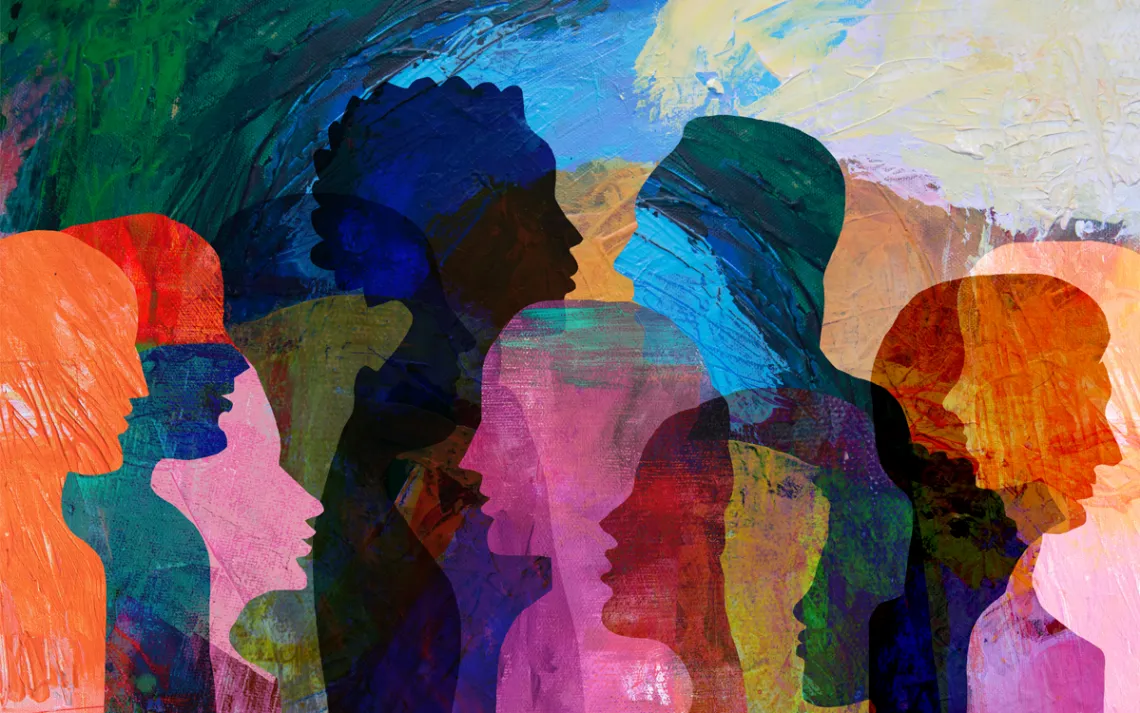
Illustration by Stella Levi/iStock
In a CNN interview last January, White House deputy Stephen Miller made clear how the Trump administration sees the world.
While speaking about the abduction of Venezuelan President Nicolás Maduro, Miller offered a philosophical premise to justify it: “We live in a world—in the real world—that is governed by strength, that is governed by force, that is governed by power. These are the iron laws of the world that have existed since the beginning of time.”
Are they?
Power—and specifically, the exercise of power through domination—is no doubt one of the organizing principles of this administration. We see it when ICE agents tackle, tear-gas, and shoot civilians. We feel it when the EPA favors polluting coal plants and their corporate owners over fenceline communities.
But while some want a world defined by power through domination, that is not how the world inherently is. From the laws of evolution to early human societies, what we find is that partnership with, not power over, is the primordial ingredient of life on Earth.
It wouldn’t take much for Miller to learn that. He could study up on Charles Darwin, who realized that altruism and sympathy between species were as fundamental to their thriving as natural selection. Or he could read Kathleen DuVal’s Native Nations, which documents how, over 1,000 years, tribes created egalitarian societies built on reciprocity in which “power and prestige lay not in amassing wealth but in assuring that it was shared wisely.” If books aren’t his jam, Miller could check out the podcast Threshold, “Season 5: Hark,” to discover that insects and plants listen to one another, dolphins introduce themselves to each other by name, and birds coordinate their actions through mutual song.
"From the laws of evolution to early human societies, what we find is that partnership with, not power over, is the primordial ingredient of life on Earth."
Riane Eisler, the founder of the Center for Partnership Systems and the author of pioneering books including The Chalice and the Blade, is a scholar of partnership and domination systems around the world. Over decades of research, she has examined human societies throughout history to identify underlying patterns. She pointed out that the rigid hierarchies—the in-group and out-group power structures—we see today didn’t always exist. In the ancient Turkish settlement of Çatalhöyük, for example, gender equality, empathy, and mutuality prevailed.
We don’t have to accept the Miller power premise. There has been another way, and there still is.
The stories in the Fall 2026 issue of Sierra show that partnership, empathy, and altruism are very much alive and at work in our troubled world. In “How Lee Zeldin Turned the EPA Into a Shield for Polluters,” Alexander Nazaryan travels to communities in West Virginia and Louisiana that are responding to Lee Zeldin’s upside-down EPA with solidarity. In “These Volunteers Are Often the Unsung Heroes of Public Lands Management,” Elisabeth Kwak Hefferan celebrates the legions of volunteers who step forward to support underfunded public lands and the staff who steward them. Jeremy Miller, in “United Front,” reports on three Sierra Club chapters that joined forces to build community resilience to sea level rise. And in “Flower Power,” Michelle Nijhuis considers how flowers “exercise their singular genius, networking with their fellow species to further life on Earth.”
Only those with a toxic relationship to power would justify domination by claiming that this is just how the world works. Some who buy into that notion may even fancy themselves kings. History is littered with such figures, and with the consequences of their actions—slavery, sexism, colonialism, xenophobia. But that doesn’t have to be our story.
In March, during a ceremony inducting Eisler into the California Hall of Fame, she said, “We are capable of something better. In fact, as archaeology, myths, even DNA evidence show through millennia of prehistory, and in communities all around the world today, there has been and is another way, a partnership way, grounded in mutual respect, in caring for one another, and, yes, in caring for our Mother Earth.”