Ever wonder how Texas makes sure that there’s enough water for everyone? As more people move into Texas, our economy keeps growing, and droughts get worse - there’s a lot to consider. That’s where the Texas State Water Plan comes in. The State Water Plan is Texas’ roadmap to securing a reliable water future.
What Exactly Is the State Water Plan?
The State Water Plan is Texas’ official path forward to prevent water shortages during future extreme droughts. It meticulously identifies how much water all Texans - from cities to farms to industries - will need, and lays out the water management strategies to meet those needs. The plan specifically helps to prepare for the "drought of record,” or the worst drought conditions in history. The need for this plan is driven by several undeniable and interrelated truths about Texas: we’re facing a rapidly growing population, declining water supplies, and intensifying droughts.
Our population is projected to soar by nearly 73%, reaching over 51 million people by 2070 (TWDB, 2022). That’s a lot more Texans needing water for their homes, schools, jobs, and daily lives, ultimately contributing to a projected 9% increase in total water demand (TWDB, 2022).
Meanwhile, our existing water supplies are projected to decline by about 18% over the same time period. On top of this, Texas has a long, often brutal, history with droughts. If we fail to properly prepare and implement the strategies in the water plan, the state could run short on water - nearly 7 million acre-feet per year - by 2070 (TWDB, 2022). This is enough of a shortage to leave the equivalent of about 16.3 million homes without water for a year during a severe drought.
How Is the Texas State Water Plan Developed?
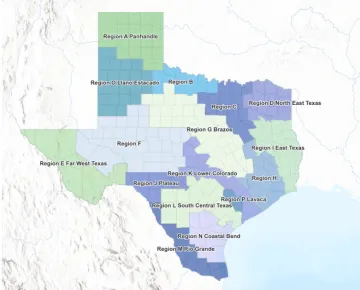
The Texas Water Development Board (TWDB) is the state agency responsible for overseeing the creation of the State Water Plan. However, the development of this plan is a bottom-up process, where the state is divided into 16 regional planning groups, each made of about 20 volunteers representing diverse local interests - from the general public and local government to businesses and water utilities. This bottom-up approach reflects the unique needs and priorities of each region, while giving communities a voice in shaping solutions that directly impact them.
Every five years, the regional planning groups study how much water their region will need in the future, how much is available, and where shortages might happen during a drought, while accounting for population estimates, water demand projections, and local water supplies. Then, each group develops recommendations for water management strategies, including estimated costs, to make sure that their respective regions have enough water for the next 50 years. These strategies can include water conservation and reuse, aquifer storage and recovery, desalination of brackish and seawater, flood mitigation projects, and more.
The public can - and should - participate throughout the regional planning process. The regional planning groups meet regularly and their meeting schedules are available on the TWDB website. These meetings are open to the public and offer a chance to stay informed and, most importantly, influence local water planning decisions by providing feedback. If you don’t know what planning region you’re located in, use this interactive map to click on your area of interest, and it will take you directly to that region's planning group website.
Once all the regional plans are complete, they're submitted to TWDB, which combines them into one statewide plan along with policy recommendations. Following the adoption of the State Water Plan by TWDB, this document is sent to the Governor, Lieutenant Governor, and the Texas Legislature.
The Texas State Water Plan is a living document, updated every five years to reflect new data, changing conditions, and evolving water needs. The most recent version, the 2022 State Water Plan, was adopted by TWDB in July 2021 and released in early 2022. Work on the next cycle, the 2027 State Water Plan, began almost immediately after the current plan was released.
How Is Your Region Preparing for the Future?
TWDB developed a very useful tool, the Interactive State Water Plan, which lets you take a closer look at the water future of your region. It allows you to explore the planning data for any region in Texas, including water demand projections, existing supplies, potential shortages, as well as recommended projects and their costs. To learn how to use this tool and find the information you need, visit the TWDB’s website.
Financing the Projects In the State Water Plan
Identifying water needs and developing strategies is a monumental task, but it’s only the first step. Actually implementing these projects requires substantial financial investment. That’s where Proposition 4 comes in, a constitutional amendment which proposes to dedicate $1 billion to the Texas Water Fund every year, thus creating a consistent funding stream for water projects across the state. The Texas Water Fund is a special fund in the state treasury, managed by TWDB, to support water infrastructure needs in Texas communities.
Proposition 4 will appear on the ballot this fall. The funds are proposed to be allocated from the state sales tax revenue, but only when collections surpass $46.5 billion (no new taxes are proposed). If approved by Texans, the funding would flow into the Texas Water Fund and be distributed among multiple programs, including the State Water Implementation Fund for Texas (SWIFT), which directly supports projects identified in the State Water Plan. At least 50% of the funding must go to SWIFT and the New Water Supply for Texas Fund, with the remaining 50% supporting other critical programs such as the Flood Infrastructure Fund, Economically Distressed Areas Program, Agricultural Water Conservation Fund, and others.
While planning sets the course, continuous funding - like that proposed in Proposition 4 - is what makes implementation of water management strategies possible. Stay tuned for upcoming blogs, where we will dive deep into Proposition 4, the Texas Water Fund, and the State Flood Plan, and what they mean for the future of water in Texas.