Key Takeaways
- Texas energy demand continues to surge, with ERCOT setting new seasonal records and projecting even higher use driven by population growth, data centers, and extreme weather.
- Renewable energy keeps expanding - Texas now leads the nation in both solar and wind generation, providing 37% of ERCOT’s total energy so far in 2025.
- Future demand could skyrocket, potentially jumping from 85,000 MW to 145,000 MW within five years as AI, crypto, and manufacturing projects ramp up.
- Sierra Club-backed legislation advanced important steps toward stronger building codes and a new Energy Waste Advisory Committee to cut energy use statewide.
- New ERCOT and utility programs are emerging to support residential demand response and energy efficiency, but utilities still profit from shareholder bonuses instead of bolstering consumer savings.
Texans can help shape what comes next - from commenting on rulemakings to holding legislators accountable through Sierra Club’s upcoming Texas Legislative Scorecard.
Rising Energy Use and Peak Demand in ERCOT
Energy use and peak energy use in ERCOT continues to rise. On February 20th, 2025, we hit an all-time peak winter energy use of 80.6 GWs - surpassing the amount during previous ice storms - while on August 18th, 2025, we hit our summer peak at 83.9 GW, though forecasts from that period said it could have reached higher if not for demand response curtailments.
This peak was lower than the all-time record of 85.5 GW set in August 2023, but was set under a mild Texas summer, suggesting a significant new record is possible if a stronger heatwave occurs. ERCOT is reporting that overall energy use is projected to grow from 464 billion kWh in 2024 to 487 billion kWh in 2025, driven by population growth, increasing data center electricity consumption, and warmer weather.
Texas Renewable Energy Growth Continues
Wind, solar, and battery energy storage continue to be built in the ERCOT grid, despite President Trump’s insistence that “they don’t work.”
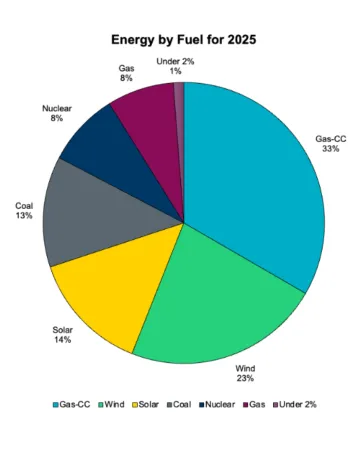
As of the end of July, there were 39,968 MWs of installed wind capacity within ERCOT, 32, 729 MWs of utility-scale solar and 14,137 MWs of installed batteries. Texas solar power set numerous records in 2025, reaching an all-time high of 29.8 GW on September 9, 2025, which contributed to grid stability. In fact, according to a recent tweet by Governor Greg Abbott, we are now 1st in Solar power - surpassing California. We are also the top state for wind, and, of course, oil and gas production. Overall, through the first nine months of the year, wind and solar provided 37% of the energy within ERCOT, while gas provided 41%.
The Coming Wave of Demand: Data Centers, AI, and Crypto
Demand is going to go up a whole lot more because of all the proposed data centers, AI and crypto mines, and more traditional manufacturing that are coming to Texas. But by how much? A bit hard to say, but the latest adjusted numbers from ERCOT predict that the peak, or highest, demand could increase from about 85,000 MWs today to about 145,000 MWs within five years.
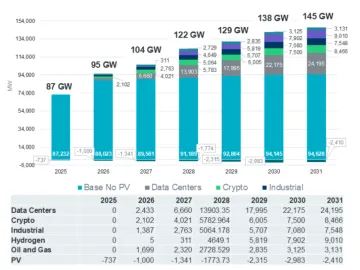
That’s on the high end, but even if only half of that comes, it will require additional transmission, generation, and efforts to reduce the demand and energy use.
So, as we see the main ERCOT grid continue to set records in the amount of energy used and in peak demand, what efforts are happening to reduce the demand and also help consumers - regular folks like you and I - save energy?
Good News and Bad News for Energy Efficiency Policy
During the regular legislative session that concluded in June, 2025, the Sierra Club supported a variety of legislative proposals designed to incentivize more energy efficiency programs and demand response - programs that help consumers reduce total demand at times when the grid is the most stressed. Most of our efforts did not proceed, including an effort to get major utilities both inside and outside of ERCOT to increase their goals and budgets to help regular Texans reduce their peak and overall energy use. Utility lobbyists work round the clock to assure they can make money, and fought many of these bills, even if it helped the consumers they represent. In some cases, we were aligned, but in most we once again found ourselves on the opposite side of the powerful utilities and their associations.
However, two pieces of legislation passed that could improve Texas’ energy efficiency programs and energy waste reduction efforts.
SB 783: Strengthening Building Energy Codes
SB 783 by Menendez involves building energy codes for new construction and will require the State Energy Conservation Office (SECO) to begin rulemaking to raise the state energy building code for new residential and commercial construction. The goal is new and refurbished buildings that use less energy and better incorporate new technologies like solar and smart thermostats. The most likely scenario is that SECO would take up adoption of the 2024 IECC (International Energy Conservation Code) in the spring of next year after some initial analysis. Of course, several cities in Texas have already adopted these codes, but setting a new, statewide floor could help reduce energy use long-term.
HB 5323: Creating the Energy Waste Advisory Committee
HB 5323 by Ken King requires the state to create a new Energy Waste Advisory Committee composed of representatives of several key state entities, including SECO, the Public Utility Commission of Texas (PUCT), the General Land Office, the Texas Facilities Commission, the Texas Department of Housing and Community Affairs, the Texas Department of LIcensing and Regulation, the Comptroller of Public Accounts and ERCOT to look for ways to reduce our energy use and meet our new reliability standards. While the committee has not been formed yet, it would be under the leadership of the Public Utility Commission of Texas and we expect it to begin meeting later this year or early in 2026.
While other efforts to increase energy efficiency, low-income discount programs and lower demand were not successful, there are still administrative efforts we are engaged on - with your help.
Regulatory Changes Are Happening - Slowly
ERCOT’s Residential Demand Response Program
In 2023, the Sierra Club worked with a variety of stakeholders to pass SB 1699 by Nathan Johnson and Tod Hunter, which encouraged the development of both “Aggregated Distributed Energy Resources” and residential demand response within the ERCOT competitive market.
Part of that bill required retail electric companies to work to get “Smart” devices which can better control energy use, in part by working with ERCOT and Transmission and Distribution Utilities (TDUs). Recently, rulemaking on the bill was completed, and retail electric providers must report four times a year on their efforts to help residential consumers reduce demand with programs like smart thermostats that can time when heating and cooling occurs in a home or apartment.
The bill encouraged TDUs, as part of their required energy efficiency programs, to provide incentives through retail electric providers to install smart devices and enroll in the demand response programs. Currently, both Oncor Electric and CenterPoint energy are working with a handful of retail electric providers to bring these devices to residential customers in the Dallas and Houston areas. The Sierra Club has been putting pressure on AEP Texas to do the same, but, thus far, AEP Texas has not begun a similar program.
ERCOT has announced their intent to add a new residential demand response program to the ERCOT market by next summer. Through a series of workshops, they received input on their proposal to create a “Residential Demand Response Program” that would pay retail electric providers that help residential consumers reduce demand during net-load peak hours.
Under the proposal, which has been filed as Nodal Protocol Revision Request 1296 - a maximum of 500 MWs of residential demand response would be paid up to $70 million dollars spread over four periods of high demand to help encourage demand response, but also to make the grid more resilient and adequate. The Sierra Club has been studying the proposal, and, while we have some concerns about some of the language, including how consumers served by public utilities can truly participate, we are appreciative of ERCOT’s efforts to respond to legislative and public interest in helping consumers save energy - and hopefully receive some sort of an incentive from their provider for participating.
A copy of a recent presentation by ERCOT on the proposal can be found here. The Sierra Club plans to file our own comments before the next workshop, scheduled for November 5th, as part of the Wholesale Market Subcommittee.
Energy Efficiency Programs in Texas: Progress and Challenges
Reviewing 2024 Energy Efficiency Results
The Sierra Club has long been a participant, proponent, and critic of Texas’ current energy efficiency programs. These programs are run by the eight private transmission and distribution utilities. Back in 2022, we filed a petition for rulemaking to increase goals, limit utility bonuses, and make improvements particularly for programs that help working Texans. While that petition was rejected, we have continued with our allies, members, and supporters to advocate for changes.
At the recent “Energy Efficiency Implementation Project” workshop held on October 7th, participants, including Tetra Tech, the third party evaluator, reviewed the results from the 2024 year. You can watch the whole proceedings here. Collectively, the eight utilities saved 602 GWhrs, and reduced summer peak demand by about 610 MWs at a very low cost - about 2 cents per kilowatt hour saved - and depending upon the program and utility between $20 and $65 for each kilowatt reduced. A copy of the presentation can be found here.
Utility Shareholders Pocket the Bonuses
The presentation also revealed some of the complicated issues with these programs - of the approximately $250 million charged to residential and commercial consumers to run these programs, nearly $97 million were bonuses paid to utility shareholders that do not actually benefit the ratepayers. That’s about 35% of the total budget. The analysis also found that most utilities could have done more since they were well under cost caps set by the Commission, meaning there were opportunities to do more to help Texas consumers save money.
Petition for Secondary Caps Rejected In Favor of Utility Bonuses
Earlier this year, the PUCT commissioners rejected a petition by their own staff to establish a limit on the bonuses utilities earn for exceeding the very modest demand reduction goals (currently just 0.4 percent of total peak summer demand) to 25% of the budget. In the current proposed budgets for 2026, some utilities like Centerpoint Energy would earn up to 40% of the budget.
Rulemaking Opens Up for Reform
Nevertheless, PUCT staff opened up a limited rulemaking on several issues related to the energy efficiency programs. Chief among these was to improve the “Low-income” and “hard-to-reach” programs that utilities must administer, along with a less “friendly” bonus structure for utilities.
The Sierra Club submitted comments - along with signatures and comments from 670 concerned Texans. In those comments, we emphasized that while we partially supported the staff proposal, it was just a first step and many more changes are needed, including assuring that the low energy savings goals (which are based on a percentage of the peak demand goal) is expanded, along with the budgets for low-income and hard-to-reach programs. You can read our comments here, and those of 670 Texans who took the time to write into the PUCT.
The next step will be for the Commission staff to consider the input from Sierra Club and many others and take action later this year. PUCT staff have also announced they will begin a second rulemaking as soon as January to deal with other issues not addressed in the initial rulemaking.
Sierra Club Interventions and Settlements
The Sierra Club sought to intervene in two “Energy Efficiency Cost Recovery Factors” for two of the largest utilities - Centerpoint Energy and AEP Texas. In our filings, we argued these companies were asking for too much in bonuses and not spending enough on actual programs to help people. While we stand by our testimony - that the bonuses of Centerpoint Energy and AEP Texas were too high and the budgets for programs too low - we recognized we were unlikely to convince the PUCT commissioners and instead have agreed to settle with both utilities.
As part of the settlement, we will be given access to CenterPoint Energy and AEP Texas’ staff to provide input on potential changes to their programs, be able to review a new energy efficiency potential study being developed by Centerpoint Energy, and will jointly host two public meetings with the utilities and their customers in 2026 to hopefully improve access. We hope these direct conversations will lead to expanded programs in the coming years. The settlement agreements are not final, but we anticipate a final settlement will be approved by PUCT staff in the coming month. The hearings themselves on the rates have been cancelled as all parties have agreed to the settlement terms. A copy of the settlement agreement with Centerpoint Energy can be found here. The AEP Texas settlement agreement has yet to be filed with the Commission, although the agreement is final.
What’s Next for Texas Energy Efficiency and Demand Response
We will continue to monitor the development of the energy efficiency rules, and the ERCOT demand response program, and will work with utilities to improve their programs. With your help, we will also continue to engage with the legislature on ways to make it easier for Texans to lower their electric bills through energy efficiency and demand response programs.
As we look ahead, accountability will be key. Later this fall, the Sierra Club Lone Star Chapter will release our Texas Legislative Scorecard, showing how state legislators voted on the issues that matter most for our environment, our energy future, and our communities. It’s a chance for Texans to see who stood up for clean energy, energy efficiency, and energy waste reduction, and who stood in the way. Now is the time to get involved - by learning how your legislators did, joining local advocacy efforts, and helping build the momentum we’ll need heading into the next legislative session. Together, we can make sure that energy efficiency, clean, reliable, and renewable energy, and programs that benefit consumers remain front and center in Texas’ energy future.
Join us on Tuesday, October 28 for our monthly Keep the Power On General Meeting as we discuss how clean energy can continue to keep our bills low.