It was only a few years ago now that a new type of very large loads on our electric grid - then known as Bitcoin Mines - began to sprout up around Texas.
How would these very large loads impact energy demand, water use, and local noise and air pollution?
Communities organized and opposed their development, even as local authorities were approving favorable tax treatment, or providing infrastructure so they could hook up to the local grid, or obtain water resources. While not all of the proposed bitcoin and cryptocurrency mines actually got built, many did, and still more today are being planned.
Legislative Response to Bitcoin and Cryptocurrency Mines
The legislature discussed these bitcoin operators (sometimes also referred to as cryptocurrency), but did not take much significant action. One bill, supported by the Sierra Club, required cryptocurrency and bitcoin operators of 75 MWs or greater to register with the Public Utility Commission of Texas. Under the adopted rule, facilities involved in virtual currency mining - defined as those using electronic systems to process virtual currency transactions on a distributed ledger and consuming more than 75MW of power with at least 10 percent interruptible load - must disclose their location, ownership structure, energy consumption, and business model on an annual basis.
Existing cryptomines had to register with PUCT by February 2025, while new ones must register as soon as they are energized on the grid. If they fail to comply, they face fines of up to $25,000 daily. While this requirement has been helpful to the PUCT and ERCOT, much of the information has been declared as trade secrets, and the public still does not have a complete picture of the number or size of bitcoin operators in Texas. This decision continues the unfortunate lack of accountability and transparency from public officials and corporations in Texas.
Bitcoin Mines Were Only the Start
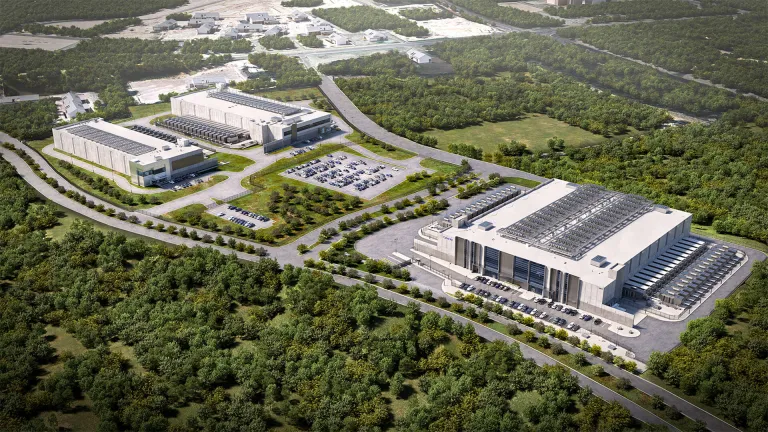
Despite the influx of bitcoin and cryptocurrency operators coming to Texas between 2021 and 2024, they were just the beginning. In 2024, even larger loads began to arrive in force. These larger loads were “hyperscale data centers”, including those designed to help grow “Artificial Intelligence.”
The truth is, whether a facility is putting computers in banks for complicated runs for cryptocurrency, or to store data on the cloud or run complicated artificial intelligence operations, these “large loads” are essentially the same - huge banks of computers which need vast amounts of energy and water to operate.
Data centers and cryptomines cause real impacts in communities - not only through their energy and water use - but noise and air pollution as well. Simply being constructed on large tracts of land often impacts habitat and agricultural lands.
Just What Is a “Large Load”?
It depends who you ask and what state you are in.
Through legislation passed during the 89th Texas legislative session and “protocols” adopted at the Electric Reliability Council of Texas, large loads are currently defined as industrial loads that have at least a minimum demand of 75 MWs or more at a single point of interconnection on the grid, but there is some wiggle room in that threshold.
For example, under SB 6 (approved last session), Texas law states:
“The commission shall establish a demand threshold of 75 megawatts unless the commission determines that a lower threshold is necessary to accomplish the purposes.” Thus far, ERCOT and the PUCT have been defining large loads as 75 MWs or larger, but some other states with their own regulations consider a load with a demand of 20 MWs or 25 MWs to be considered “large.”
While ERCOT in its “protocols” considers a large load to be 75 MWs or more, they do put some reporting and data sharing requirements on any load that is 25 MWs or more. The Sierra Club has been advocating for setting the definitional threshold at 25 MWs, which would provide more visibility on the grid, require more loads to meet stricter interconnection, and help in our transmission and generation planning.
Just How Many Large Loads Are Here and Coming to Texas?
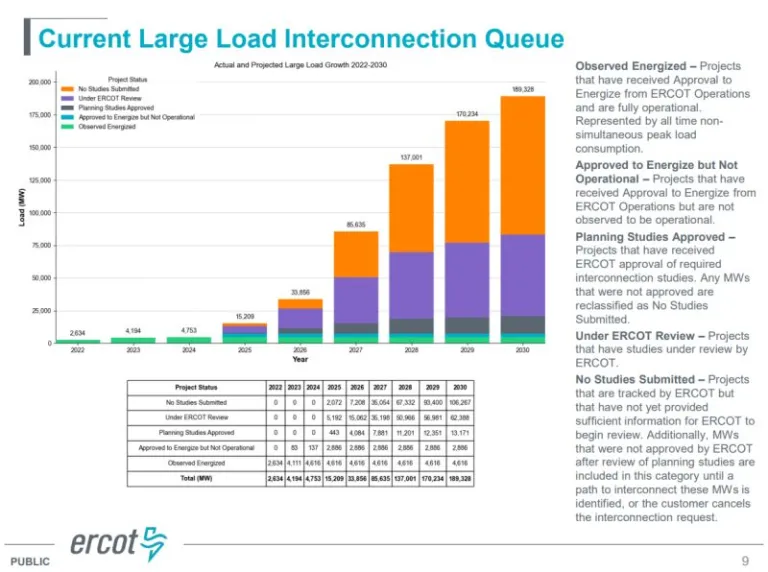
In late 2024, ERCOT sounded the alarm that so many large loads were planning to come to Texas that it could more than double our total demand by 2030.
They predicted that the current demand could rise from about 85,000 MWs to some 170,000 MWs due mainly to new data centers, cryptomines and AI development.
Just one new data center can use as much energy as an entire town!
Reliability, Cost and Pollution Implications
This growth carries real consequences for both reliability and cost. Large, fast-moving industrial loads stress transmission infrastructure, complicate planning, and increase the risk that generation and delivery fail to keep pace.
Texans could face higher electricity prices and greater reliability risks, even as data centers secure long-term power arrangements that shield them from volatility they help create.
Research from the Texas Energy Poverty Research Institute has already seen rising bills with more costs on the way. TEPRI’s newest research paper, ERCOT Electricity Affordability Outlook: Forecasting Residential Electricity Prices and Burdens (2025-2030), highlights how the rise in residential electricity prices in the ERCOT Competitive Retail Market will impact the well-being of the 4.1million low-and moderate-income (LMI) households who struggle to pay their electricity bills. The Paper details how electricity rates have increased by approximately 30% since 2021, and projects another rise of 29% for 2025-2030, primarily driven by planned, large-scale investments in transmission and distribution, some of it due to large loads.
If large loads “co-locate” at the site of an existing power plant, it could complicate supply to nearby areas since the power from that plant - whatever its energy sources - are suddenly being used by the new large load If these large loads instead choose to “bring their own” generation - such as new gas plants - or use very dirty back-up generators should the grid get spotty, it could have extreme local implications on air pollution.
ERCOT Queue and Projections
In fact, the queue of proposed projects has jumped from some 63,000 MWs in late 2024 to nearly 226,000 MWs in late 2025. However, many of the projects contained in this list are extremely speculative, and it is still unclear how “real” many of these investments were. Indeed, about 35% of this total has actually dropped out of the queue and ERCOT has arrived at what most believe is a more realistic prediction which - while still being refined through rulemaking - is at least more reasonable.
ERCOT believes that based on the queue, total demand could rise from some 85 GWs today to 140 GWs by 2030.
As of November 18, 2025, ERCOT was racking approximately 225 projects which could total up to 226,000 MW of large loads seeking interconnection to the system.
However, approximately 128,000 MW of the 226,000 MW have not yet submitted their Planning Studies for review.
As of now:
- Approximately 7,500 MW of large loads have been approved to energize
- 5,300 MW have been observed energized
- An additional 2,200 MW have been approved to energize but are not yet operational
It is worth noting that there is another group of loads between 25 MWs and 75 MWs that represent some 15 GWs of potential increased demand.
Again, while many of these may be speculative, these “smaller” loads have real impacts on our energy and water use as well.
What Are the Water Impacts?
It’s hard to say - water use is not currently required to be reported, and even the Texas State Water Plan does not currently account for either the present use or future use of water resources. The state’s planning framework largely looks backward at historic use - not forward at new industrial demand arriving by the month.
However, we do know that data centers require enormous volumes of water, both directly to cool servers and indirectly to generate the electricity that powers them.
New analysis released by the Houston Advanced Research Center estimates that data centers consume an estimated 25 billion gallons of water per year. By 2030, that figure could reach 161 billion gallons, roughly 3% of the total projected water demand statewide.
While that may appear modest at the state level, local communities will feel the impacts most directly, as data centers draw heavily on nearby water supplies, further straining aquifers, rivers, and local public water systems. The report - Thirsty Data and the Lone Star State: The Impact of Data Center Growth on Texas’ Water Supply - offers new insights and policy recommendations on the growth of this new industrial class and how Texas can better protect its resources.
Today, local officials such as city managers, water utilities, local groundwater districts and river authorities must negotiate individually with multinational companies, often with limited data, limited leverage, and limited time to make decisions that will shape their communities for decades to come. We will need serious state action and regulations to help these local officials withstand corporate pressure to make deals that are not in line with community needs.
What Has ERCOT Done About Large Loads?
ERCOT worked with stakeholders to form a “Large Load Task Force” in 2024. ERCOT was rightly concerned about the dozens of projects that were seeking to interconnect to the grid in 2024, but also the lack of specific processes.
Not only do so many loads coming at once stress the grid, but in a real sense they can overwhelm transmission lines and plans for transmission. ERCOT approved, and the PUCT endorsed, a new protocol and planning guide that required all large loads over 75 MWs to go through an interconnection process both with the local transmission company and ERCOT, including a variety of studies, while requiring those over 25 MWs to at least provide some basic reporting.
While considered an “interim” solution, the protocol became the basis for more in-depth legislative action in 2025.
What Has the Legislature and the PUCT Done About Large Loads?
In addition to the legislation passed in 2023 requiring cryptocurrency and bitcoin mines of a certain size to register with the PUCT and report annually, last session the major effort passed by the Legislature and signed by the Governor was SB 6.
SB 6 is a complex bill, so much so that the PUCT has opened up five separate rulemakings, being discussed in five different “dockets”. A list of dockets can be found in the box below. The basis of the bill was not to stop the advent of large loads, but to make sure they went through a robust interconnection process. More importantly, it ensures that the cost of that process and any required transmission buildout would be paid for by those large loads, and not by the rest of the market.
The dockets* are complex and multifaceted. Done correctly, they should allow for the development of data centers with maximum transparency, but also with significant financial commitment by those seeking to hook up to our grid, including paying for any transmission upgrade needed to incorporate their load.
SB 6 requires the commission to look at whether the current way we pay for transmission - based only on the four summer months highest peak demand - is fair to all electric consumers, and whether Texas should move to a new system.
While there is no draft rule yet, the Commission has asked for answers to some basic questions. Comments already filed by Sierra Club can be found here. Sierra Club strongly recommends moving to a new way of allocating transmission costs so that large industrial loads pay their fair share.
Planning Challenges and the Batch Study Process
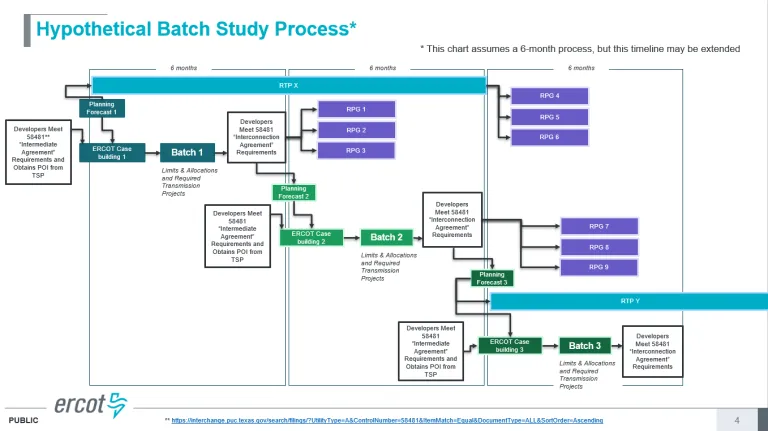
Complicating this process is the speed at which these large loads are arriving. Even as the PUCT works to implement the five dockets - including final interconnection standards - ERCOT recently announced that their current transmission planning process is at odds with the fast pace of large load development.
To play catchup, they are developing a “batch” study process where they would look at multiple projects at once and study the transmission grid collectively rather than treat each facility one-by-one. The “batch study process” is still being developed but could represent a new approach to keeping up with the unprecedented growth.
Is the Sierra Club Proposing Any Policy Changes?
In short - yes.
As part of our work at ERCOT and the PUCT, we have been advocating for robust study fees and financial assurance for all large loads, and for revising the definition of large loads to to a lower threshold of 25 MWs, which would better protect consumers from the costs associated with these large loads.
In addition to our work through rulemaking at the PUCT and through proposed revisions and changes at ERCOT, Sierra Club has been asking the Legislature to further study regulations, reporting and requirements for large loads specifically around water - such as limiting the use of groundwater resources and instead focusing on reuse of wastewaters such as fracked produced wastewater, and special consideration of improved air quality requirements on the use of backup generators.
Recently, the Sierra Club released a great new report on policies that states could take to make large loads more sustainable for communities. The report suggests that states should develop policies around four key areas:
- Protect Customers
- Clean Energy Comes First
- Fairness for All (Reducing Tax Incentives)
- Public Health
In Texas, we will be assessing these policies and how they can be applied in our market. Many of these policy ideas would better protect Texans from the public health and financial cost of large loads.
What About Local Communities? Are They Fighting Back?
Also yes.
Thousands of Texans are dedicating hours of their lives to oppose the development of large data centers and other industrial loads in their communities. This “blog” would have to be more than 20 pages to cover all the local fights going on over specific projects being planned within Texas. However, there are some very high profile cases. An important event among many organizations concerned about data centers is an upcoming conference planned for March 25th in San Antonio to bring these communities together.
Suffice it to say that there are gigantic proposed cryptomines, AI and data centers throughout the state. These include high profile developments like FERMI America near Amarillo, Stargate near Abilene, Wolf Hollow near Granbury, the CyrusOne site in San Marcos, Sat 82 south of San Antonio, Veridian near Brenham, and Project Kati in the Valley, CloudSpark in Brazoria, and Riot Platform near Corsicana. There are literally hundreds of projects at various stages of development, and Texans of all political stripes are rightly concerned about water, energy, air quality from both new power plants and backup power generators, local noise and truck traffic, and even the potential for toxic chemicals on their land or in their water.
How Can You Get Involved?
- Join our next Keep the Power On virtual meeting where we will discuss legislative accountability
- Contact Gov. Abbott & PUC - demand they protect clean energy & batteries
- Join our Legislative Action Team