By Cyrus Reed
Texas energy policy is rapidly evolving as regulators respond to growing demand from data centers, transmission needs, and grid reliability challenges. This overview explains the latest ERCOT and PUCT actions, what they mean for consumers, and how the public can stay involved.

Understanding the Acronyms: ERCOT, PUCT, and Texas Energy Governance
For many of us who spend time at ERCOT and PUCT meetings, and reading filings submitted to those two entities, the world consists of acronyms and numbers. Oh - sorry. Let me clarify: ERCOT (Electric Reliability Council of Texas) and PUCT (Public Utility Commission of Texas).
The last month has been particularly active, with active debates on data centers, reliability services, transmission lines, a new Texas Energy Waste Advisory Committee, and a proposed Residential Demand Response Product.
Data Centers, AI, and “Large Loads” in Texas
Data centers, Artificial Intelligence facilities, and other “Large Loads” are being discussed all the time. Last legislative session, the Texas Legislature passed SB 6 which put in place processes for the incorporation of these large loads - defined as facilities with at least 75 MWs of demand - into the grid. Sierra Club Lone Star Chapter has been active in participating in discussion around how to put some guardrails on the development of these facilities which can use massive amounts of energy and water, and SB 6 does provide some guardrails.
Thus far, the PUCT has been moving on five separate rulemakings. This week, the Commission approved publication of a new rule under Docket No. 58481 for public comment that would establish the interconnection standards for “large loads,” including requirements on an interconnection study, interconnection fees and information proposed loads must provide to ERCOT, the PUCT and the connecting utility before they can energize. At issue is what kind of financial security and payments these large loads must pay to better protect other consumers, and what kind of ownership of the land they must have to proceed. The proposal adopted by the Commission for comment puts in place a $50,000 per MW fee along with additional payments for the study.
A previous draft version of the rule had an even higher proposal of $100,000, but it was reduced due in part to lobbying by the large loads. Sierra Club will be submitting comments that largely support the proposal, but suggest that additional information and transparency is needed to better protect the public including the need to keep fees robust to discourage speculative projects, allow at least some of those fees to be kept for the public and apply them to reduce rates for residential consumers should the companies walk away, leaving any upgrades to the electric system on the backs of other ratepayers. We would also like to see “smaller” large loads - those between 25 and 75 MWs - with some responsibility to follow interconnection procedures and registration as well.
Co-Located Generation and Net Metering Debate (Project 58479)
Another proposed rule - Project 58479 - that has already been through the comment process would establish criteria to approve large loads that wish to locate next to an existing generation resource and utilize that resource to power their facility through “net-metering”. The legislature is rightly concerned that in such cases the public could lose access to needed generation especially during extreme weather conditions when electric demand is high.
Commissioners were not quite ready to adopt the rule at this week’s meeting but are expected to take action next week. At issue is when and in what context the commission can impose requirements on large loads during certain grid conditions once such a project is approved. With several large loads already having announced their plans to construct facilities next to existing generation sites, time is of the essence.

ERCOT’s “Batch Study” Approach and Interconnection Challenges
Hovering over the entire rulemaking process, however, is a chicken and egg problem. Because large loads - many of them speculative - have been flocking to Texas, ERCOT feels overwhelmed to plan for this growth and has come up with a new concept - a “Batch” study process in which it would attempt to study these proposed interconnecting large loads as a group rather than individually. The concern is that if they continue to be studied one by one for their interconnection and transmission needs, by the time one is built the grid will already be stressed.
However, because there is already such a large number of facilities in the queue to be interconnected, ERCOT is beginning with a “Batch Zero” process to play catch up and have proposed new “PGRR” (Planning Guide Revision Request) 145 and NPRR (Nodal Protocol Revision Request) 1325. ERCOT has been holding workshops that are highly technical to lay out its proposal which they hope to have approved by June.
Obviously, there are many data center developers who are hoping they can get to the front of the line by meeting the requirements of both the batch zero study and the upcoming rules on interconnection. And yes there are many Texans concerned about the rapid development of these large loads that don’t mind if ERCOT and PUCT take more time to get the process right - Texans are rightly feeling overwhelmed by the onslaught of new data centers, crypto mines and AI facilities.
Major Transmission Expansion: Texas’ First 765 kV Lines
Even as large loads consume space in the discussion, Texans are also facing gigantic transmission proposals to add Texas’s first 765-kilovolt (kV) transmission lines. Unlike some other states, Texas has never invested in such high voltage lines before.
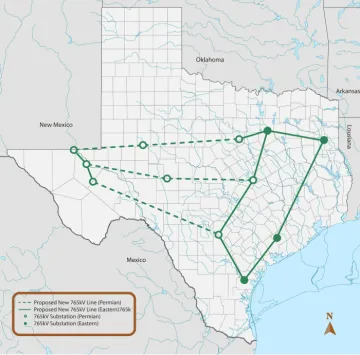
Last year, the PUCT approved an ERCOT proposal to build a series of high voltage transmission lines in response to legislation heavily supported by the oil and gas industry known as the Permian Basin Reliability Study. As oil and gas has electrified their exploration and production, and as the population has also expanded their energy demand, bottlenecks in transmission have meant that generation is not reaching all areas of the state, including the Permian Basin. The PUCT approved plan would create three new 765 kV lines between east and west Texas as well as two more 765 lines in the future in the east (see map).
Even though Sierra Club agrees that more transmission lines are needed in Texas and that 765 kV lines can make sense, the massive size of the projects are creating concerns about their impact on land, habitat, private property and water resources, as well as the potential cost to ratepayers since in Texas all transmission costs are socialized. Several of the sections of the new transmission lines are beginning the process of being approved, and hundreds of Texans are already taking the step to formally intervene in legal proceedings at the PUCT. While the transmission plan has been approved, the exact route for each individual section must still go through a PUCT process to approve the route and cost that can be recovered by the utilities involved. Several of the proposed routes would cut through environmentally sensitive lands.
How to Navigate ERCOT and PUCT Filings (Resource Guide)
So how does one actually find all these comments and proposals?
At ERCOT, go to their main website ercot.com. To see upcoming meetings go to Committees and Groups to find specific meetings. To actually view proposed rules (known as protocols) and related documents, go to Market Rules, Nodal Protocol Revisions Requests. Then click on whatever proposed rule you would like to see and it will pull up information about its status and you can also download documents - warning these are very technical and have lots and lots of acronyms!
At the PUCT, all proposed rules, comments, orders and other documents are filed in individual projects, all of which have specific numbers. All of these are filed electronically and available through the PUCT Interchange Filer, which can be found here. To find actual filings you can use the search function here. As an example if you want to see all the filings in the project related to large load interconnection standards you put in the project number - which in this case is 58481 - in the Control Number hit search and you will come up with some 130 documents related to the proposed rulemaking.
How Do You Find All of These Comments and Proposals?
At ERCOT, go to their main website ercot.com. To see upcoming meetings go to Committees and Groups to find specific meetings. To actually view proposed rules (known as protocols) and related documents, go to Market Rules, Nodal Protocol Revisions Requests. Then click on whatever proposed rule you would like to see and it will pull up information about its status and you can also download documents - warning these are very technical and have lots and lots of acronyms!
At the PUCT, all proposed rules, comments, orders and other documents are filed in individual projects, all of which have specific numbers. All of these are filed electronically and available through the PUCT Interchange Filer, which can be found here. To find actual filings you can use the search function here. As an example if you want to see all the filings in the project related to large load interconnection standards you put in the project number - which in this case is 58481 - in the Control Number hit search and you will come up with some 130 documents related to the proposed rulemaking.
New Reliability Services: DRRS and Market Debate
In addition to the focus on large loads and transmission, ERCOT - as required by legislation - has also been moving to create a new ancillary service known as DRRS - or Dispatchable Reliability Reserve Service. Recently ERCOT filed two proposed NPRR - 1309 and 1310. Stakeholders, including the Sierra Club, have been engaged in a series of discussions and debates about these proposals and whether they meet the requirements approved by the Legislature in 2023, which required ERCOT to create the new service to assure a more reliable grid.
Sierra Club is allied with many consumer groups - including both small and large consumers - in arguing that while 1309 - a narrower operational tool that would pay certain resources to come online when sudden changes in the weather or demand require more reserves - is a valid tool and should move forward, the other proposal - 1310 - goes beyond the legislative requirement and would instead pay entities “extra” money well outside the market structure. In essence, if 1310 were implemented it could create a huge extra cost on consumers and provide payments to larger fossil fuel plants with no operational reason to do so. Also at issue is what kind of resources can participate.
While some are trying to keep the resources focused on gas plants, others like the Sierra Club say battery storage resources that can meet the criteria set out in the legislation can and should be eligible to participate. The ERCOT has left this decision up to the PUCT, which is expected to provide direction at the next “open meeting” on March 26th. Assuming 1310 is not going forward at the moment, the hope is to have NPRR 1309 - including energy storage - approved by ERCOT in June, though the actual service wouldn’t become available until late 2027 at the earliest.
Residential Demand Response: Opportunities for Consumers
Also being discussed is whether or not ERCOT should create a new “Residential Demand Response Product” whereby residential consumers could be paid for using less energy at certain times when the grid is stressed. It’s NPPR - 1296 - sponsored by ERCOT is currently on hold while ERCOT does an overall study of the different demand response products already in the market and how to encourage more residential participation in a cost-effective manner. Sierra Club supports the need to look at the option to add such a service, even though we believe there may be better ways to encourage consumers to take such actions. Whether it is through 1296 or another mechanism, residential consumers should have the option to make money by making the grid more reliable in the same way that a large commercial or industrial customer does.
Positive Developments: Consumer Engagement and Energy Efficiency
The Sierra Club is celebrating a few positive developments. First, the PUCT has created a new public consumer “hub” on their website. The new hub provides information about how to make complaints, how to save energy, how to participate in transmission planning and projects - including opposing them - and how to read your electric bills. It also provides some basic information for those considering adding solar. Because the PUCT also oversees water utility rates there is similar information on the water side.
Another bright spot is a decision taken by the PUCT to require all the major private utilities that have energy efficiency and demand response programs to present their proposed plans in late April in a virtual public meeting. This is the first time that utilities have been required to actually present their proposal and take questions and input from the public. Once we have exact times and dates for these meetings we will provide information to our members.
Finally, the PUCT announced that the first meeting of the Texas Energy Waste Advisory Committee - as required by a bill the Sierra Club supported - will be held March 30th. Details can be found here. The Committee brings together expertise from 8 state agencies on how to reduce energy waste and improve energy efficiency and demand response.
For too long, the PUCT has been mainly responsive to utilities and other stakeholders and its good to see them finally thinking about the public and consumers who ultimately pay the bills. With the potential cost and concerns caused by large transmission lines and large loads, more attention to the public and ratepayers can’t come soon enough.