Gov. Greg Abbott is selling his latest electricity scheme as a way to lower Texans’ bills. But his proposal would force locally owned public utilities into the deregulated market - without the consent of their communities - and could deliver a windfall to some of his largest corporate campaign contributors.
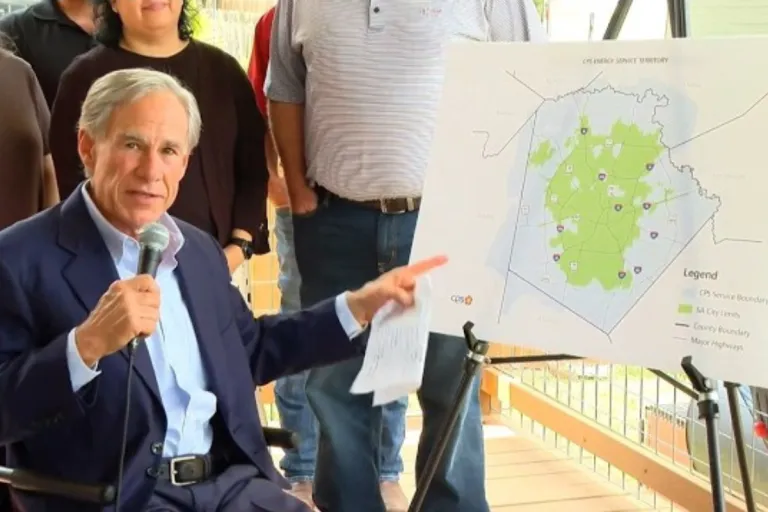
Abbott has pledged to work with the Texas Legislature to force municipal utilities such as Austin Energy and CPS Energy to allow customers to choose between them and a private retail electricity provider. He claims this would lower residential electricity prices, but there is no guarantee that consumers would save money. What the proposal would do is weaken public utilities, threaten the local services their revenues support, and give private electricity companies new opportunities to increase their profits.
So who really benefits from this pre-election proposal?
Vistra and NRG - the two largest private electricity companies in Texas - could gain substantially from forced competition. Both are, coincidentally, contributors to Abbott’s re-election campaign. During this election cycle, Vistra’s political action committee (PAC) has contributed $75,000 to Abbott’s campaign, while NRG’s PAC has contributed $25,000.
Abbott’s proposal is not consumer relief - it’s a political power play designed to benefit wealthy corporations at the expense of local communities.
What is public power?
Public power utilities are not-for-profit electricity providers owned by the communities they serve. Unlike private utilities, which distribute profits to shareholders, public utilities reinvest their revenues in the electric system and the local community. Those revenues can support reliability improvements, energy-efficiency programs, customer payment assistance and essential public services such as parks, libraries, infrastructure, and public safety. There are currently over 70 public municipal utilities in Texas as well as over 70 rural electric cooperatives which do not appear to be under attack under the Governor’s proposal.
Public power is accountable to local residents through city councils, utility boards and other public processes. However, public power is only as strong as the communities that organize to ensure their utility reflects their needs and values. In cities like San Antonio where local advocates have worked for years with CPS Energy, Abbott’s proposal would take that power away from those communities and give it to politicians and their donors.
Texas law already allows communities to choose competition
When the Texas Legislature deregulated much of the electric market in 1999, it allowed municipal utilities and electric cooperatives to decide for themselves whether to enter the competitive retail market.
That option still exists. A public utility can join the competitive market when its governing body and local community determine that doing so is in their best interest. Lubbock’s municipal utility and Nueces Electric Cooperative have made that transition, but only after public processes involving their communities.
Abbott is not proposing to give Texans a choice they do not already have. He is proposing to strip that choice from local communities and use the power of the government to force deregulation upon them.
“Choice” does not guarantee lower bills
Market competition may sound appealing, but Texas’ deregulated electricity market is heavily dominated by just two parent companies. NRG and Vistra dominate much of the competitive retail market (over 70%), limiting the meaningful choices available to consumers.
More importantly, available data does not support Abbott’s claim that forced competition would automatically produce lower bills. Residential electricity costs in public-power communities are often lower than those in deregulated areas. Austin Energy and CPS Energy - the two largest municipal utilities singled out by Abbott - have maintained competitive residential bills, in part through strong energy-efficiency and energy-savings programs. For example, Austin Energy bills are consistently found to be among the lowest in the state because of these efforts. It’s also important to note that unlike the deregulated market where companies and the state fail to provide state payment assistance programs, most of the state’s public power entities have customer assistance programs. These too would be under threat.
Forced deregulation could destabilize public utilities
Allowing private companies to take the most profitable customers from a municipal utility could create a death spiral. As customers leave, the public utility would have fewer resources to maintain infrastructure, fund energy-efficiency and bill assistance programs, and provide affordable, reliable service to those who remain. Under Abbott’s scheme, large industrial customers could use the threat of leaving to negotiate preferential rates for themselves - potentially shifting even more costs onto residential customers.
Also, because cities can reinvest electricity revenues in local services, forced deregulation would affect more than utility bills. It could reduce funding for public safety, infrastructure, parks, libraries, customer assistance, and other services residents depend on.
Abbott has a record of making consumers absorb private losses
Abbott’s claim that this proposal is about affordability also rings hollow given his record following Winter Storm Uri. State leaders supported energy plans that shifted billions of dollars in electricity and gas-market losses onto consumers, adding charges to electric and gas bills that everyday Texans will pay for years.
Now Abbott wants to undermine some of the state’s most affordable community-owned utilities while opening their service territories to companies that have contributed to his campaign.
Texans know better than to believe this is about lowering their bills.
In response, Cyrus Reed, Legislative & Conservation Director of the Sierra Club Lone Star Chapter, said the following:
“The Sierra Club opposes this scheme, which - if approved by the Legislature - would undermine public power without the consent of local communities, reduce revenue for city budgets, and potentially pad the coffers of two of the largest private electricity companies in Texas.
“Communities that want retail competition already have a process for making that transition through local action. Abbott’s plan would force it on them, threatening electricity service, local democracy, and investments in our communities.
“The Sierra Club is ready to work with legislative leaders, other elected officials and whichever candidate wins the governorship in November on real solutions, like energy efficiency and bill payment assistance, to lower Texans’ electric bills. But this proposal is a corporate power play that could weaken reliability and public services while delivering profits to wealthy companies. It will not benefit the vast majority of Texans.”