Throughout Texas, there’s a growing belief that new development and growth in the form of data centers, AI facilities, and proposed transmission lines are being foisted upon primarily rural communities with little or no guardrails. Texans are seeing firsthand how industrialization is occurring at a pace they have never witnessed, as fields are razed and groundwater wells dug. With contested elections for most statewide offices, politicians from both political parties are paying attention, and suddenly political leaders who celebrated and welcomed new growth are starting to express reservations.
Whether a change of heart or simply the result of thousands of Texans calling, emailing, and showing up at local meetings and legislative hearings, all sides are talking about slowing down development. It’s unclear if these “reservations” are real and will lead to changes in outcomes or are just political posturing. We shall see!
Data Center Woes: Growing Demand on the Texas Grid
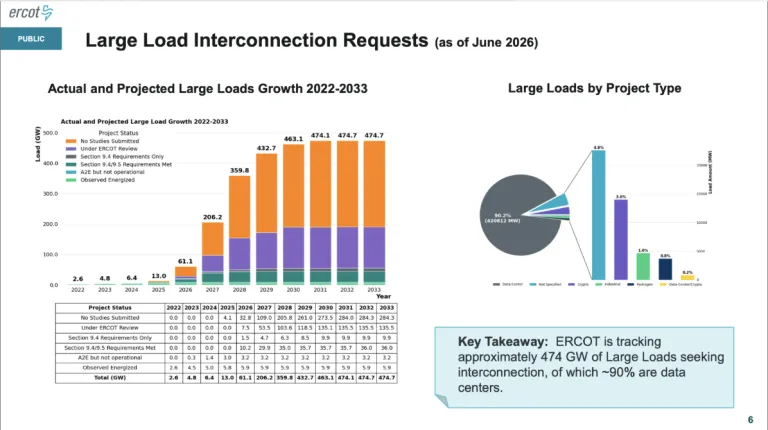
With hundreds of existing data centers already, Texas is also facing hundreds more actively seeking to do business here. Texans of all political stripes are rightly concerned about the water use, electricity use, wastewater, air pollution, noise, and loss of farmland that could result. Recently, ERCOT told committees in both the House and Senate that if all the new large loads seeking to come to Texas did so, it could lead to a five-fold increase in our electric demand—from roughly 90 GW of power at peak use today to well over 500 GW of peak use. During a recent hearing, ERCOT showed that more than 474 GW of load was seeking to interconnect to ERCOT, with 90% of that new demand coming from data centers and other large computational loads. Clearly, it is not possible for Texas’s existing transmission system and power generation to serve that many new loads.
How “Batch Zero” Would Evaluate New Data Centers
To attempt to get a handle on the situation, a few months ago both ERCOT and the PUCT approved Planning Guide Revision Request 145 (PGRR145) and Nodal Protocol Revision Request 1325 (NPRR1325), which would implement a new system-wide evaluation tool known as “Batch Zero.” The tool attempts to allow some data centers to move toward interconnection while others are studied. As a member of ERCOT, Sierra Club was supportive of this effort. Implementing these new guides and protocols is specifically designed to stop more speculative projects and approve only interconnection projects the grid can handle. The Batch Zero study process was supposed to begin already, with a decision expected next spring on which new projects could move forward. At a recent PUCT commission meeting held on September 11, ERCOT reported that roughly 195 GW of the proposed projects out of nearly 500 GW would be studied as part of the Batch Zero process. However, ERCOT noted that only about 30 GW was expected to get full approval, with only a fraction of the other large loads expected to be approved.
State Leaders Respond to Public Pressure
However, Texans have been showing up at local and statewide meetings calling for a special session and a moratorium on new data center development. Recently, the Governor of Texas—who has long supported the new investment—called for something of a reconsideration. First, he sent a letter to the PUCT asking for further investigation to ensure that such projects are real and won’t impact the grid or consumer electric costs. In some sense, his letter spurred the Commission to strengthen a proposal on how transmission costs will be allocated in the future as part of Project 58000. The Commission is expected to take action on Project 58000 and how costs are allocated to customers by December.
He then followed up his initial letter with another letter requiring the Commission to conduct a comprehensive audit of all proposed data centers on a variety of issues, including water use and other community impacts. In response, the PUCT and ERCOT slightly paused the Batch Zero process, saying they would begin it later this year, after the audit had been completed. Under the Governor’s letter, regulators cannot approve any new data center interconnections until the comprehensive audit is complete. ERCOT and the PUCT aim to finish auditing hundreds of proposals by December 10, 2026. In addition to the audit itself, they have also begun collecting additional data from large-load projects, including those smaller than the ones covered in the Batch Zero process. The audit will help determine which data centers are allowed into the study going forward and provide other information useful to regulators, the public, and the Legislature.
The Governor’s initial letter and audit do not place a moratorium on data centers—they do not, for example, impact data centers that have already received permission to interconnect—and he has not responded to calls for a special session. (Under Texas law, only the Governor can call a special session.) However, they do slow the process down by a few months and show that thousands of Texans calling on the Governor and the Legislature to protect them from the onslaught of data centers have spurred some action.
PUCT Rulemaking and Sierra Club Advocacy
In the meantime, the PUCT is still moving forward with rulemaking related to the interconnection of loads of at least 75 MW. On September 11, PUCT commission staff proposed a final version of one of the most consequential rules directly related to the Batch Zero process: what steps and financial commitments large loads must make to have a right to interconnect to our grid. While not perfect, the proposed rule does require significant financial commitments and information sharing that should better protect Texans from some of the major impacts of data centers on our grid. The PUCT Commissioners announced they expect to take action on the proposal as soon as next week.
Sierra Club continues to monitor the situation, submit comments in PUCT and ERCOT rulemakings—including the transmission cost allocation rulemaking—and participate in interim hearings. Recently, our Water Program Manager Evgenia Spears provided written and oral comments to the Senate Committee on Water, Agriculture and Rural Affairs on data centers and water use. Our written comments to the Committee on State Affairs can be found here.
Texas Transmission Lines Cause Consternation
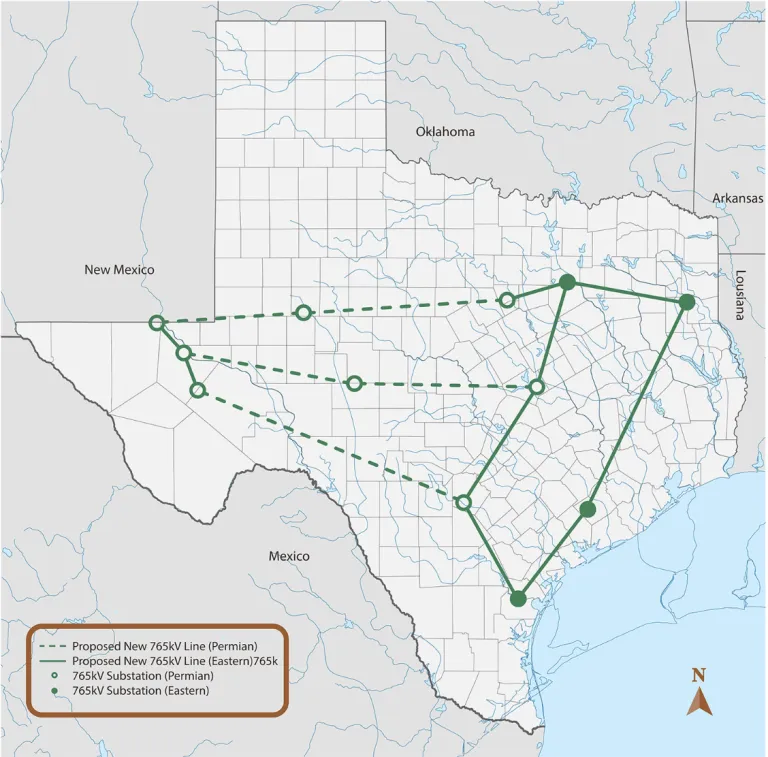
In 2023, there was a fundamental shift in transmission planning with the bipartisan adoption of HB 5066 by Charlie Geren. First, the bill required Texas to develop a new Permian Basin Reliability Plan to supercharge transmission out to West Texas, as oil and gas interests complained they couldn’t fully develop and electrify their rigs, compressor stations, and gas processing plants without an update to the local and statewide transmission system. But the bill also changed how Texas regulators considered planned new demand and shortened the decision-making timeline for any new transmission lines to 180 days, truncating the normal year-long process.
In July 2024, the PUCT made an initial decision to move forward on a vast new Permian Basin Reliability Plan. That plan formed the basis for an even larger plan approved in December 2024, which included ERCOT's STEP, the Strategic Transmission Expansion Plan—a major, multibillion-dollar project to build high-capacity 765-kilovolt (kV) power lines across Texas. The 2025 RTP (Regional Transmission Plan) then further expanded the vision to include an even greater transmission system. The first order of business was to move forward on three separate, massive east-west transmission projects, all of which went through the normal ERCOT-PUCT process for initial approval. In other words, all of the 765-kV projects have already been approved as a concept, but each individual project still must be approved by the PUCT commissioners with a specific route through what is called a CCN—a Certificate of Convenience and Necessity.
Landowners and State Leaders Challenge the Process
Since then, thousands of landowners, organizations, and others have been watching as each of these projects—it’s actually five separate projects, though some are connected to one another—moves through the routing process. Last month, the PUCT approved the northernmost of the three lines, much to the consternation of thousands of Texans, political leaders from both parties, and some conservative organizations like American Stewards for Liberty and the Texas Public Policy Foundation. Even current Attorney General and Senate hopeful Ken Paxton got into the act, filing comments in the case in support of the American Stewards for Liberty position and calling for an abatement until the 2027 Legislature has time to take up the issue. Key to his and their argument is that the individual projects have not proved “need,” and that the Legislature never contemplated 765-kilovolt lines, which have never been built in Texas. One argument put forward by some—but not all—is that the PUCT has not considered the potential for local generation, principally gas plants, in West Texas to provide the needed electricity locally, as opposed to creating a more extensive transmission system.
In addition to American Stewards for Liberty and TPPF, a group of senators, representatives, and many of the lawyers representing landowners have all asked for the cases to be remanded. Even the bill’s author, Charlie Geren, asked questions about the decision to recommend 765-kV lines, and ERCOT responded point by point to his concerns here. Meanwhile, Lt. Governor Dan Patrick has argued for slowing down the decision, while Clayton Tucker, who is running for Agriculture Commissioner, has also asked for a pause on the 765-kV decisions. One of the contracted judges through the State Office of Administrative Hearings agreed and said that the Bell East line should be rejected because the applicants—Oncor and LCRA—did not prove a specific need for the line beyond the Permian Basin Reliability Plan itself. In that case, the Commission has suggested remanding the hearing to hear further arguments on the “need” and the savings from reduced congestion costs. Judges in the other cases have largely sided with the utilities and Commission staff. Major oil and gas companies that lobbied hard for passage of HB 5066 have also pushed hard for the lines.
A different argument against approving the 765-kV lines is that the process was fundamentally flawed, since many landowners never received proper notice that the route could go through or adjacent to their land. Many who sought to be a “party” in the case were not allowed into the process because of what was essentially a paperwork error: they filed a request to be a party but didn’t explain why in a separate document. Even the utilities have acknowledged that the 180-day timeline imposed by the Legislature has led to real dilemmas in the ability to ensure due process for all. Quite simply, normal processes like discovery or cross-examination were not afforded the time needed to ensure a fair outcome.
What’s the Current Status of the 765-kV Transmission Cases?
It’s difficult to keep up with the five separate cases covering three major 765-kV lines across hundreds of miles. Each case has thousands of documents filed in it. Thus far, three of the five projects have been approved, while the other two cases have been remanded for further analysis by SOAH—the State Office of Administrative Hearings—on two particular issues: need and congestion cost savings.
Longshore to Drill Hole 765-kV Transmission Line
Oncor Informational Webpage
Application to the PUCT:
- Application filed: December 11, 2025
- Deadline to Intervene: January 10, 2026
- PUCT Decision: PUCT Commissioners approved the line on August 28, 2026.
Counties Affected: Andrews, Culberson, Ector, Glasscock, Howard, Loving, Martin, Midland, Reeves, Winkler
Dinosaur to Longshore 765-kV Transmission Line
Oncor Informational Webpage
Application to the PUCT:
- Application Filed: February 19, 2026
- Deadline to Intervene: March 21, 2026
- PUCT Decision: PUCT approved the line on August 28, 2026.
- Counties Affected: Borden, Bosque, Brown, Callahan, Coke, Coleman, Comanche, Eastland, Erath, Glasscock, Hamilton, Hood, Howard, Jones, Mitchell, Nolan, Runnels, Shackelford, Somervell, Stephens, Sterling, Taylor
Howard to Solstice 765-kV Transmission Line
AEP Informational Webpage | CPS Informational Webpage
- Application Filed: March 2, 2026
- Deadline to Intervene: April 1, 2026
- PUCT Decision: The PUCT approved the line and route on September 11, 2026, though with some changes.
Counties Affected: Atascosa, Bandera, Bexar, Crockett, Edwards, Kerr, Kinney, Medina, Pecos, Real, Sutton, Terrell, Uvalde, Val Verde
Big Hill to Sand Lake 765-kV Transmission Line
Oncor Informational Webpage | LCRA Informational Webpage
Application to the PUCT:
- Application Filed: January 15, 2026
- Deadline to Intervene: February 14, 2026
- PUCT Potential Decision: On September 11, 2026, commissioners remanded the case back to SOAH for additional analysis. A decision should come later this year.
- Counties Affected: Crane, Crockett, Irion, Pecos, Reagan, Reeves, Schleicher, Tom Green, Upton, Ward
Bell County East to Big Hill 765-kV Transmission Line
Oncor Informational Webpage | LCRA Informational Webpage
Application to the PUCT:
- Application Filed: March 26, 2026
- Deadline to Intervene: Monday, April 27, 2026
- PUCT Potential Decision: On September 11, 2026, commissioners remanded the case back to SOAH for additional analysis. A decision should come later this year.
- Counties Affected: Bell, Burnet, Concho, Coryell, Lampasas, Llano, Mason, McCulloch, Menard, Milam, Mills, San Saba, Schleicher, Tom Green, and Williamson
Has Sierra Club Taken a Position on the 765-kV Lines?
Sierra Club is not a party in any of the CCN cases involving the 765-kV lines and did not take a position—either for or against—on HB 5066. We do think that, in some cases, 765-kV lines have advantages over smaller lines. In theory, it is better to have high-voltage lines that can carry more power and move it more efficiently, and less land can be impacted by one 765-kV line than, say, two 345-kV lines built in parallel to one another.
Still, while we have not taken a position on whether “need” has been established for each individual line, we agree that the truncated process has been fundamentally flawed and unfair to many participants. Recently, we filed comments in one of the cases arguing that, because so many parties have been unable to participate, the case should be remanded.
We have also submitted comments in this and another case, arguing for better routing decisions that avoid river crossings and important habitat and attempt to follow existing rights-of-way. The decision made on September 11 to approve one route put forth by CPS Energy and AEP Texas did include a slight modification that we supported to move the line slightly north and avoid certain areas.
Finally, in recent testimony to the House and Senate, we have called for changes to the transmission planning process, including consideration of non-wires alternatives and the use of Grid-Enhancing Technologies, as well as a return to a 360-day process for major transmission projects with better notice and public input opportunities.
What’s Next for Texas Data Centers and Transmission Lines?
While the PUCT commissioners have now approved three projects involving two of the lines, those decisions can still be appealed first at the Commission and then in state district court. At least one group has already said it plans to do so. Decisions on the remaining two projects could come as early as later this month, although they are more likely to occur in October to give parties time to respond to the remand. Other 765-kV lines included in the STEP plan likely won’t move forward until 2027, at which point the Legislature could have decided to change the process.
Thus far, the Governor has remained silent on the issue, although the fact that the commissioners he appointed have approved three of the projects might indicate that he wants the lines to go forward.
The Senate Committee on Business and Commerce will hold an interim hearing on the subject on September 30, and both public and invited testimony will be allowed. A copy of the hearing notice can be found here.