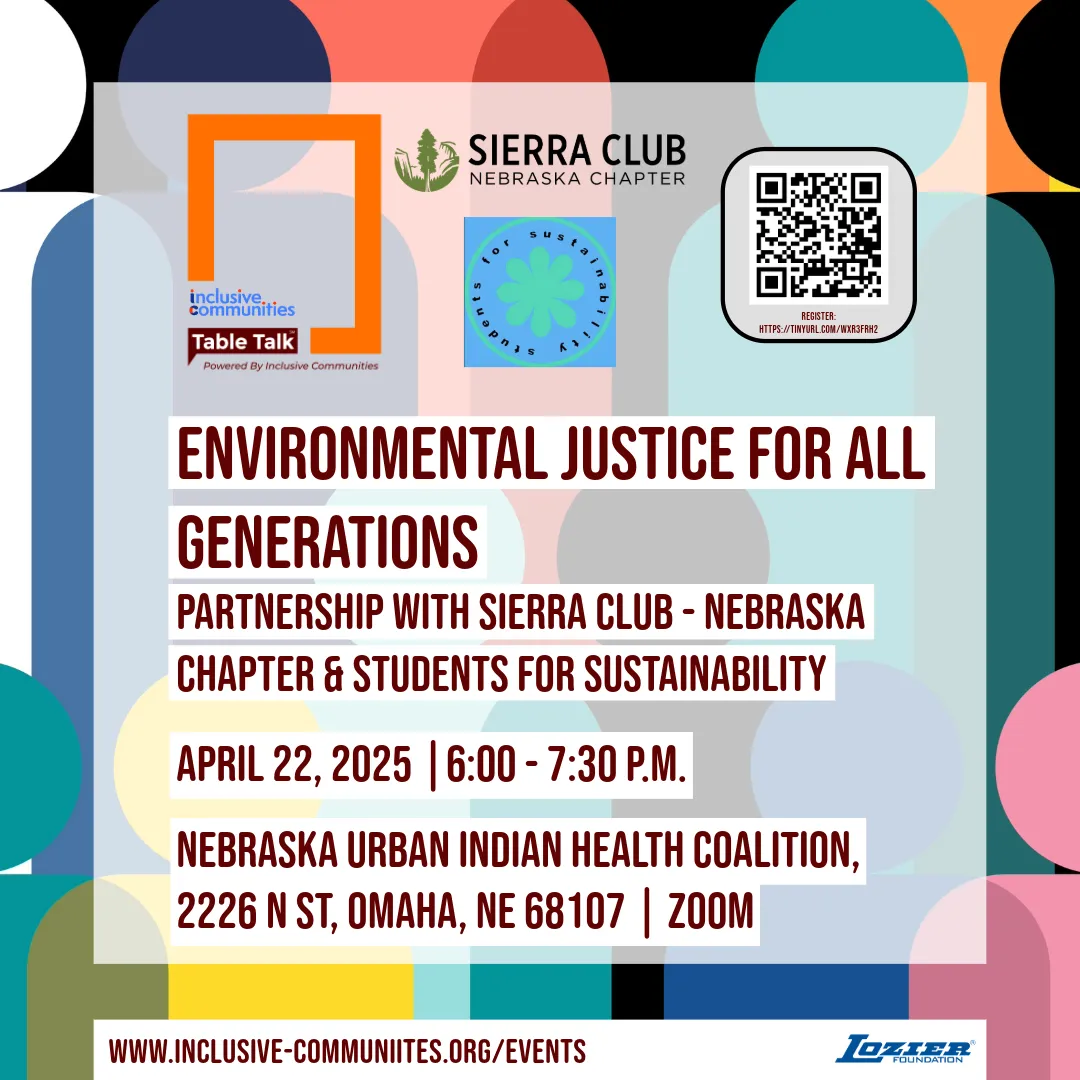
The Environmental Justice Table Talk was held on April 22, 2025 (EARTH DAY!) at the Nebraska Urban Indian Health Coalition.
Thank you to those of you who joined us last on April 22 for Inclusive Communities' final Omaha Table Talk—Environmental Justice for All Generations—on Earth Day, presented in partnership with the Nebraska Sierra Club and Students for Sustainability. To view a shortened video of the event, click here.
Together, with our wonderful panelists, the event went very well.Evalina Sain was the moderator. The panelists were Mia Perales, Sikowis Nobiss, and Cheryl Weston The discussions centered around the systemic realities that shape environmental injustice today, including the continuing impacts of colonial capitalism, the deliberate placement of industrial facilities in communities of color, and the intersections of land, climate, and Indigenous sovereignty.
Some highlights from the conversation include:
- Mia Perales emphasized the importance of grassroots advocacy and shared her experiences lobbying in Washington, D.C. for environmental legislation. Mia reflected on how young people in Nebraska care deeply about environmental justice, with unique concerns shaped by where they live—whether facing issues like lead contamination, coal plants, or meatpacking pollution. Mia also encouraged everyone to find their unique voice in advocacy and noted her ongoing work with the Green Amendment initiative.
- Sikowis Nobiss of the Great Plains Action Society discussed how environmental injustice is deeply connected to Christian colonial capitalism. Sikowis urged us to support movements like rematriation, which centers Indigenous stewardship, traditional ecological knowledge, and the re-empowerment of matriarchal values as a counter to toxic systems.
- Cheryl Weston spoke about balancing activism across multiple platforms, mentioning her work through her YouTube channel and Facebook page, Conversations with Cheryl Weston. She stressed that activism isn't about perfect balance—it's about commitment and community action, no matter how small or large the effort.
Throughout the evening, panelists encouraged us to:
- Engage in local and regional advocacy as a foundation for larger change
- Seek out resources like Clean Up MidAm, Sierra Club Nebraska, and Great Plains Action Society for ongoing opportunities
- Prioritize community connection over perfection—showing up matters
- Reframe economic arguments to demonstrate that sustainable environmental policies also provide economic benefits
We also touched on practical topics like soil remediation for Omaha's lead contamination, using Indigenous planting knowledge, and creating spaces where environmentalism is accessible and culturally rooted.


Resources:
Click here to see the extended bios of the moderator and panelists plus additional resources.