By Bill Beren • Transportation Committee Chair, Beren1@verizon.net
At the end of March, my wife and I joined the growing army of EV owners when we purchased a 2025 model year Hyundai Ioniq 5. Range anxiety played a large role in our delaying that decision by two years, as we are a one-car family and frequently take long road trips to vacation or visit relatives in Wisconsin. And now we had to decide if we could successfully make the 850-mile one-way trip to Milwaukee to attend our nephew’s wedding at the beginning of August.
Spoiler alert: We made it there and back, but not without confronting the reality of long-distance driving with an EV. This is what you can expect to find if you go on a long road trip.
Where Could We Charge?
First, JoAnn spent literally hours researching where we could stop en route to recharge our battery. We knew from prior trips to Wisconsin that most—but not all—Ohio and Indiana toll roads had Tesla charging stations at their rest stops. The biggest concern was where we could stop and recharge along the 450 miles from our house to the beginning of the Ohio Turnpike.
Unfortunately, none of the popular apps maintained by the major charging companies (Tesla, ChargePoint, EVgo, Electrify America, or PlugShare) made it easy to navigate or identify where they had fast chargers along Route 80, which complicated our planning. We found the best solution, although time-consuming, was to search in Apple Maps for Tesla fast chargers in a particular geographic area.
Another option was to use Hyundai’s in-car app, which showed charging stations near us along the drive. The problems with that app were that it included all charging stations, including slow Level 2 chargers, and it only showed chargers within a small radius of our location—both ahead and behind us—making it not useful for planning our stops.
Even along the toll roads, it was difficult to tell which rest stops had charging stations, and some of the information on the official toll road websites was inaccurate. All along Route 80, whether on the free portion or the toll portion, none of the exit signs or rest plaza signs had information about the availability of charging stations.
Another annoyance was that, unlike at self-service gas pumps, there was no overhead shelter at the charging stations or other amenities such as water and squeegees to clean our windows.
We encountered two instances where we drove up to non-operating chargers, but both times we were able to find alternative chargers a short distance away, and our overall experience was positive despite all of the challenges described above. It turns out that there are lots of charging stations, even if they are a little hard to find.
Cost and Payment
Each company that operates chargers has their own apps and payment policies. Before we left, I downloaded five apps and linked each to my credit card. However, there was still a learning curve associated with each of the four companies we used—Tesla, ChargePoint, EVgo, and Electrify America.
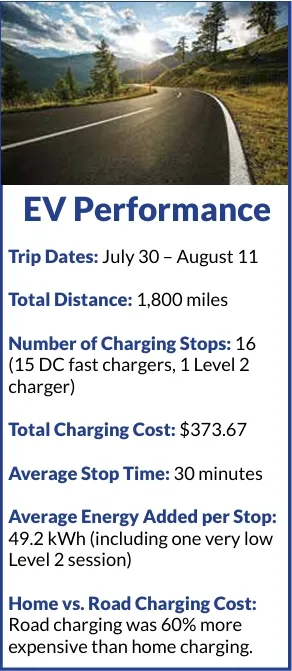
Except for the one time we charged at off-peak hours, the price per kilowatt-hour (kWh) across all vendors ranged from a low of $0.50 to a high of $0.57 for DC fast chargers. Off-peak rates and the rate for the one Level 2 charger we used was $0.40/kWh. This was almost 60% higher than the per-kWh cost of using a home charger (including the cost of utility delivery charges), so definitely charge at home whenever you can.
How Far on a Single Charge?
Hyundai advertises that the Ioniq 5 can get close to 300 miles per charge, and that it will take only 20 minutes to get from 10% to 80% of battery capacity. Eighty percent capacity is the recommended charging limit to maximize battery life for normal driving, but you can charge up to 100% for limited long-distance driving. Furthermore, Hyundai recommends that the battery charge should not be allowed to drop below 20%.
We found that looking at battery charge levels was a better indicator than mileage when deciding whether to stop to recharge. We looked to recharge whenever battery levels were dipped to 30%, and we routinely charged the battery to 90%-95% of capacity. Our average time to recharge was about 30 minutes.
This resulted in our stopping every 150-175 miles to recharge the batteries. Our longest span was 200 miles, and our battery capacity dropped to 17%. Recharging to 95% capacity took a little over 40 minutes.
Bottom Line
Driving and owning an electric car is a great experience. It is a quiet, comfortable ride. Starting and acceleration are much quicker and smoother than with a traditional gasoline-powered car. There are plenty more roadside chargers than you realize, once you start looking for them. Once you try it, you’ll be hooked.