By Tony Hagen • editor@newjersey.sierraclub.org
In this issue of The Jersey Sierran, George Moffatt writes about extreme marine heat events. These are spreading as our oceans warm up, affecting survival in the undersea world in dramatic ways.
In the Northern Pacific, warmer waters are believed responsible for a sharp decline in humpback whale populations—scientists estimate thousands may have died during a prolonged marine warming event nicknamed “The Blob,” which lasted more than four years and unbalanced the marine food web. These whales struggled as their food supply, such as krill and small forage fish, dwindled.
In the Atlantic, the northern shrimp population declined from an estimated 27 billion in 2010 to about 200 million in 2023 (-99.26%). Warmer water allowed longfin squid to range farther north and stay longer through winter. These creatures are voracious shrimp predators and likely contributed to the shrimp’s decline.
Warming ocean waters affect weather patterns inland. They enable the atmosphere to retain more moisture, making storms wetter and more intense.
A usually shallow tributary in Plainfield became a torrent during a July 14 flash flood. The flooding engulfed a car, killing both occupants. That same storm dropped 6.5 inches of rain on Watchung, 5.34 inches on Mountainside, and 3.73 inches on Franklin Lakes.
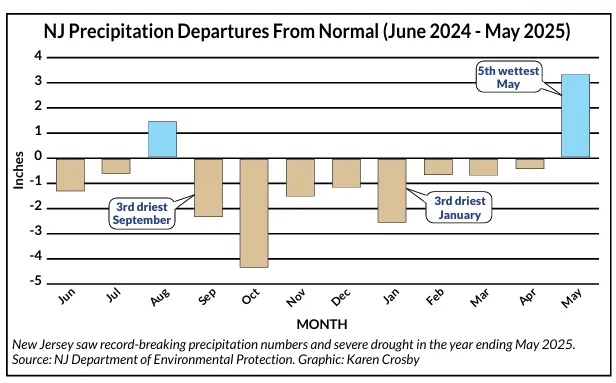
This flooding came just days after a long-standing drought warning was lifted for most of New Jersey.
Intensely dry conditions had persisted across the state since September 2024. January 2025 was the third driest January on record.
In March, three major wildfires broke out across the state, including one near Poor Farm Road in Hopewell Township that burned 293 acres—the largest wildfire on record for Mercer County.
Dramatic swings between excessive rainfall and extreme dryness are increasingly common across New Jersey. This makes it harder to manage water supply throughout the year, and meanwhile the state’s climate moves closer to that of seasonally parched states in the South and West.
Overall, annual precipitation in New Jersey is up by about 3 inches compared with 100 years ago. That may sound like good news, but the intense swings from wet to dry spell trouble for farmers. Soil hardens and dries out quickly, and aquifer recharges do not occur. Water runs into streams and rivers, which take it out to sea.
Although rainfall totals had improved by midsummer elsewhere in New Jersey, the coastal southern region remained under groundwater “watch” or “warning” status.
Whether New Jersey faces a dry fall and winter this year remains to be seen. What’s clear is the need for forward-looking climate policy, including a steep reduction in greenhouse gas emissions. This is a critical consideration as the AI industry gathers momentum. Housed in giant data centers, this technology consumes incredible amounts of power.