Gubernatorial candidate Tom Tiffany is well-known to most environmentalists. In the Assembly, he was so harmful to the environment that he earned the nickname “Toxic Tom.” When he was named to the ‘dishonor role’ of an environmental group, he treated it like a badge of honor and hung it in his office, claiming it was because he had “the audacity to take on the environmental left”.
He then took his antagonism to natural resource protection to Congress, and his deep, extreme conservatism has been on full display.
While Wisconsinites struggle to pay for groceries and utility bills skyrocket, Tom Tiffany’s priorities are not in line. His colleagues in Congress have characterized his priorities as “obsessed with hunting wolves” and “hyper focused” on extractive industries.
Click on a file to learn about Tom Tiffany’s toxic voting history
Track record
Tom Tiffany has been in the Wisconsin Legislature or Congress since 2012. In his 10 years in the Wisconsin Legislature, he scored a 0% on environmental issues in all but one session.
Sierra Club Wisconsin Scorecard Scores | |||
| Sierra Club Score | Session | Pro-Environment Votes | Anti-Environment Votes |
| 0% | 0 | 11 | |
| 0% | 0 | 6 | |
| 0% | 0 | 13 | |
| 20% | 2 | 8 | |
Days into his first term, Tiffany partnered with then-Governor Scott Walker on a Special Session to undermine the processes that allow state agencies to enact protections for the environment, health, and pollution. 2011 Special Session AB 8, Controlling Administrative Rules, gave the Governor unprecedented authority to delay or block agencies from making rules needed to implement state laws, including those passed to protect natural resources. During his floor speech about the bill, he admitted it was “far-reaching”. This kicked off a career of putting private profits ahead of Wisconsin’s natural resources.
As the scorecards show, Tiffany supported virtually every bad environmental initiative in the state legislature during the Walker administration. He helped gut funding for the Department of Natural Resources and its science programs, wetland and groundwater protections, local control, mining protections, and more.
Congressional Record
Tiffany’s voting record in Congress is equally as dismal as it was in the Assembly. He has a lifetime League of Conservation Voters score of 1%. In only 6 years, Tom Tiffany has voted against Wisconsin's environment a whopping 152 times.
League of Conservation Voters - | |||
| LCV Score | Session | Pro-Environment Votes | Anti-Environment Votes |
| 0% | 2020 | 0 | 13 |
| 4% | 2021 | 1 | 19 |
| 0% | 2022 | 0 | 18 |
| 0% | 2023 | 0 | 36 |
| 0% | 2024 | 0 | 33 |
| 0% | 2025 | 0 | 33 |
Nearly one in five of Tom Tiffany's sponsored bills in Congress have focused on undermining our natural resources, selling off or hurting public lands, or undermining the Endangered Species Act or clean energy.
Opening Wisconsin for Mining
Tom Tiffany has a track record of prioritizing mining interests over protecting our natural resources. According to an article by the Wisconsin Examiner, U.S. Rep Jared Huffman says that Tom Tiffany is “hyper focused” on promoting extractive industries.
Bad River Watershed Destruction Act (2013 Act 1)
After taking money from Gogebic Taconite during his campaign, Tiffany introduced the Bad River Watershed Destruction Act (2013 Act 1) as the first piece of legislation authored in the session. Gogebic Taconite’s attorneys drafted the bill, which drastically deregulated iron mining in order to make it easier for Gogebic Taconite to mine the Penokee Hills, despite the Bad River Band’s opposition.
Tom Tiffany was clearer than anybody about the potential impacts of the bill saying,
“The bill reflects the reality of mining. There are going to be some impacts to the environment above the iron ore body. If the law is challenged and ends up in court, the judge needs to know it was the Legislature's intent to allow adverse (environmental) impacts. That way, a judge can't find fault if the environment is impacted.”
This willingness to proudly allow a mining company to damage our environment for their private profits shouldn’t be a surprise, considering Tom Tiffany received $74,915 from donors seeking to undermine Wisconsin’s mining laws.
Tom Tiffany abruptly shut down the Mining hearing following testimony about these donations and the potential conflict of interest. Former Republican Senator Dale Schultz was in the legislature with Tom Tiffany during the Penokee Mine fight and was recently recalled,
“I remember a guy who was pretty mean, pretty heartless, and to my way of thinking, entirely too close to a mining industry, which needed very careful watching”
He even authored and pushed the passage of 2013 SB 278, a shameful example of unfair legislation that benefits a single corporate donor at the expense of the public, SB 278 closes public access to 3,500 acres of Managed Forest Land as a special favor for Gogebic Taconite (GTAC) near the proposed open pit iron ore mine, without requiring the landowner to pay $891,000 in back taxes (tax breaks are only given to other MFL owners who maintain public access).
For a full summary, read this article about how Gogebic Taconite “paid to play” in the legislature.
[As a side note, it is interesting that as a Wisconsin state senator in 2015, Tom Tiffany co-authored 2015 Senate Bill 43, which significantly altered the state's secret "John Doe" investigative procedures to remove campaign finance, ethics, and lobbying violations from the scope of crimes that could be investigated using the tool, a change critics argued shielded politicians from corruption probes.]
Mining Giveaway Bill
He then took the lead on the legislation that became 2017 Act 134 (“Mining Giveaway Bill), which repealed the Prove It First law, gutted the permitting process for metallic mining to “streamline” it by adding artificially short deadlines for permit review and approvals, and made public participation in the process far more difficult. Dave Blouin, Sierra Club’s Mining Chair, released the following statement:
“Senator Tiffany has released his latest attack on Wisconsin’s environment with his proposal to gut our Prove It First mining law along with additional giveaways to the mining industry. Just as Senator Tiffany did unsuccessfully for Gogebic Taconite, Tiffany’s proposal sacrifices environmental protections for the false promise of a few short-term jobs in a dying and unsustainable boom and bust industry. These giveaways to the mining industry are nothing more than direct subsidies that reduce their operating costs while putting Wisconsin’s sustainable tourism and agriculture at risk from pollution.”
Banning Local Control on Frac-sand Mining
Tiffany sponsored legislation to ban local governments from regulating frac-sand mining. The bill stripped local communities of their ability to create or update rules for frac-sand mines, even as the industry and its impacts continue to evolve. The bill provides no new safeguards or DNR resources to replace that local authority, putting communities at risk while benefiting the frac-sand industry.
Bringing the Mining Give-Away to Congress
In 2021, as a relatively new Congressman, Tom Tiffany also authored a bill that “bars the President, the Department of the Interior, or the Department of Agriculture from declaring a moratorium on or reversing any existing lease, permit, or claim, for the mining and extraction of any critical mineral or common varieties of sand, stone, and gravel on National Forest System or Bureau of Land Management land unless specifically authorized by statute or upon the lessee, permittee, or claimant's failure to comply with any of the provisions of its agreement.”
Boundary Waters Give-Away
In 2026, Tom Tiffany voted for legislation would roll back protections for roughly 225,000 acres of Superior National Forest watershed and clear the way for a Chilean-owned mining company to pursue a copper-nickel mine upstream from the Boundary Waters. Critics warn that sulfide mining could permanently pollute the wilderness and its interconnected waters, putting a priceless public resource at risk to benefit a foreign mining company. A copper sulfide-ore mine and its waste in this watershed would threaten the Boundary Waters, which are the most visited wilderness in the country. As Representative Mark Pocan said, “You can't claim to care about our environment when you're selling out the Boundary Waters.”
Gutting the Endangered Species Act
In the Assembly, Tom Tiffany sponsored 2011 Act 169, legislation that requires Wisconsin to host a wolf hunt if wolves are not on the Endangered Species List, regardless of the science, public input, and Tribal consultation.
Then, to effectuate a wolf hunt in Wisconsin under his 2011 legislation, he quickly sponsored his first bill in Congress to permanently remove gray wolves from the Endangered Species Act. He was not concerned about the science of extinction in setting up a burdensome process that requires congressional action to put wolves back on the list if endangered.
He claimed it would ‘return wolf management to the states” while fully knowing he effectively removed that management from Wisconsin and that his bills barred other states from naming gray wolves as endangered or threatened. Tiffany has continuously sponsored similar legislation every session he has been in Congress.
His fear-mongering about wolves reached an all-time high in 2025 when he stated, “We need to stop the slaughter that is going on in my district, in many districts across the United States, and if we don’t, we now have three threats that have been documented to humans in Wisconsin. We’re going to end up with a situation that is going to be regrettable.” If he cared to be factual, he would know there have been no documented incidents of wolf-human conflicts in Wisconsin and that livestock-wolf conflicts are actually down.
He has prioritized delisting wolves over anything else in Congress, so much so that his colleague, Haley Stevens, said he was “obsessed with changing the laws to hunt wolves” and that it was “all he ever talks about.”
A Friend of Fossil Fuels
Tom Tiffany has a strong anti-climate, pro-fossil-fuel voting record. Tiffany has repeatedly opposed climate legislation, clean-energy funding, efficiency standards and pollution protections. This isn’t surprising, considering Tiffany applauded Governor Walker’s DNR when they removed climate change from the website, “because climate change is a theoretical construct.”
He has voted for measures supporting coal development and fossil-fuel power, including reversing protections in order to promote coal development and the fast-tracking of fossil-fuel power over clean energy. He even wrote a letter to the Public Service Commission demanding they keep Wisconsin’s coal plants online. Unbelievably, he called on the Evers Administration to create a moratorium on shutting down coal plants.
On oil and gas, he has backed expanded drilling, Liquefied Natural Gas (LNG) infrastructure, pipelines and other fossil-fuel development while opposing measures that restrict or regulate those activities. In Congress, he even voted against the Consumer Fuel Price Gouging Prevention Act, which would have stopped energy companies from exploiting energy emergencies to raise fuel prices.
Tom Tiffany voted in favor of H.R. 4394, the Energy and Water Development and Related Agencies Appropriations Act of 2024, which includes numerous provisions that would lock in fossil fuel infrastructure, increase our dependence on foreign energy, and cede leadership in clean energy innovation to our global competitors – all while raising energy costs for families.
Tom Tiffany proudly sponsored the Directing Responsibility to Interior for Leases and Licenses Act (DRILL Act) that would require the U.S. Department of the Interior (DOI) to immediately issue permits for all pending oil and gas applications on public lands.
Tom Tiffany also voted in favor of H.R. 3062, the Promoting Cross-border Energy Infrastructure Act, which would effectively exempt oil and gas pipelines to or from Canada or Mexico from environmental review under the National Environmental Policy Act by requiring the Federal Energy Regulatory Commission (FERC) to approve all cross-border pipelines within 30 days, an unreasonable timeline that would effectively preclude adequate public input or analysis of potential environmental or consumer harm. Less scrutiny of cross-border pipelines would increase air and water pollution and deny affected communities sufficient opportunities for input.
Line 5
He testified at the Line 5 reroute hearing. He mischaracterized the Bad River Band’s opinion on the pipeline, even though it’s been abundantly clear and stated: “Everything about this project is a win-win.” The reroute construction caused a massive rupture in the Line 5 pipeline, releasing over a million gallons of propane, butane, and other natural gas liquids.
This Milwaukee Courier article breaks down Tom Tiffany's record on the tar sands pipelines:
In 2022, Tiffany testified at a hearing before the DNR in favor of the Line 5 project. “The Line 5 pipeline is vital to Wisconsin and our country,” he said. “The completion of this project is important for affordable energy, public safety and jobs.”
In 2021, Tiffany cosponsored H.R. 684, to authorize the Keystone XL Pipeline.
In 2016, Tiffany voted for a state budget that gave Enbridge the power of eminent domain to take private land.
And in 2015, Tiffany “expressed frustration” after the Dane County board held up an Enbridge pipeline project over oil spill insurance requirements and claimed, “I hope that people with an ideological bent aren't going to impede” the pipeline.
In the last five years, Tiffany has accepted $10,000 from Enbridge. While running for governor, he accepted $5,000 earlier this year, according to campaign finance reports. In 2020, Tiffany took $2,500 from Enbridge PAC. In 2022, Tiffany took another $2,500 from the PAC.
Attacks on Clean Energy
Tom Tiffany has a long history of attacking clean energy. Tom Tiffany supported a bill to repeal the Inflation Reduction Act (IRA), even though it would increase bills for Wisconsinites. He voted to repeal clean energy tax credits. He has sponsored multiple bills to undermine the clean energy industry.
Bans on Bans of Plastic Containers
Tom Tiffany sponsored and advocated the passage of the bill that banned the local regulation of plastic bags
and other single-use containers, removing a community’s right to make choices about what they want sold and/or used in their community. It prohibits a community from banning, adding a fee to, or otherwise creating rules for using plastic bags.
Data Centers and Artificial Intelligence
Contrary to his current positioning, Tom Tiffany has not wanted state or local safeguards on data centers. He voted for the Reconciliation bill that “included a 10-year ban preventing state and local governments from enforcing laws or regulations that restrict or oversee AI models, systems, and related digital infrastructure”
He also supported the Standardizing Permitting and Expediting Economic Development (SPEED) Act (H.R. 4776), meant to speed up permitting for fossil fuel infrastructure to support the development of Artificial Intelligence. As Rep. Bruce Westerman, sponsor of the bill, described, “The electricity we will need to power AI computing for civilian and military use is a national imperative.”
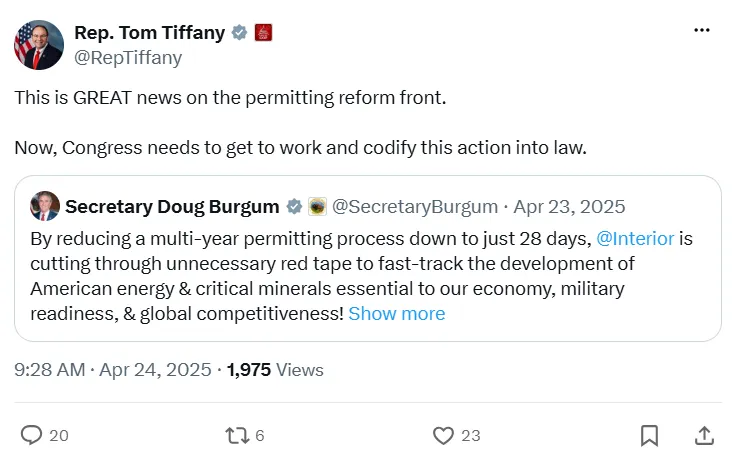
He even wrote a letter to the Public Service Commission (PSC), applauding how, thanks to the Trump Administration, “we are moving in the right direction.” He called on the PSC to keep coal plants open to support AI and data centers:
If Wisconsin is going to maintain its role as a world-class manufacturing state, we must keep all of our current power plants online and bring new generation online for the future. This is particularly critical as we enter a new era of artificial intelligence and data centers, which require a steady supply of reliable, and low-cost energy, such as coal, natural gas, and nuclear power generation.
Selling off our Public Lands
Selling off our National Forests
Tiffany has introduced legislation multiple times to sell off part of the Chequamegon-Nicolet forest to a private company for its private use.
Logging
If it needed to be clearer that Tom Tiffany will not be a protector of our natural environment, then his view of our national forests shows it. He discussed the need to prioritize our national forests for logging:
“...the reduction in access to our federal lands is really causing a multitude of problems, from being able to get wood out of the national forests, which is one of the primary reasons they’re there,”
To him, the forests clearly are not about the environment or wildlife, recreation, cleaning the air and absorbing carbon pollution, or the tourism economy.
Further showing his stripes, at a Federal Lands Subcommittee of the Oversight & Investigations Subcommittee hearing, the head of the US Department of Agriculture was being questioned. Tom Tiffany jumped in to stop any questions that could have demonstrated a conflict of interest with pro-logging groups. As the press release by U.S. Rep Jared Huffman states:
Before the chief could answer, Chairman Tiffany cut in, declared the question out of order, and told Schultz he did not have to respond. The documents were entered into the record, and the chairman moved to close the hearing.
Wetlands
Tom Tiffany supported the Bergstron Wetlands Bill that gutted protections for isolated wetlands in Brown County to allow a wealthy developer to build a retail store on a high-quality urban wetland and avoid a contested case hearing.
Stewardship Fund
As a state legislator, Tom Tiffany sponsored legislation that would change how payments for public land purchases work. Across the board, no entities supported it. The Wisconsin Wildlife Federation explained, “In effect, this bill will end the purchase of public lands under the Stewardship program…”
Tiffany has also allied himself with the far-right, anti-public lands organization American Stewards for Liberty (ASL). ASL has tried to insert language into county land-use regulations to stall land conservation purchases in northern Wisconsin, such as the recent Pelican River Forest purchase in Oneida County.
Worsening our Water
PFAS
Tom Tiffany’s voted against the 2021 bipartisan infrastructure law, which provided substantial federal funding for drinking-water infrastructure and PFAS contamination, while his broader environmental record has generally favored less regulation and greater support for extractive industries. In Wisconsin, PFAS has become a significant issue affecting communities including Madison, Marinette, Wausau and Green Bay, and state lawmakers ultimately approved more than $130 million in 2026 for PFAS testing, well replacement and cleanup.
Weakening Shoreland Zoning Protections
In 2015, Tom Tiffany supported state legislation to weaken shoreland zoning protections. According to the Milwaukee Journal Sentinel,
“He was also influential in taking away the ability of counties to pass stricter shoreline zoning laws than those in state law. Dozens of counties have approved more restrictive limits since 1995 as a tool to protect water quality.”
Fast-tracking High Cap Wells
Tom Tiffany's sponsored legislation would have made it easier to obtain and maintain approval for high-capacity wells, while limiting DNR's ability to impose conditions or revisit approvals. The bill was met with widespread opposition from the Towns Association to environmental groups to the Farmers’ Union, stating,
These high-capacity wells are beginning to negatively impact existing wells. For example, the well on the Jorgenson dairy farm in Sparta went dry when the adjacent U.S. Silica mine began running its high-capacity well.1 In Dunn County, farmers in Rock Falls have experienced water shortages as the number of high-capacity wells in the area has grown. In one five-mile radius, the DNR counts the existence of 120 high-capacity wells.
Undermining Clean Water Protections
In 2023, Tom Tiffany voted in favor of H.J. Res. 27, which would repeal the Environmental Protection Agency’s and U.S. Army Corps of Engineers’ final Clean Water Restoration Rule. This legislation would jeopardize our water resources by invalidating the Biden-Harris administration’s rule to ensure that critical waters, from small streams to rivers to wetlands, are protected from unregulated pollution and destruction when they have important downstream effects on water quality. H.J. Res. 27 would also prevent future administrations from issuing rules that are “substantially the same,” which could undermine future agency action to the benefit of polluters.
Undercutting Science/Tribal Consultation
DNR Structure and Funding
In 2015, Governor Scott Walker gutted the DNR's science bureau, cutting 30% of its science positions. Tom Tiffany supported the move, demonstrating a wilful disregard or fundamental misunderstanding of the importance of science to wildlife management and environmental policies. Proper wildlife management requires sound science in order to ensure our ecosystems can thrive, and Wisconsin’s wildlife is sustained.
He also floated such extreme ideas for restructuring the DNR that even then-Governor Scott Walker thought they were too extreme. Recently, again, Tom Tiffany suggested splitting up the DNR, something that has been opposed for decades in Wisconsin.
Tribal Consultation and Input
During the Penokee Mine fight, the Bad River Band complained multiple times about the lack of government-to-government consultation, a requirement in the federal treaty. Tom Tiffany brushed off this very serious concern, saying he wrote to the leaders about setting up a meeting.
In 2026, Tiffany was pushing legislation to turn the Apostle Islands National Lakeshore into Wisconsin's first national park. When an amendment was proposed requiring tribal consultation, Tiffany urged against the amendment, saying it would further delay the process. He said his staff had met with the Red Cliff Band's lobbyist more than a dozen times and that his bill contained language protecting tribal treaty rights, explaining that was good enough.